


A debut feature by Chiu Li-kwan, a big shot in the entertainment business whose career spans nearly 30 years, David Loman brings back bawdy humor and grassroots comedy that have subsided after the heyday of stand-up comedian Chu Ko Liang (豬哥亮), who rose to superstardom and became a household name in the 1980s. Tailor-made for the now 66-year-old Liang, the movie is a well-executed work of entertainment highlighting off-color humor without compromising a solid story line.
Liang plays David Loman, a simple country bumpkin who accidentally becomes a big boss in the criminal underworld. A decade passes, and life seems to go on as usual — drinking tea, solving everyday problems for locals and receiving “protection fees” — until one day a deity tells David through a medium that he needs to find a double to avoid a catastrophe. Panicky, the boss seeks help from Old Ho, a fortune teller also played by Liang, who agrees to pass as David for a few days, but is assassinated when attending a gathering with fellow gangsters.
The mastermind behind the killing is Pinch Junior, played by funnyman Kang Kang (康康), the son of the late Boss Pinch, who passed his authority on to David 10 years previously.
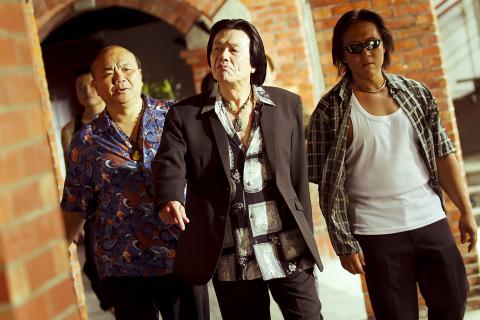
Photo courtesy of Polyface Entertainment Media Group
Blaming David for his father’s death, Xiao Ho (Tony Yang, 楊祐寧) soon reconciles with the boss who vows to avenge Ho’s murder. They become apprentices to Silly Pork, played by veteran actor Chen Po-cheng (陳博正), a kung-fu warrior who used to be a bodyguard for former president Lee Teng-hui (李登輝), and quickly masters the one-finger, martial-arts technique.
It doesn’t take long before David’s estranged daughter Jin (Amber Kuo, 郭采潔) finds out the truth and joins the team. Fighting bad guys at night, the three masked fighters win popularity among locals, and in the process, David is also able to make up for lost time and rebuild the father-daughter relationship with Jin.
The day of reckoning arrives when Pinch Junior holds a public memorial ceremony for his late father and declares his legitimacy as the rightful big boss.
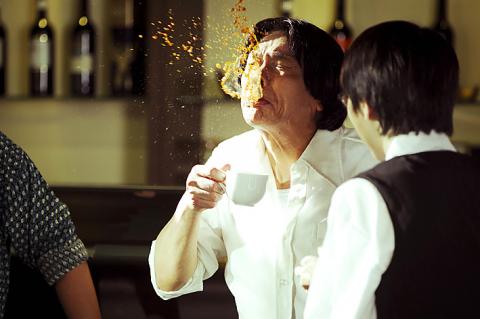
Photo courtesy of Polyface Entertainment Media Group
Wearing a floral print shirt and wooden clogs, Liang thrives in the title role as a good-natured, foul-mouthed old man constantly hurling quips and risque jokes that often involve a fixation with the male and female sex organs. The film’s boisterous and boorish humor relies heavily on cleverly written wordplay in Mandarin, English and Hoklo (commonly known as Taiwanese). A good example can be found in the title of the movie, which is a phonetic translation of “underworld boss” in Hoklo.
While Liang’s untamed humor recalls the pre-feminist era, director Chiu updates her comedy with contemporary elements such as the syndicate using Facebook to boost its popularity. More interestingly, the conventions of kung-fu and superhero movies are borrowed to create a comic, satirical effect. The elegant moves of wing chun (詠春) are replaced by the one-finger technique which can be easily mastered by banging one’s finger with a hammer. And the much revered deity Guan Gong (關公) becomes an inspiration to the trio of homegrown superheroes and heroine. To director Chiu’s credit, no comic segment ever spins out of control or is disconnected from the rest of the movie, showing an all-too-rare ability to weave seemingly peripheral humor into a sensible whole.
Meanwhile, romance kindles between Kuo and Yang, who make a lovable on-screen couple, though the toothsome Yang looks nothing like a zhainan (宅男) — the Taiwanese equivalent of the Japanese otaku, or nerd — even wearing a pair of black-rimmed glasses. The movie is also delightfully supported by a string of cameos by actors and entertainers including actress Su Chu (素珠), Jeff Huang (黃立成), Ma Nien-hsien (馬念先) and Yin Wei-min (應蔚民), better known as Clipper Xiao Ying (夾子小應).
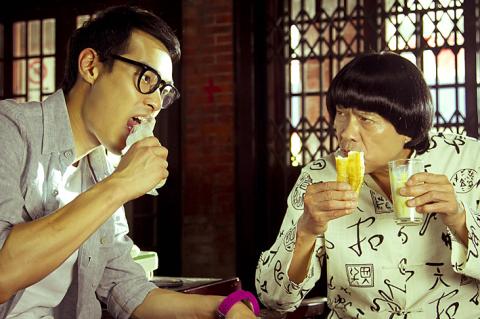
Photo courtesy of Polyface Entertainment Media Group
Fast-paced and packed with bawdy humor, David Loman should do well at the box office over the Lunar New Year, which sees several Taiwanese movies hitting the big screen to entertain the holiday crowds.
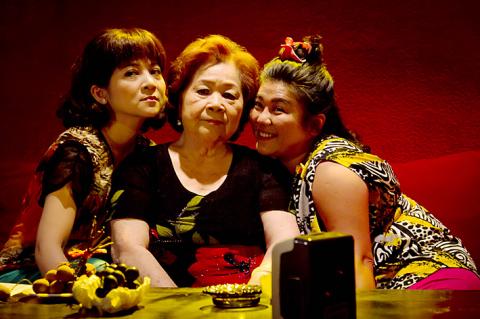
Photo courtesy of Polyface Entertainment Media Group

Photo courtesy of Polyface Entertainment Media Group

Ajay Verma, a consultant gastroenterologist at Kettering general hospital in Northamptonshire, says our gut is a “complex machine.” “It is constantly providing us with the nutrition we need, initially to grow and develop, and then for us to survive, thrive and repair from injury and illness.” How can we keep it functioning well? Put simply: “Make sure what you put into it is balanced, and that you clear out its waste products adequately,” Verma says. “In a general gastroenterology clinic, the most common conditions we see are irritable bowel syndrome (IBS), gastroesophageal reflux disease, inflammatory bowel disease and constipation,” says Nisha
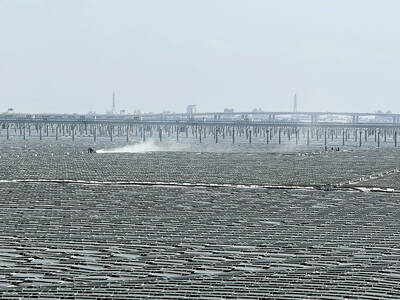
The arithmetic is straightforward and uncomfortable. By the end of 2025, Taiwan had committed itself to a 50-30-20 electricity mix — half natural gas, 30 per cent coal, 20 per cent renewables. The Ministry of Economic Affairs’s (MOEA) own monthly energy reports tell a different story. Natural gas reached 47.8 per cent of generation last year. Coal stood at 35.4 per cent, comfortably above its target ceiling. Renewables came in at 13.1 per cent, well short of the 20 per cent Taipei had pledged a decade earlier. Installed renewable capacity reached roughly half of the 12 gigawatts (GW) the government

Last week US President Donald Trump was asked by a reporter whether he would speak on the phone to the President of Taiwan. “l’ll speak to him. I speak to everybody. We have that situation very well in hand,” Trump said. This marked the second time in a couple of weeks he had said he would talk to the President of Taiwan. In 2016 he famously took a call from then-president Tsai Ing-wen (蔡英文), when he was president-elect. Despite warnings that the apocalypse was nigh because of a phone call, the world quickly forgot about the conversation between two democratically-elected presidents.
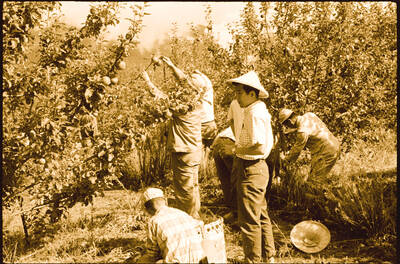
May 25 to May 31 Few believed that apples could be cultivated on a commercial scale in Taiwan’s high mountains. When horticulturalist Cheng Chao-hsiung (程兆熊) first proposed the idea in 1955, both American and Taiwanese colleagues dismissed it as implausible, arguing that temperate fruit could not be reliably grown on a subtropical island, especially on rugged terrain. However, it was this terrain in the Central Mountain Range where many Chinese Civil War veterans were resettled in the late 1950s. With limited job prospects and no family in Taiwan, they were placed on cooperative farms aimed toward self-sufficiency. Some say the conditions


 RSS
RSS