


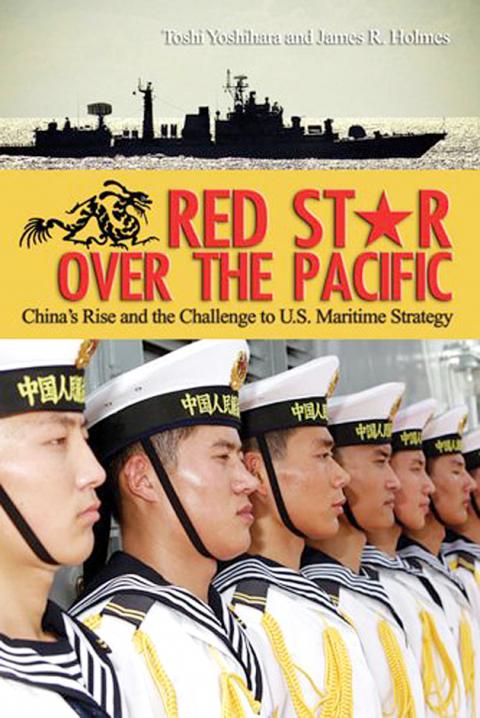
China’s maritime capacity, two associate professors of strategy at the US Naval War College argue in an important new work, is close to reaching a point where its theories will be put into practice. What this commanding of the seas “with Chinese characteristics” will look like, and what it will imply for regional stability and the ability of the US to remain involved in the region, is the focus of Toshi Yoshihara and James R. Holmes’ Red Star Over the Pacific.
While there is no dearth of studies on the People’s Liberation Army Navy (PLAN), efforts to understand it have for the most part been limited to the Order of Battle — that is, tallying up what China currently deploys, plans to deploy and is developing. Much less effort, however, has been put into understanding China’s maritime doctrine, and this is where Yoshihara and Holmes’ book, which assesses a variety of Chinese-language sources and pronouncements on the subject, provides helpful illumination.
As “Western apathy toward traditional sea power” manifests itself, the authors write, “Asians bolt together fleets with gusto.” Spearheading this effort is China, which has already built power-projection capabilities for what they call a “post-Taiwan” environment. Whether this rise will be benign and focused on non-traditional challenges (such as anti-piracy and protecting sea lanes) rather than “pounding away at enemy fleets” is something that can, if only imperfectly, be extracted from trends in Chinese defense circles.
Although the authors do not predict a cataclysmic clash of navies as seen during World War II between the US and Japan, they nevertheless argue that the “material ingredients for competition and rivalry are certainly present in the tight confines of the East Asian littoral.”
In such a rapidly evolving environment, what Chinese naval experts are reading, saying and writing can provide important clues. And what many Chinese are reading, the authors tell us, is Alfred Thayer Mahan, the 19th century US Navy flag officer and military historian whose concept of sea power had an enormous influence on navies around the world. If Chinese strategists are selective in their usage of Mahan’s theories and accept its martial themes uncritically, it is possible Beijing will follow along the lines of Germany and Japan to sea power, which in the authors’ view would imply dim prospects for the region.
While the Chinese defense community is not monolithic, some Chinese analysts have tended to “gravitate toward the more memorable passages of Mahan’s works for their own narrow purposes, ratifying predetermined conclusions” with Mahan furnishing the “geopolitical logic for an offensive Chinese naval strategy” and Mao Zedong (毛澤東) thought providing the tactics to execute that strategy.
In some quarters, Chinese theorists have argued that China should achieve a national resurgence from “continental civilization” — Mao’s inward-looking strategy — to “maritime civilization” and have made the case for national greatness as an inextricable component of sea power, a position that Yoshihara and Holmes see as “unmistakably Mahanian.”
Based on their reading of the Chinese debate and signaling on its maritime strategy, the authors conclude that China’s march to the sea and efforts to deny access to others will not end with Taiwan (though securing it would provide substantial advantages in power projection within and beyond the first island chain). China, they argue, will “strive to achieve and ensure access for itself — and amass the capacity to deny access to others — in concentric geographic rings ripping out from the Chinese coastline.”
As it built its capabilities, the authors argue that Beijing carefully managed its maritime rise “to avoid setting in motion a cycle of naval challenges and response like the one that drove Anglo-German enmity,” and therefore have so far succeeded where Germany failed. A factor that has helped China assuage fears of its naval rise, they write, is that unlike the German case, the Chinese naval threat remains largely distant and abstract to its potential targets, especially in the case of US policymakers and taxpayers. Given its geographical proximity to the UK, Germany had no such room to maneuver and an alarmed London mobilized accordingly to keep the scorpion in the bottle.
Despite cutbacks and other priorities, there is no doubt that the US remains a major actor and guarantor of security in Asia. As the Chinese navy expands its area of operation — and barring a US pullout from the region — the potential for friction between the two navies will increase. To Chinese eyes, the uncontested US presence in the East Asian seas is akin to the Chinese Nationalist Party’s (KMT) strategy of “encirclement and suppression” during the Chinese Civil War, the authors write, adding that the response to this encirclement is likely to be similar to that adopted by Mao, which is to elongate the war and tire out the enemy. Chinese naval strategists also often talk about prying the control of the waters west of the first island chain from the US Navy.
Employing its deep continental interior, China’s strategy aims to use of bases from which to strike targets in littoral sea areas, the authors say. As the range of its weapons increases, the PLA can employ its strategic depth to “draw enemies deep into Chinese territory before striking a devastating counterblow,” a strategy that, as the authors point out, would have found favor with Mao. Given this strategy and the continental pull that continues to animate PLA strategy, it is likely the Chinese will prefer to keep the PLAN close to home, and there are questions whether it would feel confident dispatching fleets for independent operations beyond shore-based cover. Which platforms China deploys in the coming years should serve as an indicator of its preferred strategy, though according to the authors we can expect a mix of both.
The central section of the book — “Fleet Tactics with Chinese Characteristics,” “Missile and Antimissile Interaction at Sea” and “China’s Emerging Undersea Nuclear Deterrent” — touches on more technical aspects of naval warfare, but does so with commendable clarity and in a way that will prove appealing, even to readers who are not military experts. One conclusion that can be reached from this section is that the US ships equipped with the Aegis radar and missile system would be a priority target.
This discussion is followed by a section on China’s “soft power” at sea, mostly through the use of the Chinese mariner Zheng He (鄭和) narrative, which dovetails with Beijing’s continued efforts to portray its rise in peaceful, and therefore non-threatening, terms. The book concludes with a discussion of the future of US naval strategy in Asia.
Cautionary though never alarmist, Red Star over the Pacific is a superb addition to the growing body of literature on Chinese military power and strategy. Future architects of naval strategy for the region should study the prescriptions contained in this volume with great care to ensure that China’s march to the sea is addressed with both the firmness and balance that is required.

In Taiwan there are two economies: the shiny high tech export economy epitomized by Taiwan Semiconductor Manufacturing Co (TSMC, 台積電) and its outsized effect on global supply chains, and the domestic economy, driven by construction and powered by flows of gravel, sand and government contracts. The latter supports the former: we can have an economy without TSMC, but we can’t have one without construction. The labor shortage has heavily impacted public construction in Taiwan. For example, the first phase of the MRT Wanda Line in Taipei, originally slated for next year, has been pushed back to 2027. The government

July 22 to July 28 The Love River’s (愛河) four-decade run as the host of Kaohsiung’s annual dragon boat races came to an abrupt end in 1971 — the once pristine waterway had become too polluted. The 1970 event was infamous for the putrid stench permeating the air, exacerbated by contestants splashing water and sludge onto the shore and even the onlookers. The relocation of the festivities officially marked the “death” of the river, whose condition had rapidly deteriorated during the previous decade. The myriad factories upstream were only partly to blame; as Kaohsiung’s population boomed in the 1960s, all household

Allegations of corruption against three heavyweight politicians from the three major parties are big in the news now. On Wednesday, prosecutors indicted Hsinchu County Commissioner Yang Wen-ke (楊文科) of the Chinese Nationalist Party (KMT), a judgment is expected this week in the case involving Hsinchu Mayor Ann Kao (高虹安) of the Taiwan People’s Party (TPP) and former deputy premier and Taoyuan Mayor Cheng Wen-tsan (鄭文燦) of the Democratic Progressive Party (DPP) is being held incommunicado in prison. Unlike the other two cases, Cheng’s case has generated considerable speculation, rumors, suspicions and conspiracy theories from both the pan-blue and pan-green camps.

Stepping inside Waley Art (水谷藝術) in Taipei’s historic Wanhua District (萬華區) one leaves the motorcycle growl and air-conditioner purr of the street and enters a very different sonic realm. Speakers hiss, machines whir and objects chime from all five floors of the shophouse-turned- contemporary art gallery (including the basement). “It’s a bit of a metaphor, the stacking of gallery floors is like the layering of sounds,” observes Australian conceptual artist Samuel Beilby, whose audio installation HZ & Machinic Paragenesis occupies the ground floor of the gallery space. He’s not wrong. Put ‘em in a Box (我們把它都裝在一個盒子裡), which runs until Aug. 18, invites


 RSS
RSS