


Winter is in full swing. And what better way to deal with cold weather than a cup of hot tea, a crochet hook or pair of knitting needles and a few skeins of velvety yarn?
Knitting and crochet have enjoyed a global resurgence over the past decade, but the two fiber arts are less popular in Taiwan than other places, says Chou Ling-chiao (周鈴樵), who has operated Lin Lin yarn store in Taipei for 10 years.
“It’s not as cold here so there is less of a desire to knit,” Chou says. “But it’s a skill that people like to learn, even if they don’t want a sweater.”
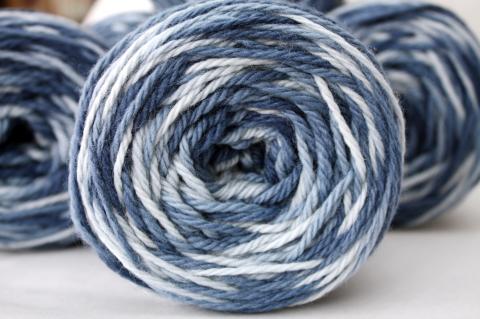
Photo: Courtesy of Yarn Passions
There are plenty of yarn stores in Taipei catering to a variety of budgets, with fibers ranging from inexpensive acrylic to luxurious cashmere and alpaca — even fair trade Peruvian cotton. Instead of sweaters, smaller projects like scarves, hats and toys are popular. Knitting looms, or frames with pegs to loop the yarn over, are an easy alternative to hooks and needles.
Most stores listed below offer basic knitting or crochet instructions with the purchase of yarn.
The basics
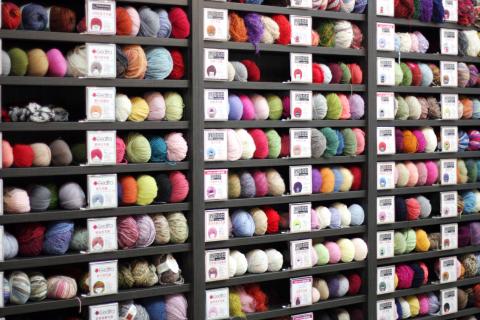
Photo: Catherine Shu, Taipei Times
Shilin Yarn Supermarket (士林毛線超市)
Address: 2F, 607, Zhongshan N Rd Sec 5, Taipei City
(台北市中山北路五段607號2樓)
Telephone: (02) 2831-3777
The warehouse-like Shilin Yarn Supermarket is an institution among Taipei’s knitters. The store’s labyrinthine aisles are stacked with overflowing piles of yarn, and giant plastic bags stuffed with yet more skeins crowd the floor. Picking through the varieties and colors can be overwhelming, especially for novice knitters. Most skeins are encased in plastic bags and if you want to feel them, you have to ask staffers for assistance. Shilin Yarn Supermarket doesn’t carry well-known yarn brands like Rowan or Filatura di Crosa, but there are plenty of bargains to be found. Soft merino costs NT$180 per 50g skein, and worsted weight wool is NT$70 for the same amount. Fluffy kid mohair is NT$600 and a wool and alpaca blend is NT$1,200 per bag of 10 skeins. Basic knitting and crocheting instruction is available for free with a purchase.
Bear Mama (小熊媽媽)
Address: 51, Yanping N Rd Sec 1, Taipei City (台北市延平北路一段51號)
Telephone: (02) 2550-8899
On the Net: www.bearmama.com.tw
Located in the heart of the “DIY district” near Taipei Main Station, Bear Mama is the city’s best-known craft store. The yarn selection takes up one wall and several shelves, and nearby tables are often filled with students taking crochet or knitting classes. Small skeins of acrylic (about 25g) start at NT$25 each, while natural fiber yarns from Japanese brand Nikke are available for NT$150 to NT$580 per skein. Bear Mama also carries a larger selection of needles and notions than most yarn stores, including six-inch (about 15cm) double-pointed needles for circular knitting.
Luxury fibers
Knitting Trend (時尚手編)
Address: 228, Changan E Rd Sec 2, Taipei City (台北市長安東路二段228號)
Telephone: (02) 2777-2930
On the Net: www.knittingtrend.com.tw
One of the most upscale and attractive yarn stores in Taipei, Knitting Trend carries imported luxury fibers like alpaca and cashmere. The centerpiece of the store is a wall of shelves with sample skeins neatly organized for customers to pick up and stroke. The store is operated by Excel (智廣實業), a company that imports yarn brands like Rowan and Filatura Di Crosa (as well as the entire spectrum of DMC embroidery floss). Buttery Schachenmayr Nomotta Alpaca Fashion yarn is NT$360 for a 50g skein, while Filatura di Crosa’s Elen Cashmere, a blend of cashmere, wool, silk and rayon, is NT$820 per 50g skein. Pattern books from England and Japan are also available.
So Easy (手藝世界)
Address: 142, Roosevelt Rd Sec 2, Taipei City (台北市羅斯福路二段142號)
Telephone: (02) 2365-6637
On the Net: www.excelcraft.com.tw
So Easy is also operated by Excel and has a similar (though not identical) selection of yarn. Located conveniently near Guting MRT Station (古亭捷運站) Exit 1, the store has a cozier ambiance than Knitting Trend, as well as a wider selection of cross-stitch supplies, kits and patterns. If Knitting Trend or So Easy doesn’t have enough stock of a certain yarn to complete your project, they can order more yarn from Excel headquarters (though, of course, you should double check the amount of yarn you need before starting).
Lin Lin (Lin Lin毛線屋)
Address: 5-9, Lishui St, Taipei City (台北市麗水街5-9號)
Telephone: (02) 2392-4289
On the Net: tw.myblog.yahoo.com/linlin-knit
Located near Shida University, Lin Lin is tiny but packed with yarn. Chou, the owner, was a teacher for Lane Mondial, and after the Italian yarn company closed its retail stores in Taiwan she opened Lin Lin, which is named after the resident calico cat. For NT$4,000 a year, Chou offers unlimited drop-in instruction and troubleshooting for even the most complicated projects, including thread crochet, lace knitting or cabled sweaters. She will also teach you how to knit or crochet a simple scarf for free with the purchase of yarn. Lin Lin features a colorful selection of luxury yarns from Filatura di Crosa and other brands, as well as less expensive acrylic mixes. Filatura di Crosa’s Zarina is spun from soft merino and comes in a rainbow of colors for NT$380 per 50g ball.
Earth-friendly yarn
Yarn Passions (炙愛毛線)
On the Net: www.yarnpassions.tw (Web site in English and Chinese)
Want to save the Earth while indulging your hobby? Then check out the selection at Yarn Passions, an online store run by a husband-and-wife team that carries yarn made from fibers harvested, prepared and spun using environmentally friendly practices. Yarn Passions’ own line includes certified organic merino yarn dyed using nontoxic, environmentally friendly materials in colors like the brilliant green Ireland, soft pink Sakura and Waterfall, a variegated yarn in shades of dusky blue. Rovings for hand-spinners and felters are also available, though not listed on the Web site (e-mail anitayarnpassions@yahoo.com.tw for more information). Imported brands include Treliske from a family-owned farm in New Zealand that specializes in humane animal husbandry. Treliske’s merino yarn comes in soothing natural hues of cream, soft gray and brown. Light, lofty fair trade organic cotton from Peru Naturtex is ideal for knitting baby items. Yarn Passions items are sold at Booday (蘑菇, www.mogu.com.tw), Earth Tree (地球樹, www.earthtree.com.tw) and Pure Harvest (自然結果, www.wretch.cc/blog/pureharvest) in Taipei and Twine (繭裹子, www.facebook.com/twinestudio) in Taichung. Payment can be made with an ATM transfer or online through Paypal.
Want to learn how to knit or crochet on your own?
Try these helpful Web sites:
Knittinghelp.com features close-up videos of knitting techniques, including basics like how to cast on and how to knit and purl. Youtube user Cyberseams (www.youtube.com/user/cyberseams) also has videos for beginner knitters. Knitting.about.com covers all the basics. For more advanced techniques and tricks on how to make your knitting look better, visit techknitting.blogspot.com.
Learn how to crochet at crochet.about.com with step-by-step photos. For videos of crochet basics, check out Youtube user Bethintx1’s channel (www.youtube.com/user/Bethintx1).
Want to meet other fiber-obsessed people from around the world? Join Ravelry (www.ravelry.com), a popular knitting and crocheting online community.
Ajay Verma, a consultant gastroenterologist at Kettering general hospital in Northamptonshire, says our gut is a “complex machine.” “It is constantly providing us with the nutrition we need, initially to grow and develop, and then for us to survive, thrive and repair from injury and illness.” How can we keep it functioning well? Put simply: “Make sure what you put into it is balanced, and that you clear out its waste products adequately,” Verma says. “In a general gastroenterology clinic, the most common conditions we see are irritable bowel syndrome (IBS), gastroesophageal reflux disease, inflammatory bowel disease and constipation,” says Nisha

And so, in the wake of US President Donald Trump’s trip to the People’s Republic of China (PRC), all the experts on the Strait of Hormuz suddenly became experts on US-China-Taiwan relations. The Internet has certainly expanded human knowledge. Lots of these sudden experts made noise this week about Trump’s words after the meeting with PRC dictator Xi Jin-ping (習近平). Trump is going to sell out Taiwan! Longtime Taiwan commentator J. Michael Cole summed the situation up neatly in the Guardian: “We need to keep in mind that he has a tendency to say many things — sometimes contradicting himself within

Last week US President Donald Trump was asked by a reporter whether he would speak on the phone to the President of Taiwan. “l’ll speak to him. I speak to everybody. We have that situation very well in hand,” Trump said. This marked the second time in a couple of weeks he had said he would talk to the President of Taiwan. In 2016 he famously took a call from then-president Tsai Ing-wen (蔡英文), when he was president-elect. Despite warnings that the apocalypse was nigh because of a phone call, the world quickly forgot about the conversation between two democratically-elected presidents.
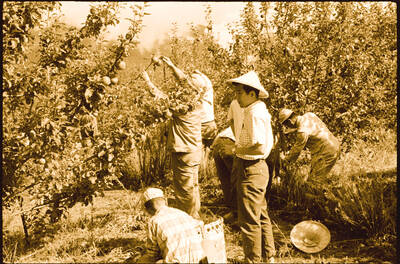
May 25 to May 31 Few believed that apples could be cultivated on a commercial scale in Taiwan’s high mountains. When horticulturalist Cheng Chao-hsiung (程兆熊) first proposed the idea in 1955, both American and Taiwanese colleagues dismissed it as implausible, arguing that temperate fruit could not be reliably grown on a subtropical island, especially on rugged terrain. However, it was this terrain in the Central Mountain Range where many Chinese Civil War veterans were resettled in the late 1950s. With limited job prospects and no family in Taiwan, they were placed on cooperative farms aimed toward self-sufficiency. Some say the conditions


 RSS
RSS