


Yang Chih-fu (楊智富), a feng shui specialist and businessman, provides special services mainly for women. Young women, to be precise.
His customers range in age from 18 to 25 and hail from all over Taiwan. The 50-something Yang operates The Palace of Holy Baby Spirits (寶寶聖靈殿), a private temple located on the third floor of a nondescript apartment building close to Xingtian Temple (行天宮), and provides fetus ghost pacification services.
According to Taiwanese tradition, fetuses have a spirit. "When a woman has an abortion, it cancels out the spirit's right to have a body, so it cannot go to heaven or the next life," Yang, said in his elegantly decorated office on the first floor.
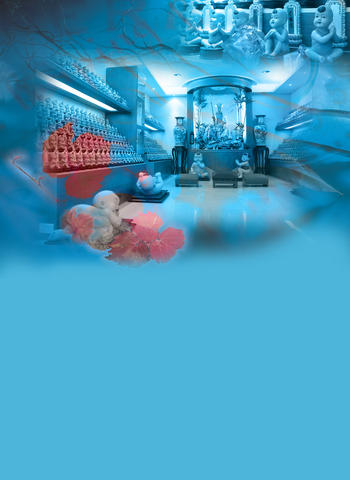
PHOTO: NOAH BUCHAN, TAIPEI TIMES
If a woman has an abortion or a miscarriage, the yingling (嬰靈), or fetus ghost, may become vengeful and haunt the woman or her family. Feelings of guilt associated with the loss of a child lead many young women to sign up for these services in person or online to appease the fetus ghost's anger.
This involves a priest (法師), who holds a ceremony during which the fetus ghost is enticed into a temple where it resides in a tablet that resembles a baby doll. Using a doll reduces the fear associated with the fetus ghost.
Appeasing the fetus ghost allays the anxiety and guilt women often feel after they've had an abortion. "After worshipping, women don't have physical and mental problems caused by fetus ghosts," Yang said.
"The doll symbolizes a human's body. Although the body of the doll is made of plastic, it is a useful home for the fetus ghost while it waits to move on to the next life." Yang, whose temple also has a Web site (www.baby-palace.com.tw), said.
Showing the ability of private temples to adapt to changes in society, Liu Han-yao (劉漢堯), a Taoist priest, began providing fetus ghost pacification services for clients at his temple in Taipei's Datong (大同) district 17 years ago. This temple was one of the first in Taiwan to do so (www.8k.com.tw/baby.asp). Abortion was legalized in Taiwan with the passing of the Genetic Health Law (優生保健法) in 1984. According to the Institute of Family Planning, now a part of the Department of Health (衛生署), roughly 300,000 abortions were performed in 1996, the most recent year for which statistics are available.
Outside Liu's cramped but tidy office is a shrine with over 1,000 cigarette box sized cubbyholes, inside which are small plastic dolls. When a devotee signs up, the mother chooses the sex of the child, after which, the client's name is affixed to the tablet. "Many don't use their real name," he said.
To further pacify the anger of the fetus ghost, Liu, like Yang, has Buddhist chants playing at all hours of the day and performs fahui (法會, a larger ceremony) four times a year. Liu also provides special requests on demand, such as photographing or videotaping the ceremony, which he then posts online. For all these services, Liu charges worshippers NT$1,000 per year.
Yang says that there are currently 400 occupied tablets in his shrine, which has 1,000. He charges NT$6,000 per doll tablet, per year. The worshipping lasts three years," he said. Yang said that the process of worshipping the tablet combined with the ceremonies performed by Taoist priests enables the fetus ghost to move on to heaven or the next life, even though it has no body. Customers also have the choice of reserving more tablets, which is a better deal, though the overall price is higher. Some customers have signed up for four tablets at a price tag of over NT$10,000 per year.
But the religious practice is not about business. "We don't charge money to people younger than 18 or who have no money," Yang said. Liu says that he can barely cover the costs of running the shrine and any extra money goes to charities.
Yeh Chuen-rong (葉春榮), an associate research fellow at the Institute of Ethnology, Academia Sinica estimates that there are at least 10,000 private temples in Taiwan offering a variety of services to worshippers - though the number specifically providing fetus ghost pacification services is significantly less.
When asked if it was common for temples to start new services like this, he replied, "Yes, of course. They have to make a living, right? It's business."
One common feature of the people running these temples is to downplay the efficacy of other temples that provide the same services. "It's all about competition," Yeh said. "If it's an old shrine, for example 40 years old, they will have to know how to deal with new trends, like yingling. Otherwise they won't have any business."
When asked if the temples have the ability to placate the guilt of the young women who seek out their services, Yeh says it does. "It's just like a counseling business in the West."
Whereas the number of clients at Yang's temple is growing, Liu's temple reached the height of its popularity in the mid 1990s when it had around 1,000 customers. Today the number has dwindled to roughly 550.
"It's competition from other temples," Liu said. "Private temples see this as an untapped market for making money and have begun to provide similar services."
Chi Hui-jung (紀惠容), CEO of the non-profit Garden of Hope Foundation, which provides counseling services to pregnant woman, says that the guilt associated with abortions can have a lifelong effect on women.
Chi adds that yingling temples can provide comfort to young women who may be too afraid to tell their parents or too timid to seek the help of professional councilors. "In Taiwanese culture, we still don't have the habit of sharing feelings with other people - especially strangers." According to her, going to the temple is a part of Taiwanese traditional culture and is easier in the short term because the woman can alleviate some of her guilt.
Though Chi doesn't discourage young women from going to worship at a temple, she advises them to seek professional counseling.
It's not just women who use these services, though. Yang tells of a man in his 60s who arrived needing to appease a fetus ghost.
"He was a playboy in his youth and was concerned that some women had abortions because of him. He was experiencing severe backaches and had difficulty sleeping. He associated his poor health with the effects of a fetus ghost," Yang said. "After one week of worshipping, the man said that the pain in his back improved and he was able to get a good night's sleep."
"For me, fetus ghosts really exist," said Yang. He gives an example of how he knows: "Sometimes, the [priest] is careless and misses part of the daily ritual. Consequently, the fetus ghost will lock us in the building until we worship them again."
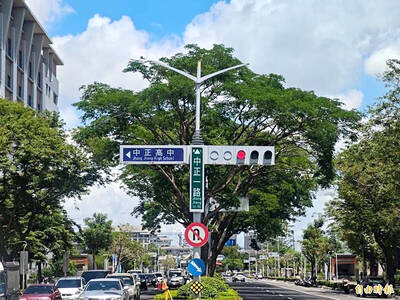
One of the most important gripes that Taiwanese have about the Democratic Progressive Party (DPP) is that it has failed to deliver concretely on higher wages, housing prices and other bread-and-butter issues. The parallel complaint is that the DPP cares only about glamor issues, such as removing markers of Chinese Nationalist Party (KMT) colonialism by renaming them, or what the KMT codes as “de-Sinification.” Once again, as a critical election looms, the DPP is presenting evidence for that charge. The KMT was quick to jump on the recent proposal of the Ministry of the Interior (MOI) to rename roads that symbolize

On the evening of June 1, Control Yuan Secretary-General Lee Chun-yi (李俊俋) apologized and resigned in disgrace. His crime was instructing his driver to use a Control Yuan vehicle to transport his dog to a pet grooming salon. The Control Yuan is the government branch that investigates, audits and impeaches government officials for, among other things, misuse of government funds, so his misuse of a government vehicle was highly inappropriate. If this story were told to anyone living in the golden era of swaggering gangsters, flashy nouveau riche businessmen, and corrupt “black gold” politics of the 1980s and 1990s, they would have laughed.
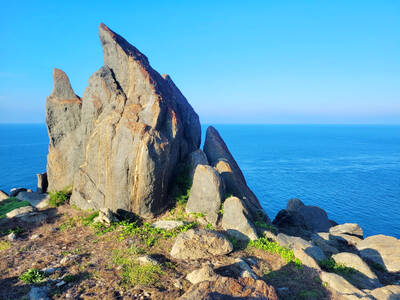
It was just before 6am on a sunny November morning and I could hardly contain my excitement as I arrived at the wharf where I would catch the boat to one of Penghu’s most difficult-to-access islands, a trip that had been on my list for nearly a decade. Little did I know, my dream would soon be crushed. Unsure about which boat was heading to Huayu (花嶼), I found someone who appeared to be a local and asked if this was the right place to wait. “Oh, the boat to Huayu’s been canceled today,” she told me. I couldn’t believe my ears. Surely,
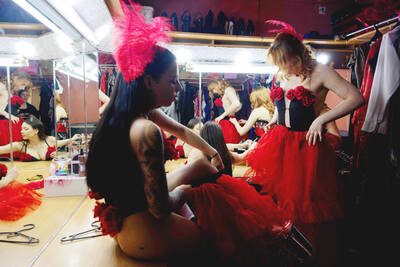
When Lisa, 20, laces into her ultra-high heels for her shift at a strip club in Ukraine’s Kharkiv, she knows that aside from dancing, she will have to comfort traumatized soldiers. Since Russia’s 2022 invasion, exhausted troops are the main clientele of the Flash Dancers club in the center of the northeastern city, just 20 kilometers from Russian forces. For some customers, it provides an “escape” from the war, said Valerya Zavatska — a 25-year-old law graduate who runs the club with her mother, an ex-dancer. But many are not there just for the show. They “want to talk about what hurts,” she


 RSS
RSS