


You might imagine that the elite band of women who buy haute couture -- an adorable little cocktail suit for NT$1.2 million, an evening gown for NT$2.8 million -- would have a few qualms about identifying themselves with Marie Antoinette. After all, as a portrait of where spending ludicrous amounts of money on clothes gets you, she is not exactly a happy example. But, it seems, the wealthy women of today's front row are not easily made squeamish: in Paris last week, the blond and beautiful queen who was beheaded in 1793 reigned supreme once more over the haute-couture catwalks.
As so often in fashion, Madonna got there first. In 1990, she seemed to predict Marie Antoinette's stint as a fashion icon, dressing as the fabled queen to perform Vogue at that year's VMA awards. Since then, the ultimate icon of the dissolute and scandalous aspects of the 18th century has enjoyed something of a reha-bilitation. In 2002, Antonia Fraser's biography painted a portrait of a woman more unfortunate than terrible. The following year, Deborah Cadbury's The Lost King of France told of a queen who, after a frivolous youth, settled into devoted motherhood.
One fashion icon who has taken an interest in these developments is Sofia Coppola, muse to Marc Jacobs and duchess of the downtown best-dressed list. She has made a film of the life of Marie Antoinette, which opens later this year. This time last year, Coppola was in Paris filming, and took a break to attend couture shows: clearly, her presence made quite an impression.
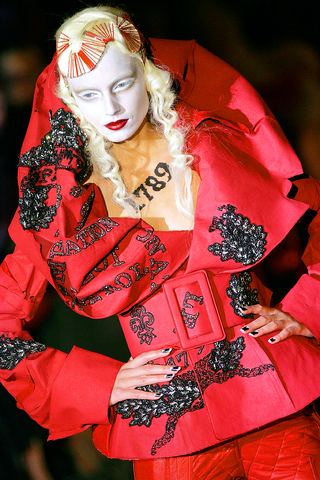
PHOTO: AFP
The tone for the week was set on Monday afternoon, when a huge marquee erected in the polo field in the Bois de Boulogne was the setting for the Christian Dior show. "Red is the new Libertine, Platinum is the new Marie Antoinette," declared John Galliano in his program. The house lights went down to a soundtrack of galloping hooves and the catwalk was spotlit by pools of red light. Dior shows are renowned for their fantastical hair and makeup, and for this season, each model had her natural hair entirely covered with a white blonde wig.
Corsets, costumes and grand gowns being Galliano's stock in trade, Marie Antoinette is a natural muse for him at the house of Dior. As ever with Galliano, there was a dark side to this collection. (He designed it around the time of the recent Paris riots, and said these were on his mind.) With vast hoods and capes, tightly laced horsemen's leathers and lashings of blood red, there was as much of the executioner as of the damsel in distress.
At Valentino that evening, it became clear that for one catwalk favorite, the Marie Antoinette blond hair was more than just Galliano's temporary fantasy. Maria Carla, Givenchy muse and the model considered first in line for lucrative contracts made vacant by the Kate Moss scandal, has switched her dark brown hair for a platinum bob. Indeed there was quite an army of white-blond models on this week's catwalks: perhaps, now that tawny-caramel hair (to blend serenely with one's fake tan) has spread from the Aniston-influence A-list to become every TV starlet's choice, statement blonde is about to recover the higher ground as fashion's ultimate look.
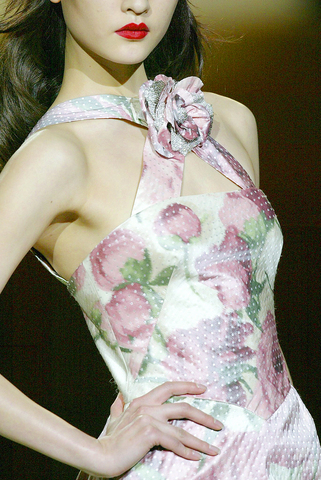
PHOTO: EPA
Jean Paul Gaultier had the final word. His last model was dressed as a fantasy bride, in huge black sunglasses and a gown whose harem-shaped skirt was suspended from a hoop of pearls. Crazy, but this week, somehow apt. At her wedding to the French dauphin, the 15-year-old Marie Antoinette wore a magnificent white dress, whose giant hoops were encrusted with diamonds and pearls. Contemporary reports sadly do not tell us whether, like Gaultier's model, the bride wore sunglasses.
If one asks Taiwanese why house prices are so high or why the nation is so built up or why certain policies cannot be carried out, one common answer is that “Taiwan is too small.” This is actually true, though not in the way people think. The National Property Administration (NPA), responsible for tracking and managing the government’s real estate assets, maintains statistics on how much land the government owns. As of the end of last year, land for official use constituted 293,655 hectares, for public use 1,732,513 hectares, for non-public use 216,972 hectares and for state enterprises 34 hectares, yielding

The small platform at Duoliang Train Station in Taitung County’s Taimali Township (太麻里) served villagers from 1992 to 2006, but was eventually shut down due to lack of use. Just 10 years later, the abandoned train station had become widely known as the most beautiful station in Taiwan, and visitors were so frequent that the village had to start restricting traffic. Nowadays, Duoliang Village (多良) is known as a bit of a tourist trap, with a mandatory, albeit modest, admission fee of NT$10 giving access to a crowded lane of vendors with a mediocre view of the ocean and the trains

The March/April volume of Foreign Affairs, long a purveyor of pro-China pablum, offered up another irksome Beijing-speak on the issues and solutions for the problems vexing the People’s Republic of China (PRC) and the US: “America and China at the Edge of Ruin: A Last Chance to Step Back From the Brink” rang the provocative title, by David M. Lampton and Wang Jisi (王緝思). If one ever wants to describe what went wrong with US-PRC relations, the career of Wang Jisi is a good place to start. Wang has extensive experience in the US and the West. He was a visiting
One of the challenges with the sheer availability of food in today’s world is that lots of us end up spending many of our waking hours eating. Whether it’s full meals, snacks or desserts, scientists have found that it’s not uncommon for us to be mindlessly grazing at some point during all of our 16 or so waking hours. The problem? As soon as this food hits the bloodstream in the form of glucose, it initiates the release of the hormone insulin. This in turn activates a switch present in every one of our cells, which is responsible for driving cell


 RSS
RSS