


The atmosphere and weather conditions that greeted music fans at this year's Formoz Festival (
And hot it was, both on and off stage, but the humidity certainly didn't deter the roughly 10,000 festival-goers who turned up on the opening night from enjoying the fantastic line-up of bands at the Yuanshan Children's Recreational Center (
Although the increase of the ticket price to NT$1,500 and the close monitoring of ticket sales had raised some questions regarding the success of the festival, organizers needn't have worried. Actual attendance figures have yet to be calculated, but it's safe to say that Formoz 2005 proved to be both the best organized and most attended in the festival's 11-year history.
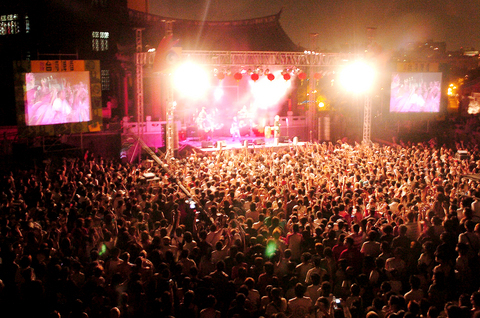
PHOTO: TAI HSIANG, TAIPEI TIMES
With hundreds of people still patiently standing in line at the venue's entrances for tickets and wrist bands at 5:30pm on Friday evening, large crowds had already begun to gather at all of the festivals six stages in order to catch the opening acts.
The focus of attention for large numbers of festival-goers on the opening night, however, were the Wind and Wood stages, where some of the big-name bands were slated to perform.
On the Wind stage Taiwan's FOTC (

PHOTO: TAI DA-HSIANG, TAIPEI TIMES
Taking to the stage after a lengthy delay due to sound-check problems, Kemuri wasted no time in rousing the crowd. Thanks to the band's energetic lead singer Fumio Ito, the combo had the audience eating out of its hand by the second number. His jokes regarding the audience being "too tired to dance" were not taken lightly by the predominantly late-teens/early-twenties crowd and the band's brass section infused Fishbone-like salvo of ska-punk had incited the first mosh pit of Formoz 2005 long before the sun had set.
Following Kemuri's blistering set, the action and attention moved to the Wood stage, where local expat punk combo, The Deported wowed the crowd with its Dead Kennedy's/Discharge-like barrage of noise.
Their performance might not have been to everyone's liking and the lyrics of the band's politico-punk songs might have been lost on large numbers of the audience, but one overly exuberant member of the audience was so taken by the set that he leapt on stage, removed his pants and began simulating sex with an equally boisterous male friend.
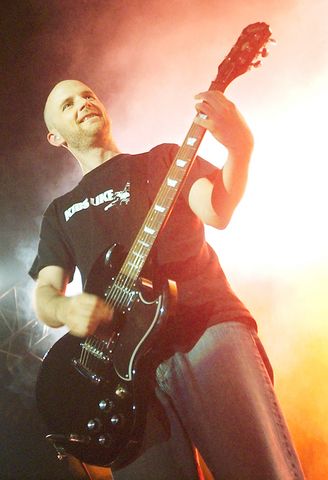
PHOTO: AP
Local psychobilly combo Chicken Rice (
It was Moby, however, that a majority of people had come to see on Friday and he didn't disappoint. Organizers still don't known the exact number of people who came solely to see Moby, but, according to head of Taiwan Rock Alliance (TRA) Freddy Lin (
In a pulsating non-stop 90-minute set Moby performed a wide range of tunes from his latest release Hotel, several older more dance-oriented tunes as well as two fantastic cover versions of AC/DC's You Shook Me All Night Long and Billy Idol's Rebel Yell.

PHOTO: AP
Saturday got off to a slower and less frenzied start, with crowds gradually filtering into the venue from about
4:30pm. The first crowd puller of the second day was local rock combo, Back Quarter (四分衛).
The long-serving yet sadly often overlooked and underestimated four-piece might not have managed to get the crowd as enthused as several of the other acts that performed on the Wind stage over the weekend, but the group pulled off a tight set which included a good selection of material from its upcoming album as well as plenty of favorites from previous releases.
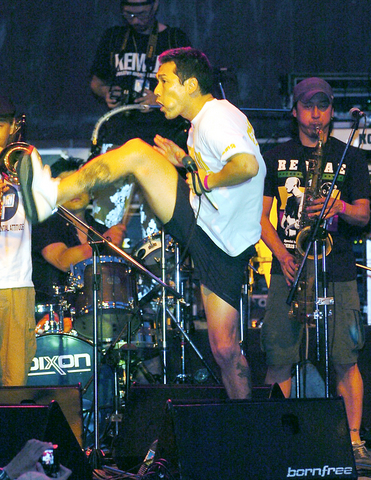
PHOTO: TAI HSIANG, TAIPEI TIMES
The highlight of Saturday night's performances was Japanese pop act Kishidan. Even before the comedic six-piece power-pop combo appeared the atmosphere in front of the Wind stage was charged with emotion. Young teenage girls sporting Kishidan patches and waving their arms wildly in the air rubbed shoulders with twenty-something beer-swilling males in eager anticipation of what was to come.
Always a crowd-pleaser when it performs in Taiwan, Kishidan's performance at Formoz 2005 was memorable. Littered with camp and comedic dance routines and blistering guitar hooks and riffs, the J-rock combo's performance had the audience hooked from the get-go. Even though the band's translator was temporarily missing in action and lost amid the crowds, the between-song, Japanese-language banter still had the audience transfixed, regardless of whether they understood a word of it or not.
As Sunday's performances began the crowds at Formoz hadn't dwindled, but the numerous Taiwan Beer sales girls were having more difficulty in persuading festival-goers to purchase beer than on Friday and Saturday nights. With the three-day festival drawing to a close, as of press time revelers were eagerly anticipating performances by mainstream rocker Lisa Loeb and local anarchists LTK (
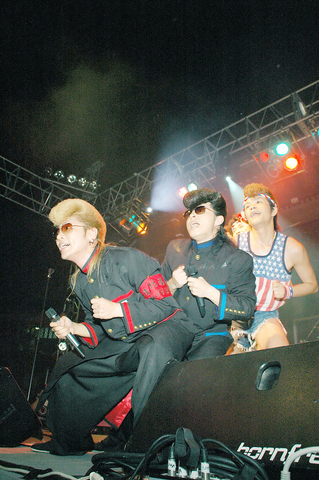
PHOTO: CHEN JUNG-LIANG, TAIPEI TIMES
Although police presence at the festival was greater then in previous years, according to organizers, no arrests were made for either violent or drug-related offenses. From an audience perspective the festival went forward without any problems. The flow of people between the six stages that were located around the park was surprisingly smooth. Ambulance crews were on standby over the weekend, but no injuries were reported at Formoz 2005.
With the events of this weekend still fresh in the minds of the thousands who attended Formoz 2005 and cleaners still removing litter from the venue, organizers have already begun making plans for next year. According to TRA, Formoz 2006 will be bigger and better than this year and boast more stages, more international acts and an even greater variety of music.

In Taiwan there are two economies: the shiny high tech export economy epitomized by Taiwan Semiconductor Manufacturing Co (TSMC, 台積電) and its outsized effect on global supply chains, and the domestic economy, driven by construction and powered by flows of gravel, sand and government contracts. The latter supports the former: we can have an economy without TSMC, but we can’t have one without construction. The labor shortage has heavily impacted public construction in Taiwan. For example, the first phase of the MRT Wanda Line in Taipei, originally slated for next year, has been pushed back to 2027. The government

July 22 to July 28 The Love River’s (愛河) four-decade run as the host of Kaohsiung’s annual dragon boat races came to an abrupt end in 1971 — the once pristine waterway had become too polluted. The 1970 event was infamous for the putrid stench permeating the air, exacerbated by contestants splashing water and sludge onto the shore and even the onlookers. The relocation of the festivities officially marked the “death” of the river, whose condition had rapidly deteriorated during the previous decade. The myriad factories upstream were only partly to blame; as Kaohsiung’s population boomed in the 1960s, all household

Allegations of corruption against three heavyweight politicians from the three major parties are big in the news now. On Wednesday, prosecutors indicted Hsinchu County Commissioner Yang Wen-ke (楊文科) of the Chinese Nationalist Party (KMT), a judgment is expected this week in the case involving Hsinchu Mayor Ann Kao (高虹安) of the Taiwan People’s Party (TPP) and former deputy premier and Taoyuan Mayor Cheng Wen-tsan (鄭文燦) of the Democratic Progressive Party (DPP) is being held incommunicado in prison. Unlike the other two cases, Cheng’s case has generated considerable speculation, rumors, suspicions and conspiracy theories from both the pan-blue and pan-green camps.

Stepping inside Waley Art (水谷藝術) in Taipei’s historic Wanhua District (萬華區) one leaves the motorcycle growl and air-conditioner purr of the street and enters a very different sonic realm. Speakers hiss, machines whir and objects chime from all five floors of the shophouse-turned- contemporary art gallery (including the basement). “It’s a bit of a metaphor, the stacking of gallery floors is like the layering of sounds,” observes Australian conceptual artist Samuel Beilby, whose audio installation HZ & Machinic Paragenesis occupies the ground floor of the gallery space. He’s not wrong. Put ‘em in a Box (我們把它都裝在一個盒子裡), which runs until Aug. 18, invites


 RSS
RSS