

The Venice Biennale has drawn attention for its focus on women artists and to the inequities regarding the treatment of women in the art world. To focus on a feminist issue may seem like an old concern dating from the 1980s. However, if there are no constant reminders it would be easy for female artists to lose their footing in the international art world, a world that is dominated by white male artists, as evidenced in exhibitions and in written art histories.
This week there are several local exhibitions that focus on the achievements of Taiwanese women in the arts. Fortunately, without being didactic, or obnoxiously proselytizing, the exhibitions act as a gentle reminder that some of Taiwan's leading artists just happen to be women.
At the Taipei Fine Arts Museum, the exhibition Lightscape -- Between Mind and Matter runs to Sep. 4. The exhibition showcases the work of twelve Taiwanese painters who gained prominence in the 1980s. Many of the works on view are abstract oil paintings with a nature-based theme.
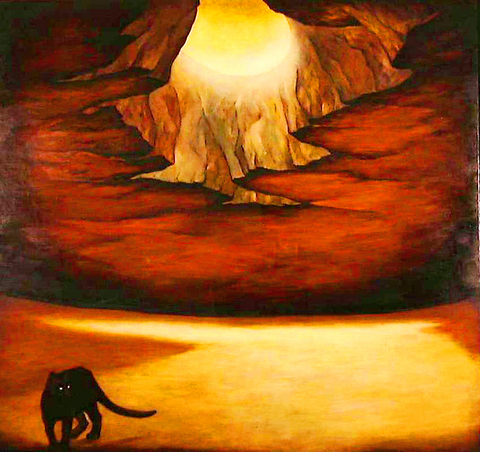
PHOTO COURTESY OF TFAM.
Wen Liyun's (
Locally reknowned abstract painters Ava Hsueh (
Another exhibition at the museum commemorates the work of late artist Chen Hsing-wan (
Opening this Saturday night is a solo exhibition by Jun Lai (
Lai is one of the few pioneering women artists in Taiwan who came to attention in the 1980s and now currently works in the field of public art. She will show new sculpture-like wall pieces that evoke springtime feelings, while her older work of brightly-hued paintings is inclu-ded in the Lightscape exhibition mentioned previously.
This last event, which is held this evening, is not by a woman artist. German prize-winning artist Patrick Palucki, who is currently doing a residency at the Taipei Artist Village, will have a presentation of his work at 7:30 tonight at the Bamboo Room at the TAV. Entitled Sign his work consists of an installation of traffic signage that symbolizes the control of masses of people and our urban collective identity. He will also show his film Today Starts On Page 23.
The experimental film is a collage of signs cinematically presented. So whe-ther you are inspired by the rural or the urban in art, there looks like there is something for everyone this weekend.
Details:
-- Lightscape -- Between Mind and Matter and The Memorial Exhibition of Chen Hsing-wan at the Taipei Fine Arts Museum.
Call (02) 2595 7656
-- Jun Lai's Spring Ether Coming and Going at IT Gallery. Call (02) 2507 7243
-- Media artist Patrick Palucki's exhibition Signis at the Bamboo Room in the Taipei Artist Village.
Call:(02) 3393 7377 X 101
When: Film showing at 7:30, Thursday July 7.
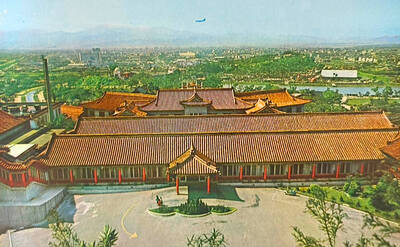
Sept. 21 to Sept. 27 When the Shah of Iran became the Grand Hotel’s (圓山大飯店) first head-of-state guest in 1958, it was hardly the landmark it is known as today. A Chinese-style, two-story structure with just 36 rooms built on the former site of the Taipei Shinto Shrine, the hotel was still referred to as its original name, the Taiwan Hotel (台灣大飯店), in an official newsreel detailing Mohammad Reza Pahlavi’s visit. The video lavished praise on the hotel, pointing out its “beautiful architecture and magnificent appearance” and noting that it had just been renovated. After being greeted personally by then-president
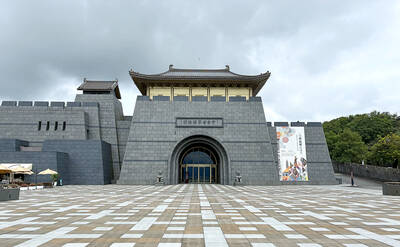
The one-day trip begins at the geographical center of Taiwan: Puli Township’s (埔里) Hutou Mountain Geographic Center of Taiwan Monument (臺灣地理中心碑), embedded at the foot of Nantou County’s dense forested slopes. It sits entrenched in forest vegetation amid the tall, spindly bodies and spiky heads of the betel nut trees; the air is cool, and its surroundings are mostly silent save the sounds of late-season cicadas. Roughly two minutes from the first destination, and after a bend in Yongfeng Road (永豐路), there’s a glimpse of a resplendent golden dome on the horizon. It’s the cap of the 135m-tall main building of the
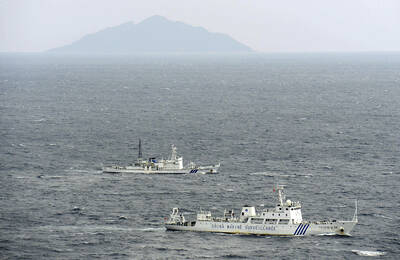
For a small nation, Taiwan has an unusually long list of territorial disputes. In part or in whole, it has disputes over the Spratly Islands (Nansha Islands, 南沙群島) with Vietnam, the Philippines, Malaysia and Brunei. It also has another territorial dispute with Vietnam over the Paracel Islands, and with Japan over the Senkaku Islands (Diaoyutai Islands, 釣魚台). Of course, the biggest territorial disputes are with the People’s Republic of China (PRC), which not only claims all of the above, but also Pratas Island (Dongsha, 東沙島), Kinmen, Penghu and all of Taiwan itself. This creates considerable headaches politically for the government, especially
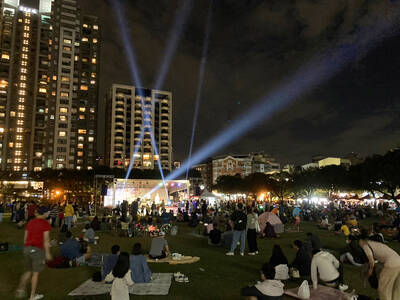
Two years ago, the music came to an abrupt halt at one of Taiwan’s largest independent music festivals. The problem: a single noise complaint. The DJ’s high-energy tunes had exceeded the allowed sound limit. As per regulation, the performance took a several-minute pause and then continued, this time at a slightly lower decibel. And then last year, the same event, Compass Taichung International Food and Music Festival, was unexpectedly canceled due to sponsorship issues. Such are the woes of trying to organize outdoor music festivals these days. “It makes it so much harder to put on a festival,” said Courtney Donovan Smith, co-publisher


 RSS
RSS