


Starting with Taiwan's "international top model" Lin Chi-ling (林志玲), who was in the news practically every day this summer despite her not having done anything newsworthy, local media have kicked up what it now refers to as a "model fever"(名模熱) that's sweeping across the land. But since poor Chi-ling has already been deemed cold toast, it's now open season on the rest of Taiwan's contingent of runway models to justify more pictures of beautiful women on their pages and on TV.
The two ladies who stumbled into the media crosshairs this time are Lei Hung (洪曉蕾) and Lin Chia-chi (林嘉綺). And Hung may have already emerged as the prime target, as evidenced by her being the cover story two weeks in a row in Next Magazine (壹週刊) -- last week for doing the "splits" with four rich old men, and this week for having taken half-naked glamor pictures 11 years ago when she was 18. The best that Chia-chi could offer in the way of salacious stories was her kissing her longtime boyfriend and, this was actually part of a headline in The Great Daily News (大成報), rubbing his back. Clearly, Chia-chi is not going to generate titillating headlines for long.
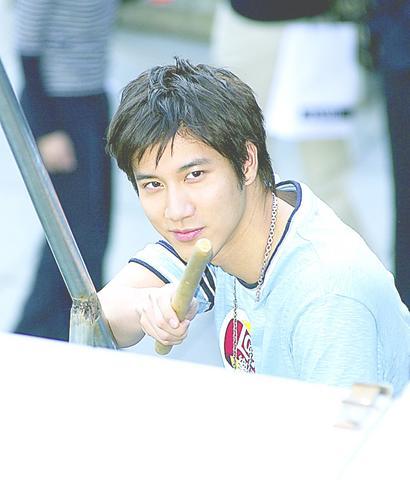
PHOTO: TAIPEI TIMES
Hung's agent, meanwhile, rose to the bait on Wednesday to denounce the publication of the old semi-nude photos and delivered a promise to sue the magazine, making sure that there will be more reports about Hung to come.

PHOTO: TAIPEI TIMES
Last Sunday having been Double Ten Day, the usual tension over who will be the lucky/daring person to take the stage in front of the Presidential Office to host the national day festivities was more muted than in previous years, presumably because the government has given up asking popular stars to take part. Much had also been made beforehand of the toning down of the celebrations' "Chineseness" and nowhere was that more apparent than in the final choice of variety show host Peng Chia-chia (澎恰恰) and the self-proclaimed sexy obasan Chen Mei-feng (陳美鳳) to serve as MCs. Both being local icons, especially for the 40-and-up crowd, they drove the point home that there's a new wind blowing through town.
And speaking of blowing wind, Lee Hom Wong (王力宏) spoke in rare harsh tones to the media this week for reporting on criticisms of a song he produced for A-mei's (阿妹) new album that described the track as sounding like a person on the toilet grunting and groaning. Lee Hom said he wanted artists to be respected and for media to avoid "low-class" criticisms that demean the artists and their producers.
In Hong Kong last week, pop singer Eason Chan (陳奕迅) became a father when his girlfriend gave birth to a healthy 3.5kg baby girl. The couple named the baby Constance. The two have been out of reach from the media, but friends have visited the new family and said Constance looks like the father, with one friend remarking the two were so similar that even the baby's farts sounded like the Eason's.
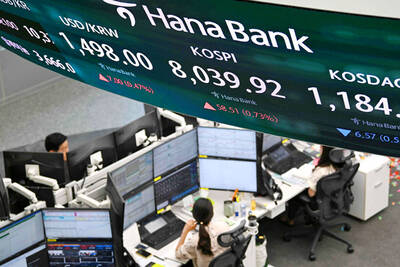
Taiwan’s overtaking of South Korea in GDP per capita is not a temporary anomaly, but the result of deeper structural problems in the South Korean economy says Chang Young-chul, the former CEO of Korea Asset Management Corp. Chang says that while it reflects Taiwan’s own gains, it also highlights weakening growth momentum in South Korea. As design and foundry capabilities become more important in the AI era, Seoul risks losing competitiveness if it relies too heavily on memory chips. IMF forecasts showing Taiwan widening its lead over South Korea have fueled debate in Seoul over memory chip dependence, industrial policy and
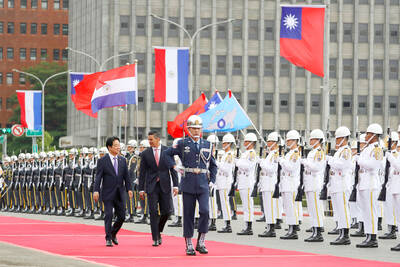
“China wants to unify with Taiwan at the lowest possible cost, and it currently believes that unification will become easier and less costly as time passes,” wrote Amanda Hsiao (蕭嫣然) and Bonnie Glaser in Foreign Affairs (“Why China Waits”) this month, describing how the People’s Republic of China (PRC) is playing the long game in its quest to seize Taiwan. This has been a favorite claim of many writers over the years, easy to argue because it is so trite. Very obviously, if the PRC isn’t attacking Taiwan, it is waiting. But for what? Hsiao and Glaser’s main point is trivial,
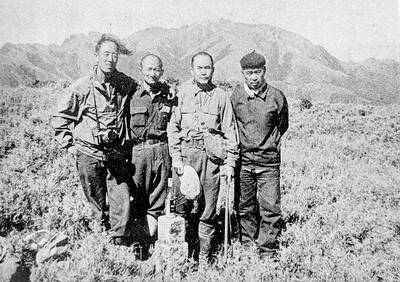
May 18 to May 24 Gathered on Yangtou Mountain (羊頭山) on Dec. 5, 1972, Taiwan’s hiking enthusiasts formally declared the formation of the “100 Peaks Club” (百岳俱樂部) and unveiled the final list of mountains. Famed mountaineer Lin Wen-an (林文安) led this effort for the Chinese Alpine Association (中華山岳協會). Working with other experienced climbers, he chose 100 peaks above 10,000 feet (3,048m) that featured triangulation points and varied in difficulty and character. The list sparked an alpine hiking craze, inspiring many to take up mountaineering and competing to “conquer” the summits. A common misconception is that the 100 Peaks represent Taiwan’s 100 tallest

And so, in the wake of US President Donald Trump’s trip to the People’s Republic of China (PRC), all the experts on the Strait of Hormuz suddenly became experts on US-China-Taiwan relations. The Internet has certainly expanded human knowledge. Lots of these sudden experts made noise this week about Trump’s words after the meeting with PRC dictator Xi Jin-ping (習近平). Trump is going to sell out Taiwan! Longtime Taiwan commentator J. Michael Cole summed the situation up neatly in the Guardian: “We need to keep in mind that he has a tendency to say many things — sometimes contradicting himself within


 RSS
RSS