


Will Taichung become the next Bilbao, a Spanish town transformed from a terrorist hideout to a cultural center? Will the Taichung branch of the Guggenheim Museum, if built, be as popular as its Bilbao branch, or fold up in its second year, like the museum's Las Vegas branch, wasting the NT$6.2 billion necessary for its construction? Is the huge investment even worth making at all? These are the questions that will exercise the minds of lawmakers and local artists alike when the bill for the Guggenheim construction is to be discussed at Taichung City Council next week.
"We want to copy the Bilbao experience. The construction of the Guggenheim revived its economy and changed [the city's] image," said Chu Chung-fen (
Taichung mayor Jason Hu (
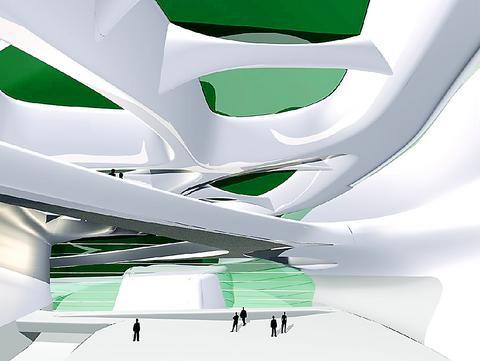
PHOTO COURTESY OF THE GUGGENHEIM FOUNDATION
In the process, much doubt has been leveled at the cost and the ability of Taichung to support the expensive museum in the future. The debate on whether the central government should break its rule of funding only half the budget of a local government project is complicated by the different political affiliations of the DPP administration and the KMT Taichung mayor.
Despite Taichung City Government's ambition to emulate the Bilbao branch, which is faring best among all of Guggenheim's branches, officials admitted that it will not be easy.
"The main difference between Taiwan and Bilbao is that the Bilbao branch's operation went quickly on the right track because there's a milieu which values culture. Art is not a popular activity here, but the museum will encourage the public's appreciation of art," Chu said.
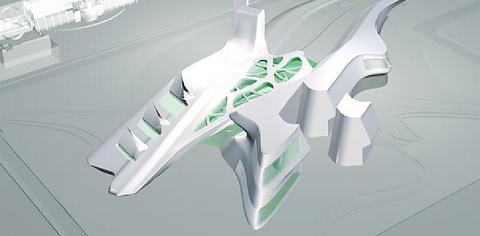
PHOTO COURTESY OF THE GUGGEMHEIM FOUNDATION
The biggest sticking point of the Guggenheim project has been its cost, which is nearly double the construction cost of the Bilbao branch. According to Chinese-language newspapers, Vice Chairman of the Council for Economic Planning and Development(
Wu Mi-cha (
When asked whether he thinks it will operate well, Wu replied that the Guggenheim Foundation's feasibility study (the final version is due to be released in two months) will provide the answer.
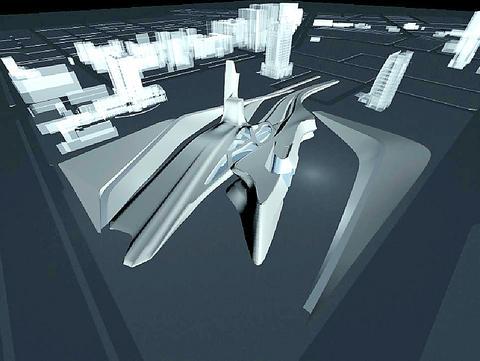
PHOTO COURTESY OF THE GUGGEMHEIM FOUNDATION
An earlier version of the study had positive results. "The museum's operation will suffer a 50 percent loss, or roughly NT30000 million. Considering all cultural institutions in Taiwan are losing money, many amounting to 80 percent, this is relatively good," Chu said. "While the museum itself may lose money, the economy of its surroundings will improve. This factor will more than offset the losses of the museum itself," Chu said.
The city government also considers the Guggenheim Foundation estimate too pessimistic. "The study is based on an estimated 1.02 million visitors a year, including 80,000 foreign tourists. Each viewer pays NT$350 for admission and there are 10 exhibitions a year. We expect more visitors than that, since the National Museum of Natural Science [which is also in Taichung city] has an annual visitor rate of 2.7 to 2.8 million and the Palace Museum 2.1 million. The Guggenheim is no less an attraction. We're more optimistic about the prospects," Chu said.
"The greatest expense in maintaining a museum lies in organizing exhibitions, with all the transportation fees and insurance. We may have only two main exhibitions and three or four secondary exhibitions a year," Chu said. Relaying the mayor's idea, Chu revealed that the opening exhibition may be of Pablo Picasso.
"The public in Taiwan love big exhibitions on famous themes [or with big names]. The terracotta soldiers and the Matisse exhibitions were great successes. The museum's content will adjust to that," Chu said.
The Taichung branch also plans to have an exclusive "Asian and Chinese Art Gallery," which will occupy one fifth of the museum space, where local art will be on show. "We expect this arrangement to encourage local artists to do better work to get the chance to exhibit in a prestigious institution and maybe in other branches or the Guggenheim's allied museums in Austria and Russia," Chen said.
Wu also stressed the importance of exchanges with museums abroad. "People have been focusing on the NT$5 billion the Executive Yuan has agreed to grant the construction and how much money it is without noticing that the premier has asked Mayor Hu to make the Guggenheim able to support itself in the future and to be careful when signing the contract with the Guggenheim Foundation. The contract had better provide Taiwanese art with the opportunity to market itself abroad and to provide cultural exchanges with Guggenheim's allies. That's the most important thing," Wu said.
As for Guggenheim's future plans on holding large-scale exhibitions, Wu advised caution. "Popular exhibitions are good in themselves, but huge crowds of viewers do not mean high quality exhibitions. Museums, including the Guggenheim, may do well to balance sufficient display space, the number of displays and the amount of time viewers spend admiring the displays, with its popularity," Wu said.
But Wu also expressed his confidence in Guggenheim. "Building a Guggenheim here is like allowing foreign companies to bid on local construction projects. It helps raise standards. Guggenheim's art management and marketing know-how will hopefully help art management in Taiwan," Wu said.
Chang Yun-tzun (
Their reason for supporting the project, Chang said, was purely for the sake of art. "With the construction of the Guggenheim, a large space and its surrounding will be beautified and arts education in Taiwan will improve, so we certainly support the project," Chang said.
Stressing that he has no political affiliations, Chang said that his support is mainly for the good of arts education in Taiwan, which has long been neglected. "We have many public culture centers holding exhibitions and activities that no one goes to, because people in charge of them have too little knowledge about art. We need an art professional like Guggenheim to organize good exhibitions. The issue is not political, it is about arts," Chang said.
As for the big budget, Chang thinks it's worth spending. "When the Guggenheim starts operating, art from Taiwan will have more of a chance to be seen abroad and there will be more artistic interaction with other countries. Compared with the money the government spends in diplomacy, this is nothing, and it also tries to foster interaction with foreign countries," Chang said.
Time Line
Jan 6, 2002: Taichung Mayor Jason Hu appealed to the Executive Yuan's Council of Cultural Affairs for the construction budget of the Guggenheim Museum, Taichung branch.
Jan 24, 2002: Local scholars and artists set up the Promotion of Guggenheim Museum task force.
June 4, 2002: Thomas Kern, CEO of the Guggenheim Foundation visited Taichung to examine possible locations.
June 24, 2002: Taichung City Government commissioned the Guggenheim Foundation to make a feasibility study.
July 13, 2003: Taichung mayor Hu revealed the architectural model for the construction of the Guggenheim Museum. Hu urged the central government to provide half of the construction budget of NT$6 billion.
July 25, 2003: Eighteen Taichung-based artists started a petition for the construction of the Guggenheim.
Aug. 10, 2003: Mayor Hu sought support from President Chen Shui-bian to include the Guggenheim Museum as a major national construction project, for which the central government would provide NT$5 billion. President Chen was supportive.
Aug. 17, 2003: Mayor Hu sought Premier Yu Shyi-kun's support of a central government subsidy for the Guggenheim's construction. Yu agreed that the central government would provide half the budget and said he would consider including Guggenheim in the five-year national public construction plan, as Hu requested.
Sept. 14, 2003: Council of Economic Construction lawmaker Chang Ching-sen returned from his trip to the Guggenheim Bilbao branch. Chang doubted whether the construction estimate was reasonable.
Sept. 15, 2003: Executive Yuan spokesman Lin Chia-long said that the Executive Yuan was supportive of the project. The Taichung City Government would ensure the "Taichung Guggenheim Complex" budget was examined by the city council.
Sept. 19, 2003: Taichung mayor Hu met with Chang Ching-sen to discuss the Guggenheim project. Hu asked for a central government subsidy of NT$5 billion. Chang said he wanted Taichung City Government to shoulder operation losses and insisted the project should boost Taiwan's interaction with the international art world.
Sept. 20, 2003: Premier Yu Shyi-kun announced the central government would provide NT$5 billion for the Guggenheim construction, as part of the national public construction plan.
Sept. 21, 2003: Mayor Hu announced that he expected the construction to start next year and finish in 2007, if Taichung City Council okays the project in October.
Sept. 30, 2003: Archeological team found human remains near the Guggenheim construction site. Mayor Hu said that the Huei-an heritage site excavation will not affect construction of the museum.

Oct. 21 to Oct. 27 Sanbanqiao Cemetery (三板橋) was once reserved for prominent Japanese residents of Taipei, including former governor-general Motojiro Akashi, who died in Japan in 1919 but requested to be buried in Taiwan. Akashi may have reconsidered his decision if he had known that by the 1980s, his grave had been overrun by the city’s largest illegal settlement, which contained more than 1,000 households and a bustling market with around 170 stalls. Fans of Taiwan New Cinema would recognize the slum, as it was featured in several of director Wan Jen’s (萬仁) films about Taipei’s disadvantaged, including The Sandwich

“Wish You Luck is not just a culinary experience, it’s a continuation of our cultural tradition,” says James Vuong (王豪豐), owner of the Daan District (大安) Hong Kong diner. On every corner of Kowloon, diners pack shoulder-to-shoulder over strong brews of Hong-Kong-style milk tea, chowing down on French Toast and Cantonese noodles. Hong Kong’s ubiquitous diner-style teahouses, known as chachaanteng (茶餐廳), have been a cultural staple of the city since the 1950s. “They play an essential role in the daily lives of Hongkongers,” says Vuong. Wish You Luck (祝您行運) offers that same vibrant melting pot of culture and cuisine. In

Much noise has been made lately on X (Twitter), where posters both famed and not have contended that Taiwan is stupid for eliminating nuclear power, which, the comments imply, is necessary to provide the nation with power in the event of a blockade. This widely circulated claim, typically made by nuclear power proponents, is rank nonsense. In 2021, Ian Easton, an expert on Taiwan’s defenses and the plans of the People’s Liberation Army (PLA) to break them, discussed the targeting of nuclear power plants in wartime (“Ian Easton On Taiwan: Are Taiwan’s nuclear plants safe from Beijing?”, April 12, 2021). The

Artificial intelligence could help reduce some of the most contentious culture war divisions through a mediation process, researchers say. Experts say a system that can create group statements that reflect majority and minority views is able to help people find common ground. Chris Summerfield, a co-author of the research from the University of Oxford, who worked at Google DeepMind at the time the study was conducted, said the AI tool could have multiple purposes. “What I would like to see it used for is to give political leaders ... a better sense of what people ... really think,” he said, noting surveys gave


 RSS
RSS