


The Swedish black metal band Dark Funeral, which performs in Taipei tonight, recorded its activities of 1997 as follows: "After totally desecrating the unsuspecting American audience with their blasphemous stage show complete with impaled pigs heads on upside-down crosses matched with the unholy members drenched in pigs blood and finishing the set off with Emperor Magus Caligula's firebreathing [sic]. `From there the band embarks on the American Satanic Crusade Tour'..."
Last week in Japan, the fire spitting of Emperor Magus Caligula (vocals and bass) got the band fined by local fire marshals, according to Doris Yeh (葉湘怡), the promoter for the Taipei show and bass player in the band Chthonic (閃靈), which toured with Dark Funeral through Japan. Yeh said Dark Funeral's Taipei set will likely include fire, but probably not pigs' heads or pigs' blood, even though these are cheap and easy to purchase locally.
In Dark Funeral's lyrics, fire is a recurrent theme, particularly evil fire wielded by Satan or other demons that's used to destroy the weak. Satan is another of the band's themes.
Yeh described Dark Funeral's music as "black metal, but faster." She and Chthonic first met the band this April when both played at the New Jersey music fest, Metal Meltdown. Then Chthonic helped schedule Dark Funeral's Taiwan appearance on its current Asia tour. Tonight, Dark Funeral headlines in Taipei at Metal Immortal V, which also includes local bands Chthonic, Snow Dance (雪舞), 666 and Anthelion (幻日). The venue is Zeitgeist (聖界), located at 122, Sec. 2, Chunghsiao E. Rd (北市忠孝東路二段122號). Doors open at 6pm and admission is NT$950.
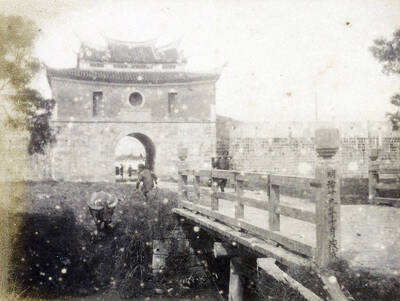
June 9 to June 15 A photo of two men riding trendy high-wheel Penny-Farthing bicycles past a Qing Dynasty gate aptly captures the essence of Taipei in 1897 — a newly colonized city on the cusp of great change. The Japanese began making significant modifications to the cityscape in 1899, tearing down Qing-era structures, widening boulevards and installing Western-style infrastructure and buildings. The photographer, Minosuke Imamura, only spent a year in Taiwan as a cartographer for the governor-general’s office, but he left behind a treasure trove of 130 images showing life at the onset of Japanese rule, spanning July 1897 to
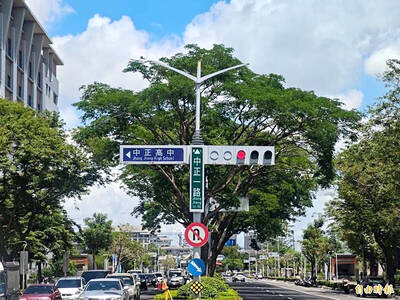
One of the most important gripes that Taiwanese have about the Democratic Progressive Party (DPP) is that it has failed to deliver concretely on higher wages, housing prices and other bread-and-butter issues. The parallel complaint is that the DPP cares only about glamor issues, such as removing markers of Chinese Nationalist Party (KMT) colonialism by renaming them, or what the KMT codes as “de-Sinification.” Once again, as a critical election looms, the DPP is presenting evidence for that charge. The KMT was quick to jump on the recent proposal of the Ministry of the Interior (MOI) to rename roads that symbolize

On the evening of June 1, Control Yuan Secretary-General Lee Chun-yi (李俊俋) apologized and resigned in disgrace. His crime was instructing his driver to use a Control Yuan vehicle to transport his dog to a pet grooming salon. The Control Yuan is the government branch that investigates, audits and impeaches government officials for, among other things, misuse of government funds, so his misuse of a government vehicle was highly inappropriate. If this story were told to anyone living in the golden era of swaggering gangsters, flashy nouveau riche businessmen, and corrupt “black gold” politics of the 1980s and 1990s, they would have laughed.

Imagine being able to visit a museum and examine up close thousand-year-old pottery, revel alone in jewelry from centuries past, or peer inside a Versace bag. Now London’s V&A has launched a revolutionary new exhibition space, where visitors can choose from some 250,000 objects, order something they want to spend time looking at and have it delivered to a room for a private viewing. Most museums have thousands of precious and historic items hidden away in their stores, which the public never gets to see or enjoy. But the V&A Storehouse, which opened on May 31 in a converted warehouse, has come up


 RSS
RSS