

Taiwan is gearing up for the nine-in-one elections tomorrow, which will not only determine the country’s local governance for the next four years, but also shape the landscape for the 2028 presidential race and the development of cross-strait relations.
The Taipei mayoral race has reflected the battles over policy direction and ideology among the major parties, as well as the differences in their election strategies and values.
Democratic Progressive Party (DPP) Legislator and Taipei mayoral candidate Puma Shen (沈伯洋) has stirred up a sensation with his campaign — officially called the “Taipei Current” (洋流) in English, also referred to as the “Ocean Wave,” as the third character in Shen’s name, yang (洋), means “ocean.” He has opted for rational and open discussions of campaign platforms, utilized technologies to engage in direct dialogues with the public, and abandoned negative campaign tactics and factional mobilization measures.
The “Taipei Current” is also transforming the DPP’s election strategy, and would likely gradually move electoral politics away from the traditional “confrontational” model.
On the other hand, the campaign of Taipei Mayor Chiang Wan-an (蔣萬安) of the Chinese Nationalist Party (KMT), who has more administrative experience and an advantage in the blue-leaning city, has resorted to accusations, verbal attacks and mudslinging.
For example, KMT candidates and supporters targeted female DPP candidates and politicians over being single or childless, sparking questions about the party’s equality stance.
Seeking cross-party support, Chiang campaigned with former Taiwan People’s Party (TPP) chairman Ko Wen-je (柯文哲) and TPP-leaning influencer Holger Chen (陳之漢), even though both are embroiled in judicial scandals. The move triggered public controversy over his disregard of judicial justice and sparked complaints within his own party.
Ironically, after the joint campaign, Ko called the KMT’s push for a NT$20,000 universal cash handout “cheating voters and draining the country’s coffers,” and said the concept of a blue-white alliance was wrong. That showed Chiang had traded social justice and party loyalty for election interests and that the two parties’ cooperation is fraught with political calculation and lacked mutual trust.
Taiwan’s election landscape has been relatively stable, with the north consistently dominated by the KMT and the south by the DPP. Tomorrow’s elections are a chance for voters to wisely use ballots to curb negative campaigning and break the traditional grip of parties in cities.
The elections have also been seen as a bellwether for the presidential election. They could be a mid-term examination of President William Lai (賴清德) and the ruling DPP, which suffered massive defeats in the 2022 local elections. They are also an assessment of the performance of the KMT and its alliance with the TPP, and the leadership of KMT Chairwoman Cheng Li-wun (鄭麗文), whose China-leaning cross-strait policies have been widely questioned. The elections would likely determine whether she could secure a ticket to the presidential race, or end up playing kingmaker for other contenders.
Ahead of the elections, the KMT-TPP alliance leveraged its legislative majority to pass populist bills in an attempt to court voters, such as a NT$20,000 universal cash handout and health insurance premium exemptions for elderly people. The bills have raised public concerns over their unconstitutionality and undermining of national fiscal discipline.
Furthermore, tomorrow would be a test of whether Taiwanese would likely yield to China’s coercion and inducements. National security agencies have found that Chinese interference in Taiwan’s local elections has become increasingly rampant and pervasive, an attempt by Beijing to surround the central government from the local level and influence the nation’s policies. Efforts include directly financing candidates, subsidizing the return of pro-China people to Taiwan to vote, channeling money through unregistered betting operations and using cognitive warfare to influence public opinion.
Over the past four months, more than 2,700 suspicious and fake social media accounts have been detected and reported by security agencies, the majority of which originated from China. They are suspected of fabricating and disseminating disinformation to campaign for or attack specific candidates, and eroding public trust in democracy.
A report to the US Congress last week by the US-China Economic and Security Review Commission warned that China is watching Taiwan’s local and presidential elections to gauge whether coercion and political pressure could move the nation toward unification, or if Taiwanese would persist in maintaining the “status quo” with democratic autonomy.
Taiwanese voters must show the nation’s democratic resilience and their determination to safeguard Taiwan’s sovereignty.
Beijing’s National Security Commission coordinates 50,000 to 100,000 Taiwanese informants via gray-zone tactics to alter elections through covert financing, criminal proxies, digital blackmail, and street intimidation. To secure the vote, this article proposes shifting from a top-down military model to a comprehensive Whole-of-Society Deterrence Framework. Central to this defense is a proposed Taiwanese Democratic Resilience and Whole-of-Society Omnibus Security Bill, turning open democratic systems into counterintelligence defenses against espionage and United Front Work Department (UFWD) operations. Below are key proposed gap fillers. The current Anti-Infiltration Act (反滲透法) is reactive, tracking illicit cross-strait capital only after distribution. This structural delay can leave
During a recent visit to Shenzhen, China, entrepreneur Elon Musk participated virtually in a technology summit held in the US. In his remarks, he expressed great admiration for China’s economic and technological development and stated that “probably at some point in the coming years, there will be some geopolitical bumps in the road over a certain country that starts with the letter T.” Although Musk did not explicitly name the country, his comment has been widely understood as referring to Taiwan. This was not the first time that Musk showed a poor understanding of relations across the Taiwan Strait. He previously
It was not immediately clear whether I was stepping into the past or the future when I got a peek at a computer that took up an entire room. As in quantum mechanics, it felt as if two possibilities could exist at once. At a research facility on the outskirts of Tokyo, I donned a hair net, blue plastic coverings over my shoes and a lab coat before entering an air-shower chamber to blast off residual dust. Then, I got to gawk at the massive collection of neatly organized cords, lasers housed in thick metal boxes and giant tanks of helium
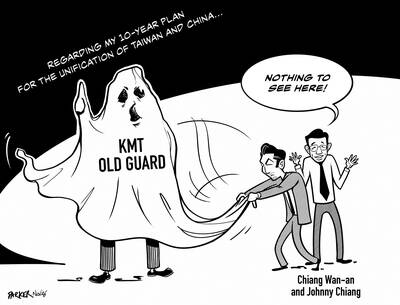
EDITORIAL CARTOON


 RSS