

I recently traveled to Shanghai, Beijing, Tokyo, and Taipei as part of an annual trip organized by the National Committee on American Foreign Policy. Across these cities, senior officials, policy advisors, and experts shared differing perspectives on the region’s future. One conclusion stood out: Taiwan enters the coming years from a position of growing strength. Taiwan’s economy is booming, public confidence is rising, and fears of an imminent military crisis appear to be lessening. Even so, Beijing remains committed to its long-term goal of unification across the Taiwan Strait and is gaining strength in pursuit of this objective. Taiwan therefore has
The Taipei mayoral race that was widely believed to be a hands-down win for the Chinese Nationalist Party (KMT) only a few months ago has taken a sudden turn. When Democratic Progressive Party (DPP) Legislator Puma Shen (沈伯洋), who is running in his first direct election, accepted his party’s nomination for Taipei mayor in May, his support trailed that of incumbent Taipei Mayor Chiang Wan-an (蔣萬安) of the KMT by nearly 30 percentage points, but recent polls have shown a much closer race. The first televised debate between Chiang and Shen was held on Oct. 31, giving voters a rare chance to
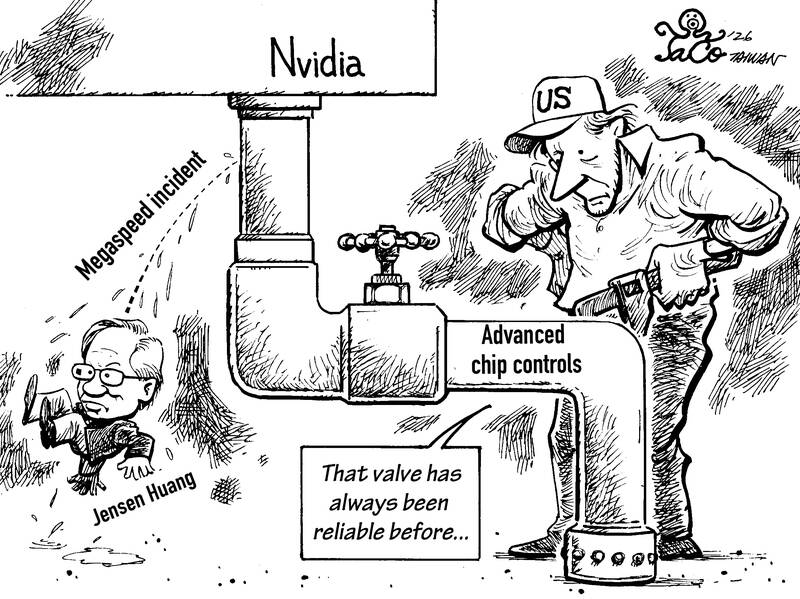
Nvidia Corp CEO Jensen Huang’s (黃仁勳) admission of having an extramarital affair has not only shaken his family, but placed the world’s most powerful artificial intelligence (AI) chipmaker in a crisis of trust. Taiwanese are familiar with Huang’s image as a tech celebrity who strolls through night markets signing autographs and taking pride in his deep ties to Taiwan’s semiconductor industry. However, now that Huang’s relationships have become entangled in suspicions of Chinese intelligence operations, Taiwan cannot let its admiration for him distract it from the more serious question: Just how many avenues is Beijing prepared to pursue to obtain
Today is the 160th anniversary of the birth of Republic of China (ROC) founder Sun Yat-sen (孫逸仙). The two sides of the Taiwan Strait intend to mark the day as if the other were trespassing. Beijing set up a preparatory office for the commemorations in November last year, under the Chinese People’s Political Consultative Conference, and has framed the anniversary around “national rejuvenation” and opposition to Taiwanese independence. Taipei has answered by telling people to stay home. Last month, the Mainland Affairs Council urged the public not to travel to China for the events, saying that attendance would “echo the Chinese communists’



 RSS