

For all the anxiety on Wall Street that too much money is being pumped into artificial intelligence (AI), one of the biggest beneficiaries of the boom is powering ahead.
New York is about 15 hours by air from Seoul, but economically they might as well be on different planets. There is little in South Korea’s data to suggest its AI-driven growth surge is about to run out of steam. That does not mean households are sharing equally in the good times, or that policymakers can ignore what comes next. Despite its remarkable strength, the expansion is strikingly uneven.
However, for now it is hard to miss. A key gauge of exports almost doubled last month from a year earlier; semiconductor shipments surged 260 percent, while computers posted a sixfold increase. Overseas customers are likely to buy more than US$1 trillion of South Korean goods this year, according to the South Korean central bank, making it only the fourth country, after the US, China and Germany, to cross that threshold. Even the won, long a source of worry, is Asia’s best-performing currency against the US dollar this year.
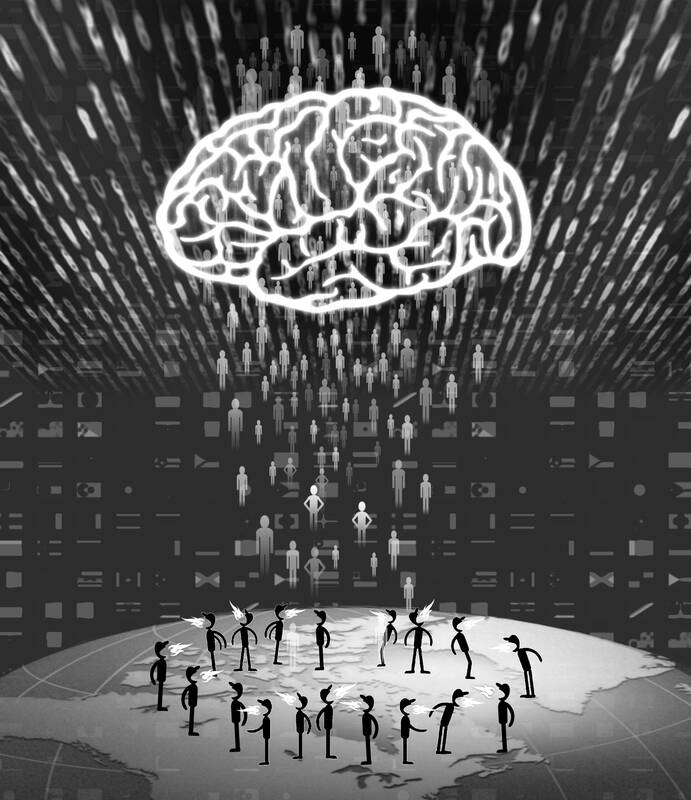
Illustration: Yusha
Forecasts for gross domestic product are being upgraded frequently, and Seoul was a standout in the IMF’s latest assessment of the global economy. Yet South Korea’s economic prowess has often struggled for attention beside the acclaim showered on its music, movies and food. If AI does nothing else, it has at least offered a competing narrative — one built around the country’s industrial and technological strengths.
Korea is not the only economy being lifted by AI. Chip demand has propelled growth in Taiwan, Singapore and Malaysia, while China has no shortage of technological ambition. Investors are increasingly sorting East Asia into AI winners and losers, and being an export powerhouse is no longer enough. Indonesia and the Philippines risk being left behind, while Thailand, with its niche in electronics, is likely to do what it often does: muddle through.
What sets Korea apart is that it is home to global leaders such as SK Hynix and Samsung, whose success is also fueling a domestic capital-spending surge. That gives the country something many of its neighbors lack: both exposure to the AI boom and companies capable of turning it into investment at home.
However, not everything is humming. Household consumption shrank last quarter even as GDP expanded faster than expected, and confidence among manufacturers is running well ahead of sentiment in other industries. Consumers are being held back by heavy debt burdens, a cooling of stock-market enthusiasm and an uneven labor-market recovery. Youth unemployment is rising. The benchmark Kospi index is still up a respectable 30 percent this year, but at one point its gains had reached 100 percent, and some of the subsequent daily swings have been jarring.
All booms have their discontents. Even the US economy of the 1990s, now generally remembered fondly, had its rough edges. The job market was slow to recover from the recession earlier that decade even as growth rebounded, helping cost former US president George H.W. Bush a second term. The expansion after the 2008 financial crisis became the longest in US history, yet was frequently criticized for failing to generate enough good jobs. Despite strong overall growth more recently, many Americans have soured on the economy — and last week voters evicted President Donald Trump’s Republicans from congressional control.
South Korea’s star turn deserves similar scrutiny. What long-term challenges might the AI rally be obscuring? Demographic constraints, for one, have not gone away. South Korea’s fertility rate remains among the lowest in the industrialized world, below even Japan’s. The consequences are already visible next door. The Bank of Japan last week warned that a contracting population would make it increasingly difficult to sustain robust growth in consumer spending. South Korea might eventually confront the same obstacle.
Another challenge might be coming from its giant neighbor. Advances in Chinese production of batteries, ships and petrochemicals are eroding Korea’s traditional advantages, Capital Economics said.
When the AI boom does fizzle, whether months or years from now, Seoul would fall back on industries where its competitive edge is already narrowing. Job losses would surely follow. The country’s time in the sun is both deserved and fortuitous. The boom depends more on global demand than on developments at home. That is hardly a criticism: South Korea spent decades building itself into an export powerhouse precisely so it could capitalize on moments like this.
However, watch those being left behind. Bong Joon-ho’s Oscar-winning 2019 movie Parasite depicted a family of grifters struggling to make it and ingratiating themselves with the rich house of tech executive. Nobody emerges particularly well. Beneath the dark comedy was a story about the gulf between those prospering in modern Korea and those fighting to get by.
Today’s AI boom is impressive, but the more lopsided it becomes, the more important it is to ask what happens when the party ends. How long before “Korea shock” becomes a household word?
Daniel Moss is a Bloomberg Opinion columnist covering Asian economies. Previously, he was executive editor for economics at Bloomberg News. This column reflects the personal views of the author and does not necessarily reflect the opinion of the editorial board or Bloomberg LP and its owners.
I recently traveled to Shanghai, Beijing, Tokyo, and Taipei as part of an annual trip organized by the National Committee on American Foreign Policy. Across these cities, senior officials, policy advisors, and experts shared differing perspectives on the region’s future. One conclusion stood out: Taiwan enters the coming years from a position of growing strength. Taiwan’s economy is booming, public confidence is rising, and fears of an imminent military crisis appear to be lessening. Even so, Beijing remains committed to its long-term goal of unification across the Taiwan Strait and is gaining strength in pursuit of this objective. Taiwan therefore has
There are a number of Chinese Nationalist Party (KMT) politicians who still seem to be at a loss as to why the more noise they make about unification and being “one family” across the Taiwan Strait, the harder it is to gain the support of young voters. Perhaps they believe that these professions of affinity for China tap into historical sentiment and demonstrate sincerity in seeking cross-strait peace. However, they fail to see the shifts that have taken place in Taiwanese society through democratization and generational changes. Their rhetoric is not only failing to bring the two sides of the
When I first arrived in Taoyuan’s Jhongli District (中壢) for university, I was struck by the scene outside the front entrance of the main railway station. The streets were lined with signs in Vietnamese, Indonesian and Thai, and authentic Southeast Asian eateries and grocery stores stood alongside a number of jewelry stores. On weekends, migrant workers would gather there to shop and spend time with friends. It was the first time I had witnessed how deeply foreign cultures could shape a place. When talking about migrant workers with classmates and friends, many mention liking the different cuisines and recognize how they
The Taipei mayoral race that was widely believed to be a hands-down win for the Chinese Nationalist Party (KMT) only a few months ago has taken a sudden turn. When Democratic Progressive Party (DPP) Legislator Puma Shen (沈伯洋), who is running in his first direct election, accepted his party’s nomination for Taipei mayor in May, his support trailed that of incumbent Taipei Mayor Chiang Wan-an (蔣萬安) of the KMT by nearly 30 percentage points, but recent polls have shown a much closer race. The first televised debate between Chiang and Shen was held on Oct. 31, giving voters a rare chance to


 RSS