

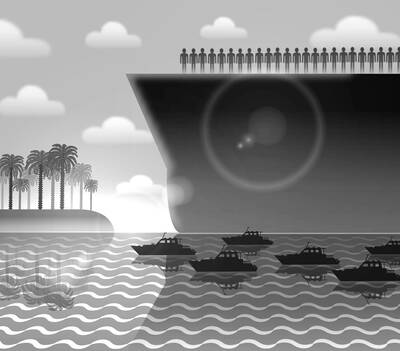
There was a moment, in 2015 or 2016, when Tulum was the coolest town on Earth. Every fashion magazine seemed to billboard the beach retreat on Mexico’s turquoise-water Caribbean coast as a mecca for global trendsetters. “Tulum style” came to describe a distinctive aesthetic — flowing fabrics, linen and crochet, neutral colors, bare feet, traditional craftsmanship — that blended rustic-chic, environmentalist and free-spirit ideals into the boho-luxe look of the moment. This effervescence bubbled to a peak in July 2018, when Vogue put modeling queen Gisele Bundchen on its cover, photographed in Tulum’s tropical forest in a printed floral Ralph

High-tech manufacturing in India, backed by billions of dollars in government subsidies, has attracted cheerleaders and critics. Optimists point to Apple Inc’s decision to build an alternative supply chain to hedge against China. A quarter of all iPhones now roll out of factories near Chennai, employing tens of thousands. Skeptics counter that much of this manufacturing is mere final assembly — screwdriver work that adds little value. The fact that a much smaller economy such as Vietnam exports more merchandise shows that Indian Prime Minister Narendra Modi’s “Make in India” initiative remains more hype than reality, they said. One way to settle
Taiwan heads to the polls next month for local elections. Beneath the campaign ads lies a deeper question: What do we call this place and who gets to decide? In the pages of the Oxford English Dictionary (OED), that question has been playing out across three centuries. The entries for “Formosa” and “Taiwan” chart an island’s journey from colonial fantasy to self-named reality. Names are rarely neutral; they are the first act of possession. Nowhere is this more evident than in the OED, where the two entries serve as a linguistic seismograph for one of the world’s most enduring geopolitical fault lines.
Only 107,812 babies were born in Taiwan last year, barely half the number recorded in 2016. The nation is now a super-aged society, with more than one-fifth of its population aged 65 or older. The National Development Council forecast that the population could fall from an estimated 23.2 million this year to just 12.1 million in 2075. The decline in the working-age population would be even more severe. The number of people aged 15 to 64 is projected to plunge from an estimated 15.8 million this year to 5.1 million by 2075, a reduction of about 67 percent. By then, people




 RSS