

Chinese Nationalist Party (KMT) Kaohsiung mayoral candidate Ko Chih-en (柯志恩) has run into a problem for which she has only herself to blame.
On Saturday last week, Legislative Speaker Han Kuo-yu (韓國瑜) appeared at her campaign rally in Kaohsiung. While he might have been expected to warm up the crowd and rally some support for Ko, Han instead used his speaking time to make suggestions such as building “a great wall” between Kaohsiung and Tainan, supposedly cutting the two cities off.
He also reiterated a policy proposal to build a “Love Ferris Wheel” from his time as Kaohsiung mayor eight years ago. It was Ko, in the end, who was left to clean up the mess.
At the Double Ten National Day celebrations, Han called for differences to be reconciled and efforts to be united; just seven days later, he started talking about building a wall. Why would a city that is valued precisely because of the air and sea transport links connecting it with the rest of the world suddenly decide to isolate itself from its neighbor?
The next day, Ko attempted to explain that Han was simply emphasizing that Kaohsiung’s self-sufficiency and economic might were enough to bring surrounding areas such as Tainan and Pingtung into the fold, in line with the spirit of 2019’s “Great South” policy agenda.
However, cutting off cities and codevelopment are clearly two very different directions. If we are to buy Ko’s reasoning, Chinese emperor Qin Shi Huang (秦始皇) must have also intended the Great Wall of China to be a collaborative project in nature.
As for the Love Ferris Wheel, Han’s fixation is unusually persistent. He was adamant about it being built during his time in office, and the city government even held investment briefings, looked for a site and discussed construction.
Eight years later, he is still bringing it up on someone else’s campaign trail; the Ferris wheel might only be turning in Han’s mind, and he certainly does not seem to be able to get off. Voters might have come out to hear how Ko would govern Kaohsiung, but they first had to endure a rehash of Han’s old dreams.
Ko said that Han was not actually suggesting that a Ferris wheel should be built, but that commercial districts should develop a distinctive character. Perhaps the city government’s efforts in 2019 were also in pursuit of a metaphor. From Han’s initial insistence to Ko’s abstraction of the issue, a development promise from eight years ago has now become a lesson in spin.
So, the Ferris wheel is metaphorical and great walls promote codevelopment. Is Ko running for mayor, or simply cleaning up after Han? She seems to be managing to not only edit his work, but imbue a deeper meaning into his words with her explanations.
When a candidate invites someone to campaign on their behalf, the hope is that the guest might help persuade voters. However, this was a case of Han making grand pronouncements and Ko dealing with the aftermath; Han’s ramblings had to be explained away before she could even get to her own policies.
For voters, what Han hoped to achieve might not be entirely clear to see, but the mess he left Ko to clean up certainly is.
Chang Shang-yang is a farmer.
Translated by Gilda Knox Streader
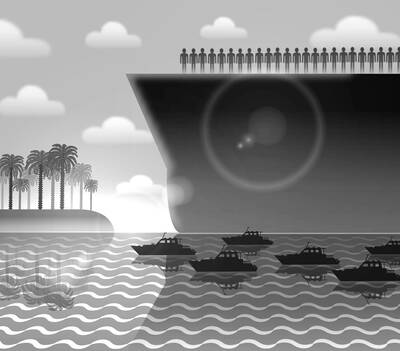
The most troubling message coming out of Washington for Taipei is not any single statement but the cumulative effect of a series of signals suggesting that US President Donald Trump is rethinking Taiwan’s strategic value while viewing the US-China relationship through the lens of a transactional great-power bargain. The danger behind Trump’s new softness toward Beijing is a potential US-China bargain that undermines Taiwan’s core interests. During Chinese President Xi Jinping’s (習近平) recent state visit to Washington, Trump and Xi appeared to rewrite the history of World War II. In a Sept. 25 fact sheet on Xi’s visit, the White House said,
The official English name for Democratic Progressive Party (DPP) Legislator and Taipei mayoral candidate Puma Shen’s (沈伯洋) campaign is “the Taipei Current.” It comes from the Chinese term yangliu (洋流), a direct translation of which would be “ocean current,” using the last character of Shen’s name, yang (洋, “ocean”). The Chinese term is a reference to the 2018 campaign for Kaohsiung mayor that swept to power a hitherto marginal player within the Chinese Nationalist Party (KMT), Han Kuo-yu (韓國瑜), now legislative speaker, whose successful campaign then was termed the “Han Wave” (韓流). Shen’s usage of the Chinese term is intentional.
There was a moment, in 2015 or 2016, when Tulum was the coolest town on Earth. Every fashion magazine seemed to billboard the beach retreat on Mexico’s turquoise-water Caribbean coast as a mecca for global trendsetters. “Tulum style” came to describe a distinctive aesthetic — flowing fabrics, linen and crochet, neutral colors, bare feet, traditional craftsmanship — that blended rustic-chic, environmentalist and free-spirit ideals into the boho-luxe look of the moment. This effervescence bubbled to a peak in July 2018, when Vogue put modeling queen Gisele Bundchen on its cover, photographed in Tulum’s tropical forest in a printed floral Ralph
Early this month, the Chinese Nationalist Party (KMT) held two large election campaign rallies in Taichung and New Taipei City on the same day. However, KMT Chairwoman Cheng Li-wun (鄭麗文) was marginalized at the rallies. Cheng shouted herself hoarse campaigning onstage for the mayoral candidates, but neither candidate was onstage at the time. In the morning of that day, the KMT’s Taichung mayoral candidate, Deputy Legislative Speaker Johnny Chiang (江啟臣), entered the venue accompanied by Legislative Speaker Han Kuo-yu (韓國瑜), Taichung Mayor Lu Shiow-yen (盧秀燕) and New Taipei City Mayor Hou You-yi (侯友宜). That afternoon, the party’s New Taipei City


 RSS