

China’s “united front” tactics against Taiwan have long gone beyond slogans and propaganda, gradually extending into identity, the economy and everyday life.
Recent media reports said that some people in Taiwan are suspected of acting as intermediaries, urging other Taiwanese to travel to China to apply for IDs. While such activities are ostensibly packaged as convenient services, in practice, they might be using the IDs to gradually draw Taiwanese into China’s governance.
Once an issue involves organized recruitment, repeated assistance with applications, or direction or exploitation by foreign forces, it is no longer simply a matter of cross-strait exchange — it is a warning sign that Taiwan’s national security defenses must be taken seriously.
Under Article 9-1 of the Act Governing Relations Between the People of the Taiwan Area and the Mainland Area (臺灣地區與大陸地區人民關係條例), people of the Taiwan Area are prohibited from establishing a household registration in China or obtaining a Chinese passport. The Mainland Affairs Council has made it clear that Chinese ID cards and permanent resident certificates are subject to regulations governing household registration in China. Those who contravene these rules might lose their status as residents of Taiwan and the rights that come with it.
Since the legal red lines have long been clearly established, no one should be allowed to exploit gaps in public knowledge by packaging something with such severe legal consequences as a “document application service” or a “business convenience.” This raises concerns about the involvement of organized recruitment, exchanges of benefits or foreign intervention. If those being recruited include active-duty military or law enforcement personnel, civil servants, defense technology workers or others in sensitive fields, this issue cannot simply be treated as an individual choice regarding one’s identity. When one’s identity is intertwined with public authority, classified information and key positions, a personal risk can become a major vulnerability for the system.
Furthermore, national security defenses cannot wait until classified information has been leaked or an organized network has already taken shape before scrambling to patch the gaps. Any organized solicitation or agency work should not be investigated merely by asking whether it is a “private activity,” but by tracing who is providing the funding, resources and directives behind it. Only then can Taiwan ensure normal cross-strait exchanges while safeguarding national security.
An ID card might appear to be a personal choice, but behind it lie questions of identity verification, legal jurisdiction and national security. What needs to be severed is not normal exchanges between people on both sides of the Taiwan Strait, but local networks that exploit Taiwan’s openness and freedom to build bridges and clear a path for foreign infiltration from within.
Yeh Yu-cheng is a secretary at the Pingtung County Public Health Bureau.
Translated by Kyra Gustavsen

Taiwan’s democracy and high-tech economy play a crucial role in global affairs and are central to the world’s embrace of a raft of next-generation technologies, including AI. It is underpinned by a security relationship with the United States that’s existed in several iterations since 1949 and the Chinese Nationalist Party’s (KMT) retreat from China. A central pillar of that security relationship is the American willingness to sell arms to Taiwan. Indeed, since 1979 it has been embedded in US law, with the Taiwan Relations Act (TRA) charging the US with helping to improve the island’s ability to deter an attack from
Academia Historica director Chen Tsui-lien (陳翠蓮), speaking at the handover ceremony for her new role on Monday, said that when she accepted the position, she knew that her peaceful life as a history professor was a thing of the past, and that from now on she would have to “wear a helmet.” A specialist in Taiwan’s post-World War II history and the 228 Incident, she has been accused of being politically divisive. A phrase she used in her acceptance speech set headlines alight this week, putting her in the sights of editorials in blue-leaning media. She said opposition figures calling for
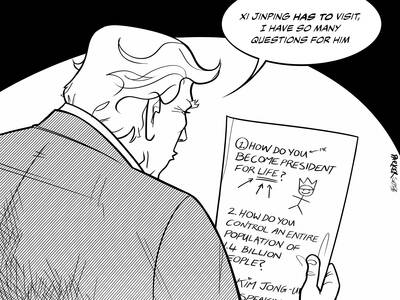
EDITORIAL CARTOON
When Panama severed diplomatic relations with Taiwan and recognized China in 2017, Beijing achieved one of its most important diplomatic victories in Central America. However, nearly a decade later, Panama is demonstrating that diplomatic recognition does not necessarily eliminate Taiwan from a country’s political system. Panama and Taiwan had diplomatic relations for more than 100 years and the goodwill between the countries was displayed last week when Panama’s National Assembly established an interparliamentary exchange group with the Legislative Yuan. Forty-five of the assembly’s 71 lawmakers joined the group, representing more than 60 percent of the legislature. Its members include National Assembly President Shirley


 RSS