

With campaigns for the Nov. 28 nine-in-one elections in full swing, former Financial Times Taiwan correspondent Kathrin Hille’s statement in an interview last month that “all the votes are bought” in Hualien County has sparked concern over the elections and cast a shadow over Taiwan’s democracy.
Hille, who moved to Hualien after she retired, recounted instances of neighbors mentioning who came by and put cash on the table, and said that despite Taiwan’s long-established democracy, vote buying remains common practice in the county.
Taipei Times columnist and former American Chamber of Commerce president Courtney Donovan Smith shared a similar experience: A Chinese Nationalist Party (KMT) politician he was working for in Changhua County years ago openly admitted to using cash to “buy votes.”
Taiwan’s democratization after the lifting of martial law in 1987 has widely won international acclaim. Taiwan has been named by the Democracy Index a “full democracy,” and has served as a model of a robust and well-functioning democratic system.
Taiwan also stipulates higher legislative penalties for electoral bribery than most mature democracies. Under the Public Official Election and Recall Act (公職人員選罷法) and the Criminal Code, vote buyers could be fined a maximum of NT$10 million (US$314,663) and imprisoned for three to 10 years. That is higher than the US’ maximum two-year prison sentence, Japan’s three years and Germany’s five years.
However, electoral bribery cases continue in Taiwan.
Among the 5,218 people prosecuted from 2016 to last year for contravening the election and recall law, more than 91 percent were convicted of vote bribery, data from the Supreme Prosecutors’ Office and the Ministry of Justice showed.
In the 2022 local elections, the victories of more than 180 officials and councilors were invalidated after they were convicted of vote buying.
Vote buying has been a long and systemic issue in Taiwan, intertwined with political and local factions, traditional social customs, economic inequality and enormous post-election interests. Local politics has long relied on networks of kinship, factions, religious organizations, hometown associations and “voter broker.” Politicians utilize those networks to disguise vote buying as personal relationships and daily interactions, such as attending weddings and funerals, or giving gifts. Those have all blurred the lines between legality and bribery.
Hualien has long faced an electoral bribery problem, evidenced by the high number of electoral investigations and convictions. A bribery case in 2018 involving a single vote purchase of NT$10,000, as well as a major crackdown during the 2022 local elections that searched 72 locations, summoned 147 people, detained seven offenders and seized more than NT$620,000 in bribes are a few examples.
The Changhua District Prosecutors’ Office said that it has already received more than 100 reports of suspected election bribery, including at least 10 cases involving vote buying with cash.
Even Changhua County Council Speaker Hsieh Dien-lin (謝典霖) and his parents were investigated and detained last week after they were accused of vote buying — a feast in June and gifts worth more than US$1,000 — and using the council’s funds to pay for the feast.
Another issue is escalating electoral interference from China, which has been offering free trips, financial incentives and political benefits to Taiwanese, and spreading disinformation. Such interference pose a threat to Taiwan’s security and democracy, and has been a significant challenge for many Western and Asian democracies.
On the eve of the 2024 presidential and legislative elections, the Supreme Prosecutors’ Office said there were 117 cases of people contravening the Anti-Infiltration Act (反滲透法), resulting in the prosecution of 287 people. Fewer cases were reported during the 2020 elections, making it clear that China’s electoral interventions have evolved and are now sweeping in.
To eliminate electoral bribery, the government has raised the reward for whistle-blowers to NT$15 million. However, the judicial authority also needs to improve law enforcement. Current legislation does not fully disqualify convicted vote buyers from seeking re-election, so civic groups are calling for greater transparency regarding electoral cases and convicts, so that voters are aware of candidates’ criminal records and election histories.
The most important, but also the most challenging, task is to raise the public’s awareness of electoral bribery. Taiwanese must understand the value of their votes and share in the responsibility of safeguarding the election’s fairness and justice. The concept behind vote buying deterrence should transform from “passively abiding by the law” to “actively defending Taiwan’s democracy.”

Taiwan’s democracy and high-tech economy play a crucial role in global affairs and are central to the world’s embrace of a raft of next-generation technologies, including AI. It is underpinned by a security relationship with the United States that’s existed in several iterations since 1949 and the Chinese Nationalist Party’s (KMT) retreat from China. A central pillar of that security relationship is the American willingness to sell arms to Taiwan. Indeed, since 1979 it has been embedded in US law, with the Taiwan Relations Act (TRA) charging the US with helping to improve the island’s ability to deter an attack from
Academia Historica director Chen Tsui-lien (陳翠蓮), speaking at the handover ceremony for her new role on Monday, said that when she accepted the position, she knew that her peaceful life as a history professor was a thing of the past, and that from now on she would have to “wear a helmet.” A specialist in Taiwan’s post-World War II history and the 228 Incident, she has been accused of being politically divisive. A phrase she used in her acceptance speech set headlines alight this week, putting her in the sights of editorials in blue-leaning media. She said opposition figures calling for
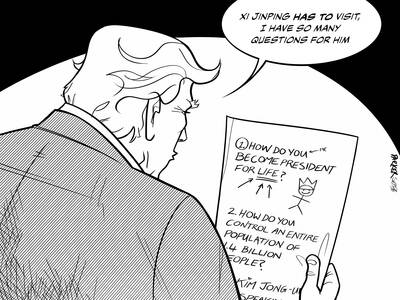
EDITORIAL CARTOON
When Panama severed diplomatic relations with Taiwan and recognized China in 2017, Beijing achieved one of its most important diplomatic victories in Central America. However, nearly a decade later, Panama is demonstrating that diplomatic recognition does not necessarily eliminate Taiwan from a country’s political system. Panama and Taiwan had diplomatic relations for more than 100 years and the goodwill between the countries was displayed last week when Panama’s National Assembly established an interparliamentary exchange group with the Legislative Yuan. Forty-five of the assembly’s 71 lawmakers joined the group, representing more than 60 percent of the legislature. Its members include National Assembly President Shirley


 RSS
RSS