

It is October 2030. In hindsight, the vulnerabilities that triggered the third great natural gas crisis in eight years seem painfully obvious.
After Russia’s invasion of Ukraine cut off Europe from two-fifths of its gas in 2022, importers reassured themselves that the Persian Gulf and the US had plenty to spare.
When the war with Iran similarly knocked out 20 percent of the global liquefied natural gas (LNG) supply, the US’ booming fossil-fuel industry again promised to fill the gap.
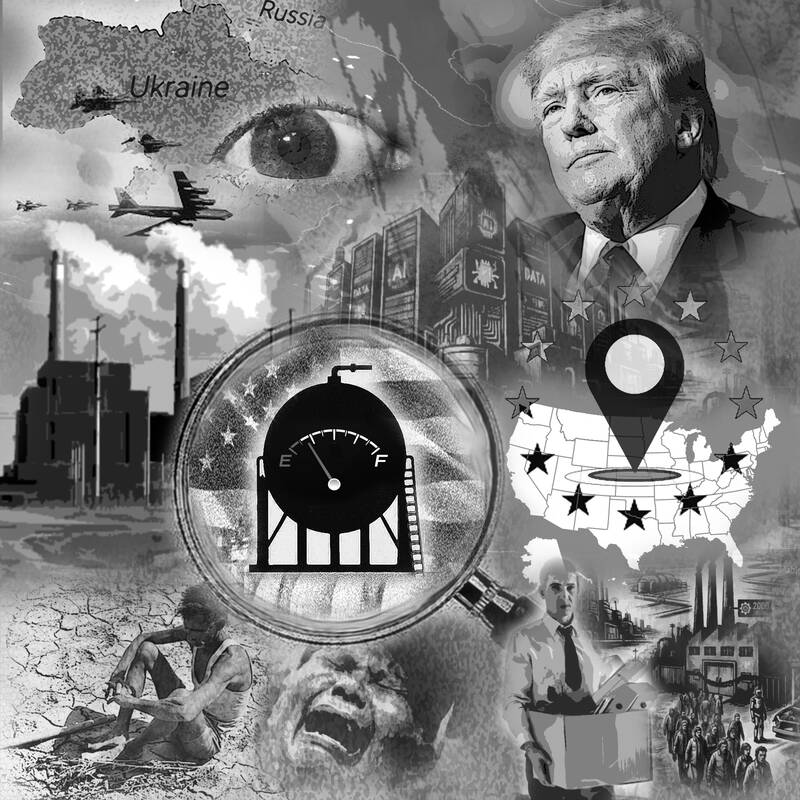
Illustration: Kevin Sheu
That confidence now seems shockingly naive. US natural gas prices have been caught in a perfect storm: Growth in shale output has been faltering. Season upon season of extreme weather has hit a power sector crippled by former US president Donald Trump’s war on clean energy. Frontier artificial intelligence (AI) labs, racing to beat a technological singularity they are warning is finally just months away, are sucking up fossil fuels to power data centers. Meanwhile, LNG terminals are allowing foreign buyers to compete with the US’ habituated to rock-bottom prices.
With storage tanks at record lows amid a polar vortex cold snap in February, US benchmark Henry Hub prices rose above US$10 per million British thermal units for the first time since 2008. Summer heatwaves repeatedly drove them back there. The ripples spread quickly through the economy.
In Iowa, a tripling in the price of gas-derived fertilizer caused farmers to plant their smallest spring corn crop in two decades. In June, China’s Fuyao Glass Industry Group Co blamed gas prices in announcing the closure of an iconic glass factory outside Dayton, Ohio, with the loss of 2,000 jobs. A month later, Ford Motor Co eliminated the second shift at its Wayne, Michigan, assembly line, citing rising energy and supply chain costs. Another 2,000 workers were put on indefinite layoff.
What began as an energy shock was becoming a political hot potato. Much as how a backlash against data centers erupted from nowhere, calls to “keep American energy for Americans” quickly became deafening. With midterms approaching, Democratic lawmakers in the northeast who had long sought restrictions on LNG exports found unlikely allies among Republicans watching one of the country’s great competitive advantages — cheap energy — disappear.
Then came July’s heat dome. New Orleans recorded 70 heat-related deaths. Many were suburban retirees who had switched off air conditioners as electricity bills devoured half of their Social Security payments.
On the day a new poll showed Louisiana Republican gas-export advocate Steve Scalise trailing a populist primary challenger by 11 points, Fox News broadcast footage of four LNG tankers departing the Gulf Coast bound for China.
Within days, protestors carrying “It’s OUR gas” placards were outside Congress.
After demurring for weeks, the president signed the bipartisan Secure American Fuel for Everyone Act, declaring a gas supply emergency and ordering the Department of Energy to curtail exports within 30 days.
That is when all hell broke loose. European gas storage was already running dangerously low after the same torrid El Nino summer, leaving importers heavily dependent on US shipments. Japan and South Korea were even more exposed. After a bruising trade fight with Washington, both had restricted Chinese clean-energy imports in return for preferential access to US LNG. That slowed deployment of the technologies that might have insulated them from the crisis.
Russia was in no position to come to the rescue. Eight years of war in Ukraine, an economy approaching Venezuela-style degeneration and incessant hybrid-warfare attacks on its petroleum infrastructure had decimated its capacity to respond.
The situation in the Gulf offered little reassurance. Relations between Qatar and Iran’s increasingly lawless government were deteriorating over the management of their vast shared offshore gas field, threatening the uneasy truce in Hormuz brokered after the 2028 US election. Then Iran’s Revolutionary Guards boarded a QatarEnergy LNG tanker and turned it back.
Australia offered no respite either. The world’s biggest LNG exporter as recently as 2022 had imposed US-style export restrictions to shield domestic supplies.
How did the world fail to see what seems so inevitable now? It was hardly unprecedented. In the 1970s, the US banned exports of soybeans and crude oil to protect consumers from rising prices. The oil ban lasted four decades before being lifted in 2015, sparking a production boom that eventually hardened into hubris about a new era of US energy dominance.
The mistake was to believe the petroleum industry’s bromides about the stability of LNG — what Shell PLC described as the fuel’s “flexible and reliable energy security.” The poorer Asian countries hit hardest by the 2022 and 2026 crises look best-placed right now. Rather than betting their power systems on a fuel for which rich countries could always outbid them, countries from Pakistan to the Philippines accelerated investment in solar, batteries and domestic energy.
In contrast, developed Asia and Europe conflated flexibility with security, and were slower to pivot. That was a disastrous choice. LNG can be shipped halfway around the world, but Russia, Qatar and the US each demonstrated how quickly politics can disrupt those flows.
After three gas crises in eight years, perhaps the remarkable thing is not that countries are finally learning this. It is that anyone still needed the lesson.
David Fickling is a Bloomberg Opinion columnist covering climate change and energy. Previously, he worked for Bloomberg News, the Wall Street Journal and the Financial Times. This column reflects the personal views of the author and does not necessarily reflect the opinion of the editorial board or Bloomberg LP and its owners.
At the 18th BRICS Summit in New Delhi, people will remember less what China achieved and more what the global south attained. China did not lose face: President Xi Jinping (習近平) was an honored guest in India, was endorsed as the chair of BRICS for next year, and China is to host the next summit. Yet the carefully crafted 140-paragraph New Delhi Declaration (NDD), the longest BRICS declaration so far, reveals a subtle, but important shift. BRICS is moving from a loose grouping toward a more substantive platform for the global south, giving developing countries greater voice and bargaining space
As of the end of last month, Taiwan had a total population of 23,224,721, declining for the 32nd consecutive month, the latest household registration data released on Thursday by the Ministry of the Interior showed. The figure was down 103,622 from a year earlier — or an average decline of 283.9 per day — and 10,281 from the previous month. Last month, Taiwan recorded 7,492 births — averaging about one baby every 6 minutes — dropping by 972 from the same month last year and 414 from July. From January to last month, the number of newborns was 61,742, decreasing by
Taiwanese-Americans, lawmakers and civic groups marched through Manhattan on Saturday last week in support of Taiwan’s participation in the UN. Marshall Islands Permanent Representative to the UN John Silk joined the demonstration, saying he hoped Taiwan would one day be able to participate in UN meetings as a member, and Democratic Progressive Party Legislator Wang Yi-chuan (王義川) took part while visiting New York City with a delegation. Taiwanese communities in Vancouver held a “UN for Taiwan” event. The campaign comes as the 81st UN General Assembly gets under way. In Taipei, President William Lai (賴清德) said China was deliberately misinterpreting UN
Taipei has seen successive incidents involving the shirking of responsibility in recent years. The first involves city police repeatedly failing to crack down on drug trafficking, only to realize that former Taipei mayor Ko Wen-je’s (柯文哲) administration had made public detailed data on all municipal vehicles — including the license plate numbers, makes and models of police vehicles — allowing drug dealers to use artificial intelligence (AI) to cross-reference the data and conduct countersurveillance. The second involves the controversy over Taipei Mayor Chiang Wan-an’s (蔣萬安) eldest son being selected for a Taipei City Government-funded international student exchange program to


 RSS
RSS