

China often leans into its “developing country” status, portraying itself as a defender of the global south’s interests and cultivating a close alliance with the Group of 77, which includes 134 countries from Africa, Asia, Latin America and the Caribbean. However, some have questioned whether China’s efforts to lead the global south are less about shattering the “status quo” and more about consolidating its power as the US disengages from the international system it built.
Determining China’s motivations requires a deeper understanding of its rivalry with the US. In 1820, Qing Dynasty China was the world’s largest economy, accounting for nearly one-third of world GDP in purchasing-power-parity terms, while the US economy was one-10th the size of the British Empire’s.
Then came China’s “century of humiliation.” While large parts of China were occupied by Western powers and Japan, the US economy grew at an extraordinary rate, becoming the world’s largest by 1903. In the wake of World War II, the US consolidated its economic hegemony by playing a central role in establishing the UN, the Bretton Woods institutions, and the General Agreement on Tariffs and Trade, the precursor to the WTO.
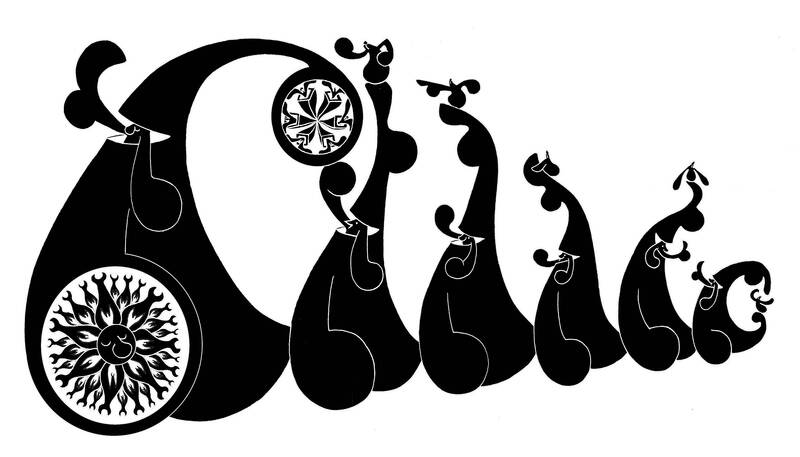
Illustration: Mountain People
In 1978, Deng Xiaoping (鄧小平) sought to reclaim China’s lost glory through his visionary economic reforms. By 2010, China’s economy had become the world’s second-largest (after the US) and, as of 2024, its share of global manufacturing had risen to more than 30 percent, while the US’ had declined to 15 percent, down from more than 50 percent in 1945.
This reversal of fortunes set the stage for the two countries’ ongoing trade war, which began when the US imposed tariffs on select Chinese goods in 2018 and left the WTO’s Appellate Body inquorate and unable to resolve disputes.
As a result, China’s trade surplus with the US fell from a peak of US$400 billion in 2018 to about US$200 billion last year, although many Chinese exports still reach the US through third countries such as Mexico and Canada. China has since accelerated its pivot to self-sufficiency, which includes developing resilient supply chains for critical technologies such as semiconductors, and weaponized its dominance in rare earths.
The general consensus within Chinese leadership circles is that “the East is rising and the West is declining,” as Chinese President Xi Jinping (習近平) famously declared in 2021, and that the US, suffering from “hegemonic anxiety,” is lashing out against its main rival.
However, the US’ decline should not be overstated. Despite its huge national debt, which surpassed US$40 trillion, and despite representing only 4 percent of the global population, the US, with a nominal GDP of about US$32 trillion, remains the world’s largest economy. Moreover, the US dollar has retained its dominance, accounting for about half of international payments.
The US is an overextended hegemon, and its decline would continue slowly, as other powers such as China assume more global responsibilities, but the US retains its hard and soft power. About 165,000 US military personnel are deployed in 178 countries. The US is home to 35 of the world’s top-ranked 100 universities and remains the top destination for immigrants. Tellingly, 55 percent of the US’ billion-dollar start-ups had at least one foreign-born founder. China, by contrast, is an extraordinarily homogenous and closed society.
The biggest battle between the US and China is for artificial intelligence (AI) supremacy. The two countries account for 90 percent of the world’s frontier computing power, implying that the winner of the AI race would gain an unassailable technological lead. China is quickly catching up, focusing on affordable models. This reflects the Chinese government’s growing emphasis on basic science: Its spending on research and development surpassed the US’ in 2024, while Chinese scholars published as many papers as American, British, German, and Japanese researchers combined last year.
Meanwhile, China has shown that it cannot be a credible leader of the global south. Rather, it is a reliable, if hardheaded, trading partner that pursues its own interests. The country’s cheap textile exports led to job losses across Africa, while its free-trade agreements with Chile and Peru have been criticized as extractive and contributing to deindustrialization. Equally important, China has been reluctant to transfer technology — especially the clean tech that has been a powerful driver of economic growth — to the global south.
In short, China is happy to preserve the “status quo.” At the US-China summit in May, officials eagerly sought US acknowledgment of China’s superpower status — more than they have ever sought global south approval. When the US intervened in Venezuela and, together with Israel, attacked Iran, China’s response was muted, seemingly because the country was more interested in avoiding a direct military confrontation with the US than in supporting its reliable oil suppliers (and, in the case of Iran, a BRICS+ member).
China also failed to veto a UN Security Council resolution condemning Iran’s attacks on Gulf countries. Still, many in the Global South see the sharp contrast between China and the US, which has vetoed at least 53 UN Security Council resolutions critical of Israel since 1972.
Under Xi’s leadership, Chinese diplomats have become “wolf warriors” who use aggressive tactics, including the threat of boycotts, to defend China’s interests. For example, senior African and Jamaican diplomats said that China threatened Zambia and Jamaica with aid cuts to secure the removal of their permanent representatives at the UN, who were championing Security Council reforms. Such crude bullying tends to alienate potential allies and betrays an extraordinary lack of understanding of how to wield soft power.
To be sure, the global south hopes to emulate certain elements of China’s rise, particularly its technological innovation and its success in lifting nearly 800 million people out of extreme poverty. However, China is ultimately a “status quo” superpower more concerned with the repression of dissent at home and the protection of its own interests abroad than with leading the development of an international system that works for all countries.
Adekeye Adebajo, a professor and a senior research fellow at the University of Pretoria’s Centre for the Advancement of Scholarship, is the editor of The Black Atlantic’s Triple Burden: Slavery, Colonialism, and Reparations.
Copyright: Project Syndicate
Taiwan’s democracy and high-tech economy play a crucial role in global affairs and are central to the world’s embrace of a raft of next-generation technologies, including AI. It is underpinned by a security relationship with the United States that’s existed in several iterations since 1949 and the Chinese Nationalist Party’s (KMT) retreat from China. A central pillar of that security relationship is the American willingness to sell arms to Taiwan. Indeed, since 1979 it has been embedded in US law, with the Taiwan Relations Act (TRA) charging the US with helping to improve the island’s ability to deter an attack from
When Panama severed diplomatic relations with Taiwan and recognized China in 2017, Beijing achieved one of its most important diplomatic victories in Central America. However, nearly a decade later, Panama is demonstrating that diplomatic recognition does not necessarily eliminate Taiwan from a country’s political system. Panama and Taiwan had diplomatic relations for more than 100 years and the goodwill between the countries was displayed last week when Panama’s National Assembly established an interparliamentary exchange group with the Legislative Yuan. Forty-five of the assembly’s 71 lawmakers joined the group, representing more than 60 percent of the legislature. Its members include National Assembly President Shirley
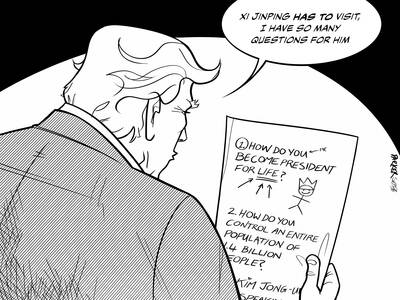
EDITORIAL CARTOON
Ten years ago, when I was an undergraduate at National Chung Hsing University (NCHU), there was a referendum on whether to remove a statue of Chiang Kai-shek (蔣介石) from the campus. I wrote to the Liberty Times (the Taipei Times’ sister newspaper) urging faculty, staff and students to vote for its removal. Eventually, the statue was removed from the university. Today, I am filled with emotion at seeing students at Soochow University democratically remove their own statue of Chiang, a figure of authoritarian rule, after it was on display for 48 years The timing is noteworthy, with the nine-in-one local elections approaching.


 RSS
RSS