

China exploits the mythical “status quo” to undermine regional stability. Crucially, the 1979 Taiwan Relations Act (TRA) never actually mentions this concept. Instead, Sections 2(b) and 3 establish explicit, legally binding US obligations to provide defensive weapons and maintain the capacity to resist any force or coercion that threatens regional peace or Taiwan’s security, society and economy. Framing these mandates as a vague “status quo” creates a conceptual trap. It paralyzes defenders by mislabeling Taiwan’s self-defense as a provocation, allowing Beijing to slowly strangle the island through gray-zone warfare. To fulfill the TRA, Washington and Taipei must replace passive ambiguity with
Did the artificial intelligence (AI) boom begin when it did simply as a result of scientific breakthroughs? At first glance, it would seem so. The transformer architecture — the foundation of today’s large language models — was introduced in 2017. By 2020, researchers had established the basic logic of scaling: More computation and data produce predictably better models. Then, in late 2022, the public launch of ChatGPT revealed the mass-market appeal of the technologies, setting off a global race for AI leadership. However, scientific advances alone do not trigger investment booms. Rather, AI delivered a market-wide shock to the semiconductor
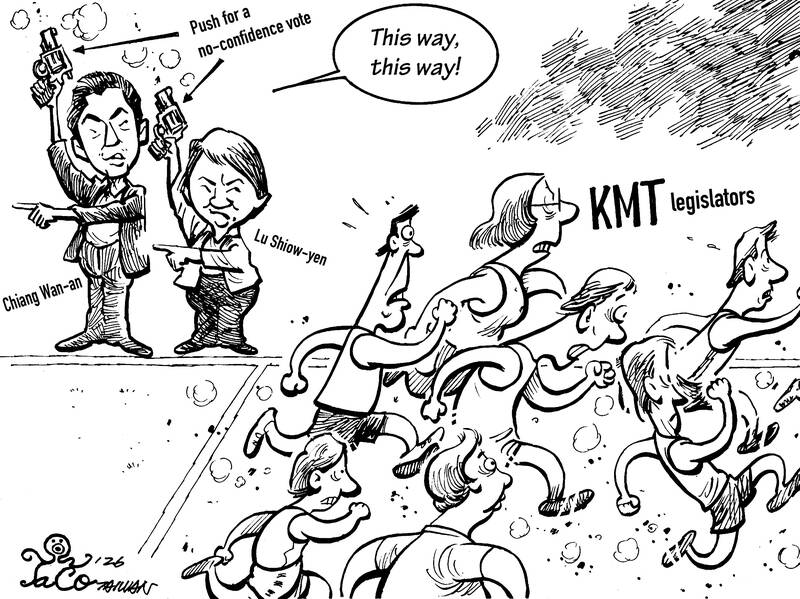
Taipei Mayor Chiang Wan-an (蔣萬安) has developed a habit of overstepping his authority. The question is: Why? On Monday last week, he said that Chinese Nationalist Party (KMT) legislators had discussed holding a vote of no confidence in Premier Cho Jung-tai (卓榮泰) and that he fully supported the move. On Wednesday, he praised the work of Kaohsiung Mayor Chen Chi-mai (陳其邁) for his handling of food safety in the municipality and suggested that President William Lai (賴清德) should replace Cho with Chen. That appeared to be a magnanimous thing for a mayor from an opposition party to say of a counterpart from
A Chinese Nationalist Party (KMT) Central Review Committee member has called for the party to discuss a vision of “peaceful reunification” with China, a proposal that was defended by the KMT’s think tank. Although it is currently an internal party conversation, the measure is significant. Political ideas rarely move from the fringe to the mainstream overnight. Before they become policy proposals, they are introduced, debated and normalized. That process might be under way. Taiwanese overwhelmingly oppose unification. Data from National Chengchi University’s Election Study Center show that only a small share of the public support immediate or eventual unification. So



 RSS
RSS