

About an hour north of central Beijing, the skyline gives way to the foothills of the Yanshan mountains. Amid the greenery, China is building a vast scientific park as part of its bid to dominate the next era of discovery.
Huairou Science City is essentially a shiny playground for physicists, home to the Synergetic Extreme Condition User Facility (SECUF).
In layperson’s terms, researchers subject materials — including superconductors, which carry electricity without resistance — to punishing conditions such as ultra-high pressures and extremely low temperatures. Their objective is nothing less than discovering new states of matter.
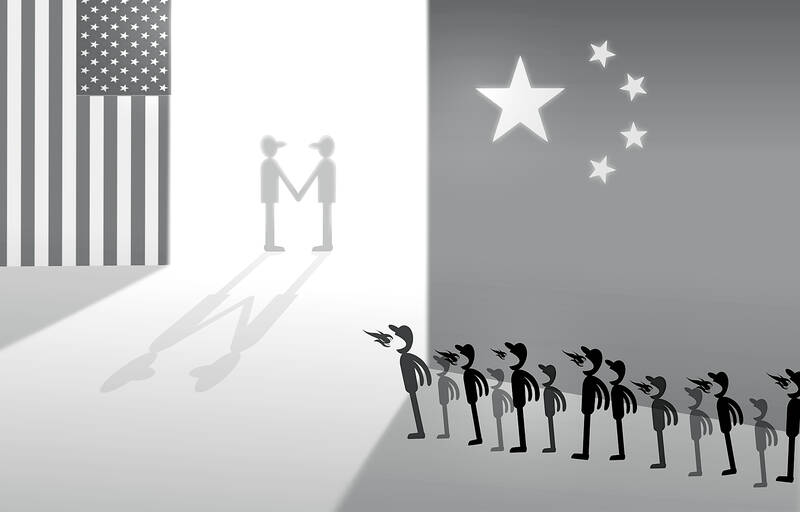
Illustration: Yusha
Next door is China’s first high-energy synchrotron radiation light source. This is where electrons race around a 1.36km ring at nearly the speed of light, creating one of the world’s brightest X-ray beams. The result is a giant microscope that allows scientists to peer inside materials at the atomic level.
Together, the facilities amount to a multimillion-dollar paradise for nerds. Earlier this month, I joined a small group of foreign journalists on a tour organized by China’s Ministry of Foreign Affairs. Scientists spoke exuberantly about no longer having to travel abroad to use such equipment, and the simple joy of being able to track the movements of protons. The brand new buildings are spotless, their halls lined with posters of Nobel laureates for inspiration. The optimism for basic research, driven by foundational questions rather than immediate applications, was contagious.
Still, I kept pressing for the practical applications. The researchers saw no need to rush.
Their goal was to investigate fundamental queries that could take years, even decades, to resolve, they said.
The commercial uses come much later: As Li Lu (呂力), SECUF’s chief scientist and a professor at the Chinese Academy of Sciences’ Institute of Physics said, research on areas such as permanent magnets and rare earth elements that began 40 years ago is only now being applied in the battery industry. The founder and CEO of Contemporary Amperex Technology Co, the world’s biggest lithium-ion battery maker, graduated from the institute in 2006.
Huairou is one of dozens of science parks rising across China, the physical manifestation of a global shift. Walking through these labs, it was impossible not to think about how Washington is making research harder to fund and pursue — just as Beijing is investing in the talent, tools and, most importantly, patience that discovery requires.
In the US, immigration restrictions are part of the problem, but so is the systemic evisceration of funding for basic research.
More than 75 percent of US researchers polled by the journal Nature last year said they were considering leaving the country.
Meanwhile, separate data from the same scientific outlet showed that Chinese universities account for nine of the 10 institutions producing the most academic research globally.
The US retains advantages that one administration cannot easily undo. Freedom of expression, press and religion, as well as its historical image as a melting pot of cultures have long drawn ambitious scientists. English remains the language of scientific publication, and it is unclear how quickly foreign scientists are willing or able to master Mandarin. Not to mention the close connection between US labs, industries and investors.
However, those advantages are slipping. I saw it in the countless researchers who spoke flawless English, because they had studied abroad, but made the decision to return to China. CAS Institute of Physics deputy director Jinguang Cheng (程金光), got his doctorate at the University of Texas at Austin under a Nobel laureate. He was considering US postdoctoral positions when he learned that China would build SECUF. The project lured him home.
China can now afford these massive X-ray machines, because the economy has changed rapidly in the past 10 years, CAS Institute of High Energy Physics deputy director Lu Wei (陸衛) said. The government has built enough rural roads, it is now spending on “infrastructure for innovation.” He considers that a better use of taxpayer money than wars.
It is not only returning postdocs who are attracted by the investment in science. Omar Yaghi, last year’s Nobel laureate in chemistry, recently joined Tsinghua University, leaving a position at the University of California, Berkeley. He is part of a growing list of senior US-based researchers drawn to opportunities in China.
Top talent is also returning to launch enterprises. The US has spent recent weeks debating how it lost Yang Zhilin (楊植麟), the founder of Moonshot, and mind behind the artificial intelligence (AI) model Kimi K3, who returned after earning a doctorate at Carnegie Mellon University.
As the US’ magnetism as the center of scientific research fades, China is eagerly filling the void.
Organisation for Economic Cooperation and Development data this year confirmed that it has overtaken the US in research and development investment. The consequences would affect all of us, from advances in climate and health science to the US’ competitiveness in future industries ranging from semiconductors and AI to weapons systems.
That would not happen overnight. The damage from starving foundational research arrives with a lag, as do the rewards of funding it. By the time Washington realizes what has been dismantled, Beijing might have already built the future.
Catherine Thorbecke is a Bloomberg Opinion columnist covering Asia tech. Previously she was a tech reporter at CNN and ABC News. This column reflects the personal views of the author and does not necessarily reflect the opinion of the editorial board or Bloomberg LP and its owners.

EDITORIAL CARTOON
China exploits the mythical “status quo” to undermine regional stability. Crucially, the 1979 Taiwan Relations Act (TRA) never actually mentions this concept. Instead, Sections 2(b) and 3 establish explicit, legally binding US obligations to provide defensive weapons and maintain the capacity to resist any force or coercion that threatens regional peace or Taiwan’s security, society and economy. Framing these mandates as a vague “status quo” creates a conceptual trap. It paralyzes defenders by mislabeling Taiwan’s self-defense as a provocation, allowing Beijing to slowly strangle the island through gray-zone warfare. To fulfill the TRA, Washington and Taipei must replace passive ambiguity with
A lecture by Tao Yi-fen (陶儀芬), an associate professor in National Taiwan University’s Department of Political Science, offered an insightful assessment of US-China strategic competition and Taiwan’s future. Drawing on academic research and her national security experience, Tao argued that China faces mounting economic and political constraints, that “the East rising and the West declining” is a false narrative, and that time remains on the side of the US and Taiwan. Her analysis deserves serious consideration. Yet it also illustrates an important point: Theories of international relations often produce different conclusions from the same set of facts. As a specialist in international
India’s defense diplomacy in the Indo-Pacific region is entering a new phase. What began with the landmark export of the BrahMos supersonic cruise missile to the Philippines is now expanding to Indonesia, while Vietnam has long been considered a likely customer and several Southeast Asian states continue to evaluate Indian defense systems. However, one crucial aspect of this story has remained largely overlooked: None of these exports would have been possible without Russia’s explicit approval. This overlooked fact deserves far greater attention because it reveals an important, although subtle, dimension of Indo-Pacific geopolitics. While Moscow publicly proclaims a “no-limits partnership” with


 RSS
RSS