

It is the movie event of the summer: A spectacle in which our protagonist journeys to mysterious islands, encountering monsters and sirens, and depends on companions to help navigate a hostile world.
No, it is not The Odyssey. This is Chiikawa the Movie: The Secret of Mermaid Island, the most anticipated film this year in Japan, the world’s third-largest box office. It grossed ¥2.24 billion (US$13.99 million) in its opening weekend, one of the strongest Japanese openings of recent years. And with Chiikawa taking over most movie screens during the school summer vacation period, filmmaker Christopher Nolan’s epic does not even open there until mid-September.
That is a common event in a market that marches to the beat of its own drum. Foreigners in Japan are frequently frustrated when Hollywood hits open later than in other countries, but the reality is that the number of screens is finite, domestic movies dominate and Hollywood must work to their schedules, not the other way around. The five highest-grossing hits last year were all Japan-made, a situation that is no longer unusual.
While still largely unfamiliar in the West, Chiikawa is a veritable phenomenon. It has taken over the country that invented the kawaii (cute) character and become near-ubiquitous: It is almost impossible to walk down a street without encountering it, on anything from 7-Eleven sandwiches and bottles of Pepsi to insect-bite ointment.
Partnering with the brand is an instant way to juice revenue. Kura Sushi Inc’s sales jumped 23 percent after a collaboration, while a promo with McDonald’s was so popular that it had to be suspended after stores were overwhelmed with demand from resellers. On X, Chiikawa’s account is one of the most popular in the Japanese language, with nearly 5 million followers — almost twice as many as Japanese Prime Minister Sanae Takaichi.
What is Chiikawa, exactly? A contraction of nanka chiisakute kawaii yatsu — “some kind of small, cute thing” — it emerged from a Web series on Twitter, now X, in 2020. The eponymous main character is genderless, looks something like a hamster, and is largely monosyllabic. Each manga is little more than a series of panels, or about one minute when rendered into animation. While it initially presents as the kind of wholesome, cozy slice-of-life genre favored by Gen Z as Chiikawa and friends Hachiware and Usagi share ramen and sweets, it hides a darker side.
Whereas Hello Kitty, perhaps the most famous kawaii character to emerge from Japan, was raised in a suburb of London with a trading company worker for a father, the characters of Chiikawa have to scrape, save and grind to survive. The world they inhabit is very much like a video game, taking quests and fighting monsters to make ends meet, constantly facing the threat not just of poverty, but of being killed and eaten. It is as if Peanuts had been inspired by role playing games and born on Twitter.
One argument posits that Chiikawa’s popularity is down to how the characters’ struggles mirror the uncertainty faced by today’s gig-economy youth. While I am less than convinced, it likely does reflect where it comes from. Unlike Kitty (or Pikachu or Labubu), Chiikawa does not originate from a large company such as Kitty’s creator Sanrio Co. Instead, it was born in the online doodlings of illustrator Nagano who, like many manga creators, works pseudonymously.
She got her start selling downloadable stickers on Line, Japan’s top messaging app. Like in the world of Chiikawa, online artists face survival of the fittest: Thousands of creators experiment online and audiences gravitate to the best. Going forward, the skill for character-licensing firms might not be in creating ideas in-house, but quickly identifying which ones are booming.
The pace of Chiikawa’s growth has been stunning, from the first post six years ago on a little-followed account to the country’s top movie. The push was not all organic; Nagano teamed up with licensing firm Spiralcute, which works with artists who share what it calls a “sophisti-cute” aesthetic (other brands include the cats-in-costumes illustrations of mofusand, recently seen in a viral tie-up with Starbucks in Singapore).
In 2022, a short animated segment on one of Japan’s most-watched morning TV shows helped supercharge sales. In the Japan Character Awards, a sort of industry Oscars organized by the Character Brand Licensing Association, Chiikawa has won the grand prize for three years running.
It is already wildly popular in some East Asian markets, a success that appears to predate an official marketing push, as tourists to Japan return home with Chiikawa merchandise. Recent tie-ups with the likes of KFC and Miniso have seen huge queues in China, where the series has been dubbed “digital ibuprofen” for stressed-out youth. Taiwan has an official store, and the character has been used to promote tourism to Hong Kong.
The question for Chiikawa is whether a character that emerged organically, with Japanese users encountering it online and tourists finding it during visits, can recreate those conditions outside Asia.
In writer Dante Alighieri’s Inferno, Odysseus (as Ulysses) reveals that after the end of Homer’s epic, he sailed west in search of new worlds. With Spiralcute having just announced partners for a push into the US and elsewhere, Chiikawa’s next journey lies west, too.
Gearoid Reidy is a Bloomberg Opinion columnist covering Japan and the Koreas. He previously led the breaking news team in North Asia and was the Tokyo deputy bureau chief. This column reflects the personal views of the author and does not necessarily reflect the opinion of the editorial board or Bloomberg LP and its owners.

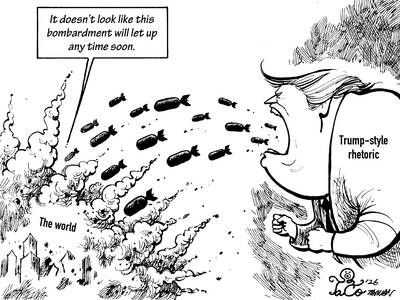
EDITORIAL CARTOON
Spain is having a good summer. The economy is forecast to grow 2.6 percent this year, far higher than the eurozone in general, and is expected to keep expanding by more than 2 percent in each of the next few years. The country has doubled its wind and power capacity since 2019, and is riding out Iran-related energy price turbulence far better than its European peers. And its football team just won the World Cup with a display of teamwork that stifled the world’s best attacking team, France, and then the belligerent Argentinians. Spain, and its long-serving center-left premier, Pedro Sanchez,
EDITORIAL CARTOON
War in the Middle East drags on, while Ukraine’s fortunes are improving despite Mr. Putin’s ongoing assault on Ukrainian sovereignty. Meanwhile, a great deal of energy is focused on China’s behavior in the western Pacific and the threat it poses both to global peace and security and to the free people of Taiwan. Taiwan’s open economy, vibrant democracy, and commitment to its national sovereignty through robust defense stand as a beacon in the Indo-Pacific. Like-minded countries, like the United States, can and should continue to support Taiwan through relationships underpinned by mutual interest and shared trust. Trust is the glue that


 RSS
RSS