

When Israel goes to the polls this year, voters would weigh in on conscription, the economy and how the state should investigate its inability to prevent Hamas’ Oct. 7, 2023, attack.
Below are the key issues shaping the campaign as Israel gears up for elections on Oct. 27.
ACCOUNTABILITY
Many Israelis have demanded an independent state commission of inquiry into the failures that allowed Hamas’ Oct. 7, 2023, attack on Israel, which resulted in the death of more than 1,200 people.
The deadliest assault in Israel’s history, it inflicted a profound national trauma, the repercussions of which continue to shape the country’s politics, society and collective psyche.
Opposition parties said establishing such a commission would be their first priority if elected, adding that Israel has relied on similar inquiries after previous national crises.
However, Israeli Prime Minister Benjamin Netanyahu’s government, which was in office when the attack occurred, has rejected the proposal.
Instead, it has blamed the security establishment for failing to prevent the assault and proposed a bipartisan commission whose members would be appointed by politicians.
The government-proposed commission’s purpose “is to whitewash [those responsible] and prevent a genuine investigation into the greatest disaster the Jewish people have experienced since the Holocaust,” opposition leader Yair Lapid wrote on X.
Netanyahu has also come under mounting scrutiny over his government’s past dealings with Qatar, a key financial backer of Hamas that has long hosted the group’s political leadership.
For years, Qatar transferred hundreds of millions of dollars to Gaza with Israeli approval, in a policy critics said helped entrench Hamas’ rule before the attack.
SECURITY STRATEGY
For decades, Israel’s security doctrine has rested on three principles: strong intelligence, deterrence and short wars, but that changed after the Oct. 7 attack.
The government has instead embraced long military campaigns, reflected in the army’s continued presence in Gaza, southern Lebanon, Syria and regular operations in the occupied West Bank, as well as strikes in Iran and against Yemen’s Tehran-backed Houthi rebels.
The Israeli military has established what it calls “security zones” in all three areas while also conducting near-daily operations in the occupied West Bank.
Inside Israel, this new doctrine has fueled debate over the country’s ability to sustain a military deployed on multiple fronts.
Tens of thousands of reservists have been repeatedly mobilized since 2023, often at significant personal and economic cost, while military leaders continue to warn of manpower shortages.
“We have gone from a logic of deterrence and prosperity between wars to a society that lives permanently by the sword,” Institute for National Security Studies researcher Ofer Shelah said.
The campaigns have come at a cost to Israel’s reputation amid mounting international criticism, with the death toll in Gaza alone exceeding 73,000, according to the Gaza Health Ministry.
Thousands more have also been killed in Lebanon.
Israel has faced growing backlash internationally, including in the US, its closest ally, over the human and economic costs of the wars.
Even US President Donald Trump publicly rebuked Netanyahu over Israel’s conduct during the conflict with Iran, at one point launching a profanity-laced tirade.
IDENTITY, RELIGION, CONSCRIPTION
With the Israeli military facing manpower shortages, the debate over exemptions from military service for ultra-Orthodox Jews has evolved into a broader argument over Israel’s identity.
Ultra-Orthodox parties want to preserve exemptions that allow religious students to avoid military service, and they are backed by Netanyahu’s Likud party and its far-right coalition partners.
Most opposition parties support ending the exemptions and have said they would refuse to join any government that includes ultra-Orthodox parties.
The divide extends beyond military service.
Just days before the Israeli parliament was dissolved, the outgoing coalition introduced measures promoting gender separation in some public spaces and passed legislation emphasising the importance of Torah study.
Supporters said these policies bolster Israel’s Jewish character.
Critics argue that they move the country toward greater religious influence over public life and do not reflect the views of the broader population.
HIGH COST OF LIVING
While security dominates the political debate, the economy remains a major concern for many voters.
Despite strong economic growth, with GDP more than doubling since 2000 and unemployment remaining historically low, Israelis continue to face one of the world’s highest costs of living.
At the same time, median wages remain below the Organisation for Economic Co-operation and Development average, putting increasing pressure on households.
Economists point to long-standing structural problems, including housing shortages, trade barriers and limited competition in key sectors, as the main drivers of high prices.
The wars have added another challenge.
Since 2023, Israel’s defense budget has doubled, placing growing pressure on public finances and making the balance between security spending and domestic priorities another key question for voters.

EDITORIAL CARTOON
Spain is having a good summer. The economy is forecast to grow 2.6 percent this year, far higher than the eurozone in general, and is expected to keep expanding by more than 2 percent in each of the next few years. The country has doubled its wind and power capacity since 2019, and is riding out Iran-related energy price turbulence far better than its European peers. And its football team just won the World Cup with a display of teamwork that stifled the world’s best attacking team, France, and then the belligerent Argentinians. Spain, and its long-serving center-left premier, Pedro Sanchez,
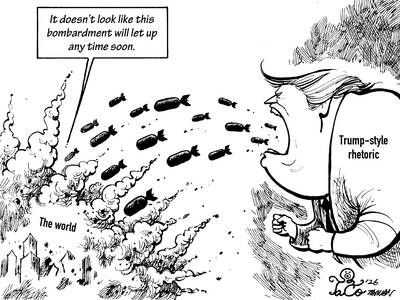
EDITORIAL CARTOON
War in the Middle East drags on, while Ukraine’s fortunes are improving despite Mr. Putin’s ongoing assault on Ukrainian sovereignty. Meanwhile, a great deal of energy is focused on China’s behavior in the western Pacific and the threat it poses both to global peace and security and to the free people of Taiwan. Taiwan’s open economy, vibrant democracy, and commitment to its national sovereignty through robust defense stand as a beacon in the Indo-Pacific. Like-minded countries, like the United States, can and should continue to support Taiwan through relationships underpinned by mutual interest and shared trust. Trust is the glue that


 RSS
RSS