

The cooking oil scandal is first and foremost a regulatory failure. Contaminated oil entered the food-processing system, corporate safeguards failed and authorities struggled to explain how far the problem had spread.
Yet the scandal is no longer only about what entered Taiwanese kitchens. It is also about who gets to explain what failure means.
On June 30, the Food and Drug Administration was notified that about 1,300 tonnes of soybean oil produced by Taichung-based Central Union Oil Corp contained more than four times Taiwan’s legal limit of benzopyrene. An independent investigation later identified additional noncompliant batches and hundreds of downstream businesses, prompting broader recalls.
These are not invented problems. Beijing did not manufacture the oil or weaken corporate quality controls.
On July 15, China’s Taiwan Affairs Office (TAO) spokesperson Zhu Fenglian (朱鳳蓮) accused the Democratic Progressive Party (DPP) government of trying to “cover up and conceal information.” The phrase converts an evolving investigation into evidence of deliberate deception.
The geopolitical purpose soon became explicit. Zhu accused the DPP of “time and again sacrificing the lives and health of the public as a pledge of loyalty to the United States.” Party-state media connected the oil scandal to earlier controversies over US pork containing ractopamine, US agricultural imports and Japanese food from Fukushima prefecture.
There is not yet sufficient public evidence to identify a covert account network comparable to previously exposed Chinese influence operations. What the evidence does show is coordinated overt party-state messaging. The TAO, the state-run Xinhua news agency and the People’s Daily are converting a regulatory failure into an argument about democratic failure, and are then linking it to Taiwan’s relations with the US.
Food safety offers almost ideal terrain for such manipulation. Contamination is invisible, the science is difficult to interpret and government assurances arrive through institutions that failed to prevent the problem.
When Japan began releasing treated water from the Fukushima Dai-ichi nuclear power plant on Aug. 24, 2023, the decision triggered intense debate in South Korea. It came only days after South Korean, Japanese and US leaders met at Camp David in Maryland to deepen trilateral security cooperation. South Korean concern about seafood safety was genuine, as was domestic opposition to then-South Korean president Yoon Suk-yeol’s rapprochement with Japan.
An operation by Storm 1376, a Chinese Communist Party (CCP)-linked group, sought to amplify that division. It published hundreds of Korean-language posts, boosted protests and amplified then-South Korean opposition leader Lee Jae-myung’s description of the release as “contaminated-water terrorism.” Some content accused the US of pursuing “water hegemony.” Beijing did not invent South Korean anger. It borrowed South Korean voices and made the division louder.
In Poland, the controversy grew directly out of Russia’s full-scale invasion of Ukraine. After Russia disrupted Ukraine’s Black Sea export routes, the EU suspended duties on Ukrainian agricultural products in May 2022 to help Kyiv move grain overland. Much of that grain remained in neighboring states, depressing prices.
Poland’s Supreme Audit Office later identified genuine weaknesses in import controls, including grain declared for technical rather than food or feed use. When farmers began a general strike on Feb. 9, 2024, Russian state media and affiliated networks promoted claims that Ukrainian produce was poisonous and that Poland was sacrificing consumers and farmers to Ukraine and the EU. Moscow did not create the grievance; it used the border blockades to portray Polish-Ukrainian wartime solidarity as collapsing from within.
In Slovakia, regulators reported on April 17, 2023, that one sample of Ukrainian wheat contained chlorpyrifos above the permitted limit.
Within days, pro-Kremlin actors generalized one failed sample into claims that Ukrainian grain was toxic. The scare unfolded months before the Sept. 30 parliamentary elections, amid claims that the West was dragging Slovakia into war. Robert Fico’s Social Democracy party won after campaigning to end military aid to Ukraine. The grain story did not determine the election, but it connected food anxiety with opposition to helping Ukraine and distrust of the government.
The same escalation ladder is visible in Taiwan: A contaminated batch becomes a poisoned food system. An evolving investigation becomes a cover-up. A regulatory failure becomes proof that democracy cannot govern. Finally, that alleged failure is blamed on Taiwan’s relations with the US and other democratic partners.
Taiwan’s authorities have halted production, expanded recalls, published downstream information and commissioned an independent investigation. Yet the government has communicated primarily as a regulator when it needed to communicate as a defender of public trust.
A regulator publishes batch numbers and legal thresholds. Strategic communication explains why information changed, what remains unknown, what exposure means, and when the next update would arrive.
Without that structure, each disclosure looks less like progress and more like reluctant admission.
Taiwan should draw three lessons: First, every major food incident needs one continuously updated public record distinguishing confirmed facts, unresolved questions, affected products, consumer guidance and the timing of the next briefing.
Second, the government needs validators trusted precisely because they are not the government. Independent laboratories, toxicologists, physicians, consumer groups, retailers and local authorities should explain the difference between exceeding a legal threshold, exposure to a hazard and an actual health risk.
Third, Taiwan and the EU should turn their shared concern about foreign information manipulation into further practical cooperation. Europe has experience of Russian groups exploiting agricultural grievances and distrust of regulators. Taiwan understands how Beijing localizes political narratives and inserts anti-US messaging into domestic controversies.
Joint exercises should test not only elections and military contingencies, but contaminated food, animal-disease outbreaks, agricultural blockades and disruptions to essential supplies. These are where many citizens experience the credibility of the public institutions most directly.
Beijing’s advantage does not come only from sophisticated propaganda. It comes from the narrative space democratic institutions surrender when they communicate slowly, defensively or in fragments.
The answer is not to hide failure in the name of resilience. It is to prove that democratic accountability works: Admit what went wrong, explain uncertainty honestly, correct the failure visibly and expose foreign manipulation without dismissing public concern.
Marcin Jerzewski is head of the Taiwan office of the European Values Center for Security Policy and a fellow at Visegrad Insight.

EDITORIAL CARTOON
Spain is having a good summer. The economy is forecast to grow 2.6 percent this year, far higher than the eurozone in general, and is expected to keep expanding by more than 2 percent in each of the next few years. The country has doubled its wind and power capacity since 2019, and is riding out Iran-related energy price turbulence far better than its European peers. And its football team just won the World Cup with a display of teamwork that stifled the world’s best attacking team, France, and then the belligerent Argentinians. Spain, and its long-serving center-left premier, Pedro Sanchez,
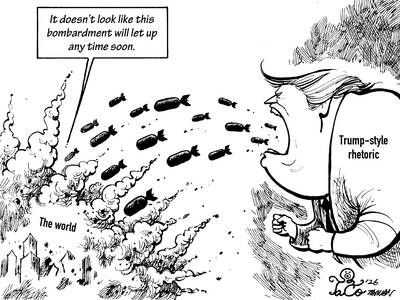
EDITORIAL CARTOON
War in the Middle East drags on, while Ukraine’s fortunes are improving despite Mr. Putin’s ongoing assault on Ukrainian sovereignty. Meanwhile, a great deal of energy is focused on China’s behavior in the western Pacific and the threat it poses both to global peace and security and to the free people of Taiwan. Taiwan’s open economy, vibrant democracy, and commitment to its national sovereignty through robust defense stand as a beacon in the Indo-Pacific. Like-minded countries, like the United States, can and should continue to support Taiwan through relationships underpinned by mutual interest and shared trust. Trust is the glue that


 RSS
RSS