

China — a technological, industrial and geopolitical force that is approaching parity with the US — is underrepresented in terms of international tourism. Beijing should make the most of a recent surge in overseas visitor interest, rather than allowing the goodwill to fade as quickly as the optimism surrounding the 2008 Summer Olympics did.
The costs of not doing so are evident. It failed to crack the top 10 of the most-visited countries last year, which remains dominated by the likes of France, Spain and the US, according to data from UN Tourism and Tourism Economics, a research firm and consultancy.
That is despite a post-pandemic push by the government to encourage inbound travel. China attracted fewer foreign visitors in 2025 than Saudi Arabia, the ultra-conservative kingdom that opened to mass tourists only a few years ago.
To be sure, the memory of draconian Covid lockdowns and a decade-long turn to authoritarianism have made China a hard sell. Beyond a souring of perceptions, there are simple impracticalities, such as geography, a language barrier and a separate internet universe with its own payments ecosystem. Western social media platforms like Instagram, WhatsApp and TikTok are inaccessible without virtual private networks.
At precisely the moment China’s influence as one of two superpowers integral to reshaping global politics and business is growing, opportunities for Westerners to understand it are diminishing; the number of journalists, students and official exchanges have dwindled. Many view the nation only through the lens of national security or trade relations. Much of this is self-inflicted.
Before 2008, China was eager to present itself as a modern, rising and increasingly integrated global power. The Olympics became the centerpiece of that effort. However, after Chinese President Xi Jinping (習近平) took power in 2012, there was a turn toward greater political centralization and tighter control, which affected how the country was perceived abroad, denting enthusiasm.
The introduction of a visa-free policy for citizens of 50 countries has made travel easier for those who may not have considered it before. Challenges remain, but there is a fresh opportunity as the country becomes relatively cool thanks to social media.
For the first time since 2008, China has acquired a newfound cultural cachet thanks to Gen Z popular culture, Labubu dolls and Tang-style fashion. The phenomenon was further amplified by American livestreamers iShowSpeed and Hasan Piker making high-profile trips last year to marvel at high-speed trains, futuristic cars and the cuisine.
Those visits are a form of propaganda, but their popularity demonstrates that younger Westerners are curious about life in a place that has long felt foreign, distant and “other.”
The wave of what has been dubbed “Chinamaxxing,” a fascination with social media feeds filled with people boiling water or wearing house slippers, reinforces that trend. The interest serves as a useful counterpoint to societies grappling with political and social upheaval.
China has to do its bit and not squander this opportunity again. Beijing should recognize that immersive experience is particularly important at a time when the country’s ascendancy is causing conflict with the West, especially the US, and discourse and policy abroad are being shaped by few who have ever visited.
Though China Studies was always a niche subject, the precipitous decline in students from the US is a case in point. The resulting lack of on-the-ground expertise presents a national security and economic competitiveness challenge for Washington, noted a March report from the US-China Education Trust, a non-profit body that promotes educational exchange.
Another problem is China’s restrictions on visas for international journalists; there’s no shortage of those wanting greater access to report on its industrial rise and unique social trends. As their numbers drop, tourists become an even more important bridge between cultures.
Beijing should begin by doing much more to address the digital divide that can intimidate potential visitors. Its highly developed online ecosystem works seamlessly for hundreds of millions of people. For tourists, however, navigating services built around local identification, mobile numbers and banking credentials can create a lot of friction, turning simple errands like buying train tickets into time-consuming exercises.
Visiting a country is not an endorsement of its political system. For most visitors, Chinese cities will be neither the dystopian nightmare nor the impoverished backwater of their imagination. Foreign visitors are still a novelty for many locals, who are struggling like their peers in the West with a job market disrupted by AI and declining social mobility.
The online craze appears to have tapered off in the way most internet trends eventually do. However, the curiosity behind the phenomenon remains. The authentic China resides somewhere between the exuberant maxxing and mutual suspicion.
Juliana Liu is a columnist for Bloomberg Opinion’s Asia team, covering corporate strategy and management in the region. She was previously CNN’s senior business editor for Asia, and a correspondent at BBC News and Reuters.This column reflects the personal views of the author and does not necessarily reflect the opinion of the editorial board or Bloomberg LP and its owners.

Taiwan’s democracy and high-tech economy play a crucial role in global affairs and are central to the world’s embrace of a raft of next-generation technologies, including AI. It is underpinned by a security relationship with the United States that’s existed in several iterations since 1949 and the Chinese Nationalist Party’s (KMT) retreat from China. A central pillar of that security relationship is the American willingness to sell arms to Taiwan. Indeed, since 1979 it has been embedded in US law, with the Taiwan Relations Act (TRA) charging the US with helping to improve the island’s ability to deter an attack from
Academia Historica director Chen Tsui-lien (陳翠蓮), speaking at the handover ceremony for her new role on Monday, said that when she accepted the position, she knew that her peaceful life as a history professor was a thing of the past, and that from now on she would have to “wear a helmet.” A specialist in Taiwan’s post-World War II history and the 228 Incident, she has been accused of being politically divisive. A phrase she used in her acceptance speech set headlines alight this week, putting her in the sights of editorials in blue-leaning media. She said opposition figures calling for
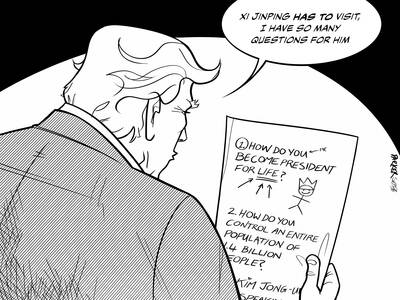
EDITORIAL CARTOON
Taiwanese-Americans, lawmakers and civic groups marched through Manhattan on Saturday last week in support of Taiwan’s participation in the UN. Marshall Islands Permanent Representative to the UN John Silk joined the demonstration, saying he hoped Taiwan would one day be able to participate in UN meetings as a member, and Democratic Progressive Party Legislator Wang Yi-chuan (王義川) took part while visiting New York City with a delegation. Taiwanese communities in Vancouver held a “UN for Taiwan” event. The campaign comes as the 81st UN General Assembly gets under way. In Taipei, President William Lai (賴清德) said China was deliberately misinterpreting UN


 RSS
RSS