

In Asia, the supply of light crude oil as a feedstock for plastic production has long been dependent on the Middle East, with about 60 percent of supply coming out of the region. The supply chain is evidently vulnerable to the escalation of geopolitical tensions, with the war in Iran and blockade of the Strait of Hormuz stifling the flow of naphtha and affecting the entire plastics industry.
Within a single month, Taiwan has experienced a plastic bag shortage, South Korea has seen panic over garbage bag supplies and Japan has had issues with the supply of plastic packaging and sanitary equipment. This crisis of transnational proportions is not a regular fluctuation in the market, but a concentrated manifestation of supply chain vulnerability. Virtually overnight, long-overlooked issues around supply of basic materials have been brought to the fore.
The crisis has highlighted Asia’s heavy dependence on a single source of raw materials.
The petrochemical industry has certain economies-of-scale advantages, but its upstream feedstocks are overly concentrated in specific regions. Once shipments are obstructed, the entire industry can be thrown into gridlock. Plastic products are widely used both in daily life and for industrial purposes, meaning that unstable supplies can have far-reaching and unpredictable impacts. Used in everything from shopping bags and food packaging to medical supplies and electronics manufacturing, plastics have become one of the world’s critical basic materials.
Plastic supply chains have long pursued a model of low reserve stocks and real-time production, which helps in reducing costs and boosting efficiency. In a crisis, however, this poses a significant risk, with companies unable to absorb shocks in the supply chain.
Shortages are quick to appear, causing market price fluctuations that ultimately land on consumers, further demonstrating how modern supply chains have come to overemphasize efficiency at the expense of resilience. Crises, however, can also represent opportunities for transformation. Plastic shortages have led countries all over the world to re-evaluate the extent of their reliance and provided a new impetus to develop policies aimed at reducing their usage.
In the past, cutting back on plastic stemmed primarily from environmental concerns, but supply chain security and economic resilience are now emerging as additional factors.
When reducing plastic becomes a necessary strategy for risk mitigation, governments and businesses are more likely to step up.
From Taiwan’s perspective, the situation offers several important policy directions to consider.
First, it is necessary to diversify raw material sourcing to mitigate reliance on a single region, for example through international cooperation or the development of alternative petrochemical feedstocks.
Second, strategic reserves of key raw materials are needed to provide a buffer against supply-related shocks and to stabilize prices and availability.
Accelerating the drive for alternative materials and a circular economy is crucial, including through the development of bioplastics, decomposable materials and new recycling technologies.
With subsidies and industrial transformation support, companies could gradually lower their reliance on petrochemicals while creating new economic opportunities.
Additionally, encouraging businesses to minimize packaging and use reusable materials would help in reducing demand at the source.
Furthermore, the government could introduce a more nuanced, tiered plastic-reduction policy scheme that targets non-critical single-use products while protecting necessary uses to avoid compromising medical care or food safety. Public procurement and regulatory frameworks can help guide market transformation in this space.
Shifting consumer behaviors are an important part of the picture. When supply is limited, the public is naturally more amenable to alternatives; the government should use this moment wisely.
Encouraging the use of reusable bags, containers and eco-friendly products could help turn a transitory crisis into behavioral changes that stick.
The plastic shortage reminds us that the world has entered an era of supply chain instability.
Any industry with overreliance issues is vulnerable to shocks. Besides dealing with present shortages, Taiwan must build more resilient systems for industries and consumers alike.
As plastic reduction is elevated from an environmental issue to become a key element of the nation’s economic and security strategies, the crisis at hand presents an opportunity for transition.
Roger Lo is a freelancer.
Translated by Gilda Knox Streader
Taiwan’s democracy and high-tech economy play a crucial role in global affairs and are central to the world’s embrace of a raft of next-generation technologies, including AI. It is underpinned by a security relationship with the United States that’s existed in several iterations since 1949 and the Chinese Nationalist Party’s (KMT) retreat from China. A central pillar of that security relationship is the American willingness to sell arms to Taiwan. Indeed, since 1979 it has been embedded in US law, with the Taiwan Relations Act (TRA) charging the US with helping to improve the island’s ability to deter an attack from
Academia Historica director Chen Tsui-lien (陳翠蓮), speaking at the handover ceremony for her new role on Monday, said that when she accepted the position, she knew that her peaceful life as a history professor was a thing of the past, and that from now on she would have to “wear a helmet.” A specialist in Taiwan’s post-World War II history and the 228 Incident, she has been accused of being politically divisive. A phrase she used in her acceptance speech set headlines alight this week, putting her in the sights of editorials in blue-leaning media. She said opposition figures calling for
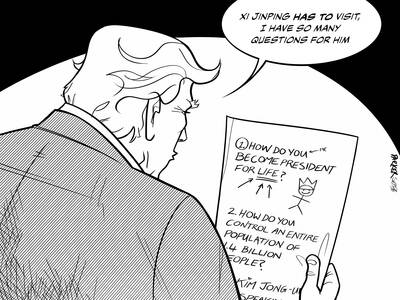
EDITORIAL CARTOON
When Panama severed diplomatic relations with Taiwan and recognized China in 2017, Beijing achieved one of its most important diplomatic victories in Central America. However, nearly a decade later, Panama is demonstrating that diplomatic recognition does not necessarily eliminate Taiwan from a country’s political system. Panama and Taiwan had diplomatic relations for more than 100 years and the goodwill between the countries was displayed last week when Panama’s National Assembly established an interparliamentary exchange group with the Legislative Yuan. Forty-five of the assembly’s 71 lawmakers joined the group, representing more than 60 percent of the legislature. Its members include National Assembly President Shirley


 RSS
RSS