


When Taiwan High Speed Rail Corp (THSRC) announced the implementation of a new “quiet carriage” policy across all train cars on Sept. 22, I — a classroom teacher who frequently takes the high-speed rail — was filled with anticipation. The days of passengers videoconferencing as if there were no one else on the train, playing videos at full volume or speaking loudly without regard for others finally seemed numbered.
However, this battle for silence was lost after less than one month. Faced with emotional guilt from infants and anxious parents, THSRC caved and retreated.
However, official high-speed rail data have long indicated that the true sources of noise pollution are typically adults who treat trains as a mobile office by holding conference calls, and those who watch videos on their phones at full volume — often referred to as “giant babies.” Yet the public debate somehow devolved into a confrontation between families with children and child-hating passengers. What should have been a discussion about self-discipline and public etiquette became an emotional confrontation of labeling and blame.
We can absolutely empathize with children who cannot control their behavior, but that is different from parents who neglect their duties and allow their older children to misbehave. To equate a baby’s crying with three or four-year-olds running around, screaming and kicking the seat in front of them is the ultimate insult to parenting. The former is a natural instinct — society should show tolerance to infants and parents should comfort them. The latter is disorderly behavior, and parents have a responsibility to discipline their children and not allow them to infringe on others’ space.
When high-speed rail staff gently reminded parents about noisy children, their actions were blown out of proportion online and denounced as discrimination against children, unfairly labeling them as lacking empathy. The emotional blackmail has blurred the lines between right and wrong. In the end, the company opted to remove the signs altogether.
I took a southbound train the other day, a two-hour ride. For one full hour, the carriage was filled with the playful screams of two or three children about 10 years old, with absolutely no sign of parental intervention. From now on, it seems that this would be the new normal for the high-speed rail after its surrender.
European railways have clearly defined “quiet carriages” and “family carriages,” allowing people to choose the carriage that best suits their needs. In quiet carriages, any form of noise — whether from adults or children — is discouraged to maintain a peaceful environment for those who require rest or focus. Children are given more leeway in family carriages, although such tolerance should never serve as a free pass for parents to shirk their responsibilities.
THSRC’s surrender marks yet another instance of public policy being defeated by populist sentiment. True civility lies in the ability to clearly distinguish between those who cannot and those who simply refuse — and in the courage to hold the latter accountable. The quiet carriage policy’s failure is a prelude to the collapse of civility in Taiwan’s public spaces.
Lin Po-kuan is a junior-high school teacher.
Translated by Kyra Gustavsen
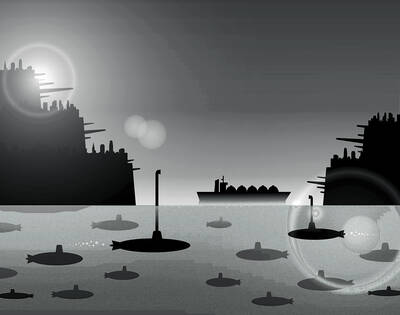
In the event of a war with China, Taiwan has some surprisingly tough defenses that could make it as difficult to tackle as a porcupine: A shoreline dotted with swamps, rocks and concrete barriers; conscription for all adult men; highways and airports that are built to double as hardened combat facilities. This porcupine has a soft underbelly, though, and the war in Iran is exposing it: energy. About 39,000 ships dock at Taiwan’s ports each year, more than the 30,000 that transit the Strait of Hormuz. About one-fifth of their inbound tonnage is coal, oil, refined fuels and liquefied natural gas (LNG),
On Monday, the day before Chinese Nationalist Party (KMT) Chairwoman Cheng Li-wun (鄭麗文) departed on her visit to China, the party released a promotional video titled “Only with peace can we ‘lie flat’” to highlight its desire to have peace across the Taiwan Strait. However, its use of the expression “lie flat” (tang ping, 躺平) drew sarcastic comments, with critics saying it sounded as if the party was “bowing down” to the Chinese Communist Party (CCP). Amid the controversy over the opposition parties blocking proposed defense budgets, Cheng departed for China after receiving an invitation from the CCP, with a meeting with
To counter the CCP’s escalating threats, Taiwan must build a national consensus and demonstrate the capability and the will to fight. The Chinese Communist Party (CCP) often leans on a seductive mantra to soften its threats, such as “Chinese do not kill Chinese.” The slogan is designed to frame territorial conquest (annexation) as a domestic family matter. A look at the historical ledger reveals a different truth. For the CCP, being labeled “family” has never been a guarantee of safety; it has been the primary prerequisite for state-sanctioned slaughter. From the forced starvation of 150,000 civilians at the Siege of Changchun
The two major opposition parties, the Chinese Nationalist Party (KMT) and the Taiwan People’s Party (TPP), jointly announced on Tuesday last week that former TPP lawmaker Chang Chi-kai (張啟楷) would be their joint candidate for Chiayi mayor, following polling conducted earlier this month. It is the first case of blue-white (KMT-TPP) cooperation in selecting a joint candidate under an agreement signed by their chairpersons last month. KMT and TPP supporters have blamed their 2024 presidential election loss on failing to decide on a joint candidate, which ended in a dramatic breakdown with participants pointing fingers, calling polls unfair, sobbing and walking


 RSS
RSS