

“It is a wonderful and necessary fact of political biology that we never know when our time is up.”
British Prime Minister Boris Johnson had these prophetic words — his own — quoted back to him by British lawmaker Munira Wilson during prime minister’s questions on Wednesday, the day before he announced his resignation.
“Long after it is obvious to everyone that we are goners, we continue to believe in our ‘duty’ to hang on, with cuticle-wrenching tenacity, to the perks and privileges of our posts,” he wrote in June 2006. “We kid ourselves that we must stay because we would be ‘letting people down’ or that there is a ‘job to be finished.’ In reality, we are just terrified of the comedown.”
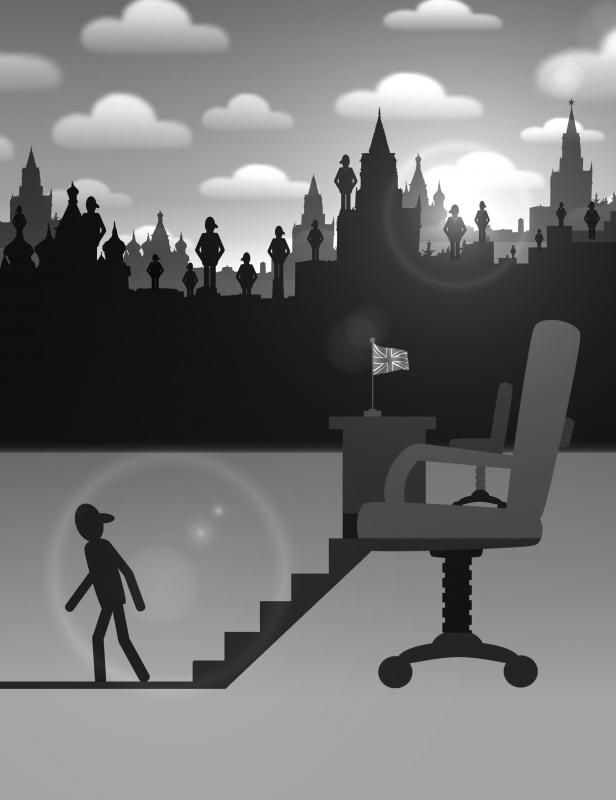
Illustration: Yusha
Ironically, Johnson was writing about former British prime minister Tony Blair, who had let it be known he would be stepping aside in spring 2007. Johnson clearly found this unimaginable, and predicted it would not happen. Blair left on schedule.
A reluctance to quit is familiar to most people. From an early age they are taught that “quitters never win,” that walking away is tantamount to failure and that giving up is giving in. Even when they criticize someone for “not knowing when to quit,” they often do it with a hint of admiration.
How does anyone really know when it is the right time to take their ball and go home?
If anything, the majority err on the side of sticking with unpromising prospects for too long, life coach Sally Ann Law said.
“It’s hard for most of us to let go of something we’ve been good at for so long or that we’ve invested a lot of time and energy into becoming good at,” she said. “It’s hard to agree with ourselves that we’ve reached our high point.”
This reluctance is a version of what is known as the “sunk cost fallacy”: Because a person has already dedicated time and effort to a job or a project, they feel an obligation to their investment, even if that investment is irrecoverable — the equivalent of throwing good money after bad.
When making big decisions about staying or quitting it helps to work out what is important — what will make you happy, productive and challenged — and what is the “noise in the equation,” the idea that “all my identity and self-esteem and self-respect are tied up with being this amazing person doing this,” Law said.
Knowing when to quit is not a skill normally required of high-level politicians. Most do not get the option to jump before they are pushed, either by colleagues or by the electorate.
“It is said that all political careers end in failure,” said Thomas Borwick, the director of the College Green Group political consultancy. “It is very hard to stay relevant as times change, and the forces required to get into office are different to those needed to stay in office.”
Political consultant Chris Whitehouse, head of Whitehouse Communications, said that he is certain of one thing: Johnson should have realized his appointed hour had arrived.
In light of the allegations against former Conservative Party deputy chief whip Chris Pincher, the prime minister’s position was untenable, he said.
“The big beasts of the Cabinet could no longer stand back and hope that this blows over. This one is not going to blow over,” he added.
When trying to come to grips with the consequences of quitting, it can help to consult those who have already made the same leap — “others who have moved on and appear happy with their choices,” Law said.
Johnson is lucky in this sense, as upward of 50 of his colleagues have made the decision to quit their jobs in the past week alone. He is also unlucky, in that their main motivation for quitting was him, but in many cases they might also have calculated that the path to any future in politics had to begin with a tactical retreat.
“This is a balancing act for some of the big beasts of Cabinet, a double-edged sword,” Whitehouse said. “If we’re seen to stick the knife in for reasons of self-advancement, it would not work. It could be counterproductive. If we’re seen to go gracefully, to acknowledge what we achieved, and quietly go and sit in the tea rooms for a few weeks, I think that will go down much better.”
Johnson’s main motivation for quitting would probably be to protect whatever legacy he has left. Ironically again, one might cite Blair as an example.
“The power base within the Labour Party wanted Tony out,” Whitehouse said. “The left wing never accepted New Labour, and what they’d had to do and say to get elected, and frankly, Tony Blair just had enough. His legacy was trashed by his own party.”
Thanks in part to the manner of his leaving, Blair was eventually reassessed.
“History, I think, will look back and conclude his legacy in some ways was better than his own party have accepted,” Whitehouse said.
While it feels inherently unsafe to talk about Johnson’s premiership in the past tense until he is actually gone, he should probably prepare himself for some inner turbulence.
Law said that people who make the decision to quit often experience an initial bout of seller’s remorse.
“Expect some difficult days, like maybe you meet somebody from your old world, and you think: ‘Oh shit, that person is still being a super-professional in that world,’” she said. “But don’t forget, you went through the process to make a really good decision.”
She said that most people who make an informed decision to quit have no long-term regrets.
“What I find is more the opposite, that people will say things like: ‘It took me ages to get over the line, but now I just wish I’d done it sooner, because it was so obviously the right decision.’ That’s what I hear way more often: ‘Oh my God, I should have done this earlier,’” she said.
For all our sakes, let us hope Johnson comes to feel that way soon.
High-tech manufacturing in India, backed by billions of dollars in government subsidies, has attracted cheerleaders and critics. Optimists point to Apple Inc’s decision to build an alternative supply chain to hedge against China. A quarter of all iPhones now roll out of factories near Chennai, employing tens of thousands. Skeptics counter that much of this manufacturing is mere final assembly — screwdriver work that adds little value. The fact that a much smaller economy such as Vietnam exports more merchandise shows that Indian Prime Minister Narendra Modi’s “Make in India” initiative remains more hype than reality, they said. One way to settle
Taiwan heads to the polls next month for local elections. Beneath the campaign ads lies a deeper question: What do we call this place and who gets to decide? In the pages of the Oxford English Dictionary (OED), that question has been playing out across three centuries. The entries for “Formosa” and “Taiwan” chart an island’s journey from colonial fantasy to self-named reality. Names are rarely neutral; they are the first act of possession. Nowhere is this more evident than in the OED, where the two entries serve as a linguistic seismograph for one of the world’s most enduring geopolitical fault lines.

There are two space races that the democracies must win: one to deter military campaigns near Earth, and the other to secure positional deterrence on the Moon and beyond. The good news is that the US is engaged in both races, which will also benefit US allies and partners in Asia, including Taiwan. On Sept. 14, US Air Force Secretary Troy Meink disclosed, “...the US now has on-orbit space control weapons capable of defending the Joint Force against hostile adversary action.” No details about these “space control weapons” have yet been disclosed. However, a graphic apparently issued by French Space Command and posted
Only 107,812 babies were born in Taiwan last year, barely half the number recorded in 2016. The nation is now a super-aged society, with more than one-fifth of its population aged 65 or older. The National Development Council forecast that the population could fall from an estimated 23.2 million this year to just 12.1 million in 2075. The decline in the working-age population would be even more severe. The number of people aged 15 to 64 is projected to plunge from an estimated 15.8 million this year to 5.1 million by 2075, a reduction of about 67 percent. By then, people


 RSS