


Pumping the bandaged hand of John Crane, a beaming Perry Pritchard said: “I had money on you and you saved me a fortune, mate.”
Pritchard, a director at the brokerage ITG Hong Kong Ltd, played the odds last night and placed his bet of HK$1,500 (US$194) on 3A Asia Ltd’s Crane, the oldest boxer at Hong Kong’s Hedge Fund Fight Night, because “he looked pumped.”
At the black-tied charity event attended by about 720 members of the city’s hedge-fund industry, the 49-year-old, 69kg Crane beat his heavier, 32-year-old challenger, Justin “Carve ‘em Up” Jones of ICAP PLC in three, two-minute rounds.
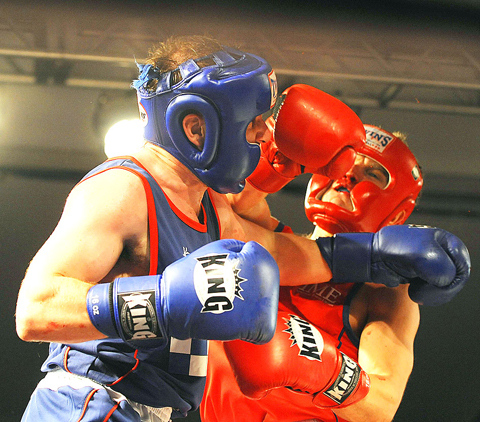
PHOTO: AFP
“He got in the ring and gave it all,” Pritchard said. “He stayed on his feet. And that’s why my money came home.”
The same might be said for the hedge funds. After suffering their worst year on record last year, the industry had its best nine-month performance in a decade this year through September, according to Eurekahedge Pte. The company forecasts industry assets will exceed US$1.5 trillion by the end of the year.
About a fifth of Asia’s US$126 billion in hedge-fund assets was managed in Hong Kong as of December, more than other cities in the region, figures from Alternative Investment Management Association (AIMA) and Eurekahedge show.
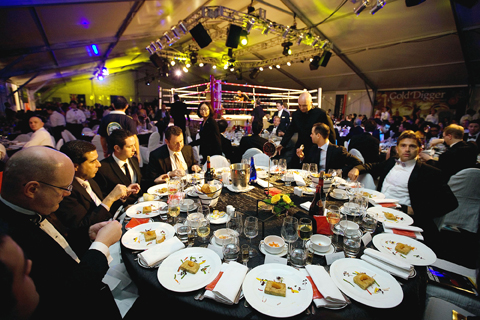
PHOTO: BLOOMBERG
In another sign confidence is returning to Asia, a former executive of Citadel Investment Group LLC is preparing to open the largest Asia-focused hedge-fund startup since May 2007 with the backing of Blackstone Group LP, people familiar with the plan said earlier this month.
“This is a tough year but we are doing fine with the hedges and the shorts,” said Benoit “La Tornade” Descourtieux, manager of the Calypso Asia Fund, which bets on stock prices and their derivatives. “The aim is the same as in the ring, to survive because there is going to be more volatility and you don’t want to get punched in the face.”
Descourtieux, 46, lost his fight by judges’ decision to Jesse “Happy Feet” Kavanagh, a 34-year old tax lawyer at Nomura Holdings Inc who took up the challenge of training after recovering from cancer and open-heart surgery.
During the charity auction to raise HK$1 million for Operation Smile and Operation Breakthrough, guests bid on pheasant-shooting trips in southern China and a six-night stay at the Whistler Ski Chalet in Canada. The most-expensive lot of HK$150,000 was for a five-course lunch for 12 prepared by Relish Kitchen in the Dragon Garden historical site in Hong Kong where Roger Moore shot a scene from the 1974 James Bond movie, The Man With The Golden Gun, organizer IronMonger Events Ltd said.
The money raised help repair children’s facial deformities and combat crime and juvenile delinquency in low-income and immigrant communities, IronMonger said.
“It’s important for the industry to give something back to the community,” Pritchard said.
Laughter and loud chatter filled the tent at the Happy Valley Racecourse, against the thumping beat of rock music and tracks like Eye of the Tiger as guests and their companions hobnobbed between courses of grilled Angus sirloin with lobster and foie gras and apricot compote. Champagne flowed and neon glasses of tequila shots bobbed in the dimmed space as the fighters emerged amidst gusts of dry ice to wild cheers.
One of the most-anticipated bouts was between South African Jacques “Sugarbok” Scherman of Sovereign Group and Jacco “The Punching Dutchman” Klip of the Hong Kong Jockey Club.
Scherman, a 183cm, 86kg trust-and-tax lawyer, outlasted his older opponent, making up for his weaker defenses with more frequent jabs. Fighters scored on hits to the face, chest and stomach as a medical team looked on during the bouts.
“My opponent fought very well. He’s a much bigger guy than me and he’s heavier. He matched me shot for shot,” said Scherman, 34, after the match.
Scherman said even though he’s worried about walking into the office “with a black eye,” he’s glad he won and that his five-month training has ended.
“I’ll start off with drinking a lot of beer,” he said.

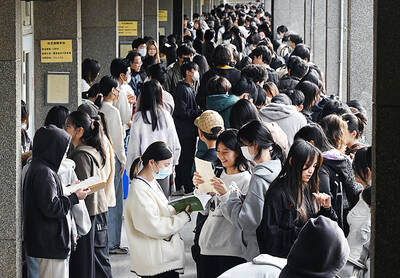
A global survey showed that 60 percent of Taiwanese had attained higher education, second only to Canada, the Ministry of the Interior said. Taiwan easily surpassed the global average of 43 percent and ranked ahead of major economies, including Japan, South Korea and the US, data from the Organisation for Economic Co-operation and Development (OECD) for 2024 showed. Taiwan has a high literacy rate, data released by the ministry showed. As of the end of last year, Taiwan had 20.617 million people aged 15 or older, accounting for 88.5 percent of the total population, with a literacy rate of 99.4 percent, the data

NEW LOW: The council in 2024 based predictions on a pessimistic estimate for the nation’s total fertility rate of 0.84, but last year that rate was 0.69, 17 percent lower An expected National Development Council (NDC) report expects the nation’s population to drop below 12 million by 2065, with the old-age dependency ratio to top 100 percent sooner than 2070, sources said yesterday. The council is slated to release its latest population projections in August, using an ultra-low fertility model, the sources said. The previous report projected that Taiwan’s population would fall to 14.37 million by 2070, but based on a new estimate of the total fertility rate (TFR) — the average number of children born to a woman over her lifetime — the population is expected to reach 12 million by
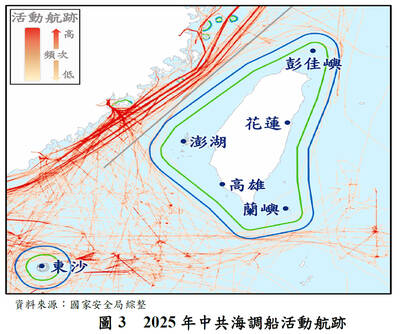
INTENSIFYING THREATS: Beijing’s tactics include massive attacks on the government service network, aircraft and naval vessel incursions and damaging undersea cables China is prepared to interfere in November’s nine-in-one local elections by launching massive attacks on the Taiwanese government’s service network (GSN), a report published by the National Security Bureau showed. The report was submitted to the Legislative Yuan ahead of the bureau’s scheduled briefing at the Foreign Affairs and National Defense Committee tomorrow. The national security team has identified about 13,000 suspicious Internet accounts and 860,000 disputed messages, the bureau said of China’s cognitive warfare against Taiwan. The disputed messages focus on major foreign affairs, national defense and economic issues, which were produced using generative artificial intelligence (AI) and distributed through Chinese

COUNTERING HOSTILITY: The draft bill would require the US to increase diplomatic pressure on China and would impose sanctions on those who sabotage undersea cable networks US lawmakers on Thursday introduced a bipartisan bill to bolster the resilience of Taiwan’s submarine cables to counter China’s hostile activities. The proposal, titled the critical undersea infrastructure resilience initiative act, was cosponsored by Republican representatives Mike Lawler and Greg Stanton, and Democratic Representative Dave Min. US Senators John Curtis and Jacky Rosen also introduced a companion bill in the US Senate, which has passed markup at the chamber’s Committee on Foreign Relations. The House’s version of the bill would prioritize the deployment of sensors to detect disruptions or potential sabotage in real-time and enhance early warning capabilities through global intelligence sharing frameworks,


 RSS
RSS