


Apinun Pongthavornsawas had to rush to beat a crowd of potential buyers hoping to snap up apartments in a new development in downtown Bangkok, near the city's elevated train line.
Tired of battling Bangkok's traffic every day, the 44-year-old engineer decided to spend 3 million baht (US$88,750) on a unit in a development that hasn't even broken ground yet.
His was among the 16,000 apartments sold in the first 10 months of the year, driving a trend that pushed sales up 20 percent over the same period last year, Siam City Securities figures show.
"I almost wasn't able to get this unit, because so many people wanted to buy it," Apinun said.
"The condo is just next to the BTS station and very easy to commute," he said, referring to the capital's elevated rail lines.
"In two years, when the condo is finished, I will give up driving to work and use the SkyTrain instead," he said.
The enormous demand for apartments in Bangkok is powered by frustration with the city's notorious traffic and the much easier commutes offered by the city's three light rail lines.
New lines are already in the works, and developers are changing the city's skyline by throwing up new apartment blocks along all the routes.
Construction on 24,000 apartments was launched between January and August, accounting for more than half of new property projects, according to property consultant Agency for Real Estate Affairs.
The agency's managing director Sopon Pornchokchai said that overall, construction of new homes is down 8 percent over last year, and down 22 percent in terms of value.
"Condominiums are the only segment posting an annualized growth this year to date, reflecting changes in as consumer's lifestyles," Sopon said.
"Meanwhile, the property market overall has declined over the last two years time, due to slumping confidence in politics and the economy," he said.
Thailand's economy has been held back by prolonged political turmoil surrounding the ousting of former prime minister Thaksin Shinawatra in last year's coup and installation of the army-backed government.
Siam City Securities said the kingdom's housing demand plunged to a five-year low in September.
Excluding apartments, units sold dropped by almost 30 percent over the 10 months to October, it said.
"Consumers are worried about their incomes, given the country's poor economic outlook. They're afraid they cannot afford to buy a house, so they are putting off the decision," said a property analyst at Siam City.
Thailand is holding elections on December 23, the first polls since the military coup.
But with no clear frontrunner in the election, experts said the political outlook was still uncertain so the property market could remain in the doldrums next year.
The economy is targeted to grow by 4.3 percent this year, among the lowest rates in Southeast Asia, and 4.6 percent next year, World Bank estimates show.
Khan Prachuabmoh, president of the Government Housing Bank, said political instability, high oil prices and rising inflation were among the negative factors hurting the economy and the property market next year.
"The property market is likely to continue its slowdown next year as oil prices and rising inflation will lower the purchasing power of consumers," he said.
"If the political situation improves and property gets a boost from the next government, the sector could rebound in the latter half of next year."
The rush to build new apartments has also raised fears of an oversupply, especially if the central bank decides to raise interest rates to tame inflation, the Kasikorn Research Center said.
Pimonwan Mahujchariyavong, the center's head of macroeconomics, said that high oil prices and the fallout from the mortgage crisis in the US could also have larger-than-expected effects on the Thai economy.
"If new condominium projects are launched at the same frantic pace, the segment could be flooded with huge supply next year," Pimonwan said.
In a worst case scenario, demand in the market could be badly hit by an economic slowdown," he said.

AIR SUPPORT: The Ministry of National Defense thanked the US for the delivery, adding that it was an indicator of the White House’s commitment to the Taiwan Relations Act Deputy Minister of National Defense Po Horng-huei (柏鴻輝) and Representative to the US Alexander Yui on Friday attended a delivery ceremony for the first of Taiwan’s long-awaited 66 F-16C/D Block 70 jets at a Lockheed Martin Corp factory in Greenville, South Carolina. “We are so proud to be the global home of the F-16 and to support Taiwan’s air defense capabilities,” US Representative William Timmons wrote on X, alongside a photograph of Taiwanese and US officials at the event. The F-16C/D Block 70 jets Taiwan ordered have the same capabilities as aircraft that had been upgraded to F-16Vs. The batch of Lockheed Martin
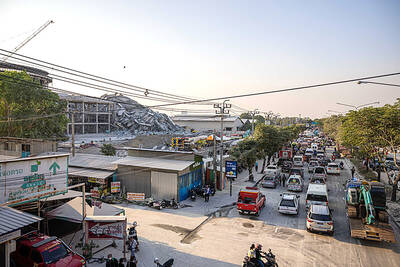
GRIDLOCK: The National Fire Agency’s Special Search and Rescue team is on standby to travel to the countries to help out with the rescue effort A powerful earthquake rocked Myanmar and neighboring Thailand yesterday, killing at least three people in Bangkok and burying dozens when a high-rise building under construction collapsed. Footage shared on social media from Myanmar’s second-largest city showed widespread destruction, raising fears that many were trapped under the rubble or killed. The magnitude 7.7 earthquake, with an epicenter near Mandalay in Myanmar, struck at midday and was followed by a strong magnitude 6.4 aftershock. The extent of death, injury and destruction — especially in Myanmar, which is embroiled in a civil war and where information is tightly controlled at the best of times —
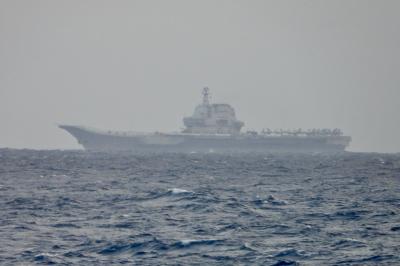
China's military today said it began joint army, navy and rocket force exercises around Taiwan to "serve as a stern warning and powerful deterrent against Taiwanese independence," calling President William Lai (賴清德) a "parasite." The exercises come after Lai called Beijing a "foreign hostile force" last month. More than 10 Chinese military ships approached close to Taiwan's 24 nautical mile (44.4km) contiguous zone this morning and Taiwan sent its own warships to respond, two senior Taiwanese officials said. Taiwan has not yet detected any live fire by the Chinese military so far, one of the officials said. The drills took place after US Secretary

THUGGISH BEHAVIOR: Encouraging people to report independence supporters is another intimidation tactic that threatens cross-strait peace, the state department said China setting up an online system for reporting “Taiwanese independence” advocates is an “irresponsible and reprehensible” act, a US government spokesperson said on Friday. “China’s call for private individuals to report on alleged ‘persecution or suppression’ by supposed ‘Taiwan independence henchmen and accomplices’ is irresponsible and reprehensible,” an unnamed US Department of State spokesperson told the Central News Agency in an e-mail. The move is part of Beijing’s “intimidation campaign” against Taiwan and its supporters, and is “threatening free speech around the world, destabilizing the Indo-Pacific region, and deliberately eroding the cross-strait status quo,” the spokesperson said. The Chinese Communist Party’s “threats


 RSS
RSS