

Artificial intelligence (AI) development is driving demand for talent beyond the technology sector, with job openings in chemical-related manufacturing surging more than 70 percent in the third quarter from the first quarter, a report jointly released yesterday by the Institute for Information Industry (III) and online job bank 1111 showed.
The report showed that job openings in the chemical industry, whose manufacturers supply materials such as glass cloth and copper-clad laminate (CCL) used in AI-related products, increased 74.32 percent in the third quarter compared with the first quarter, the highest growth among major industries in Taiwan.
The warehousing and transportation support services sector also benefited from AI-related business expansion, recording the second-largest increase in AI-related job openings at 44.83 percent, followed by the architectural planning and design industry, which saw a 24.57 percent increase, the report said.
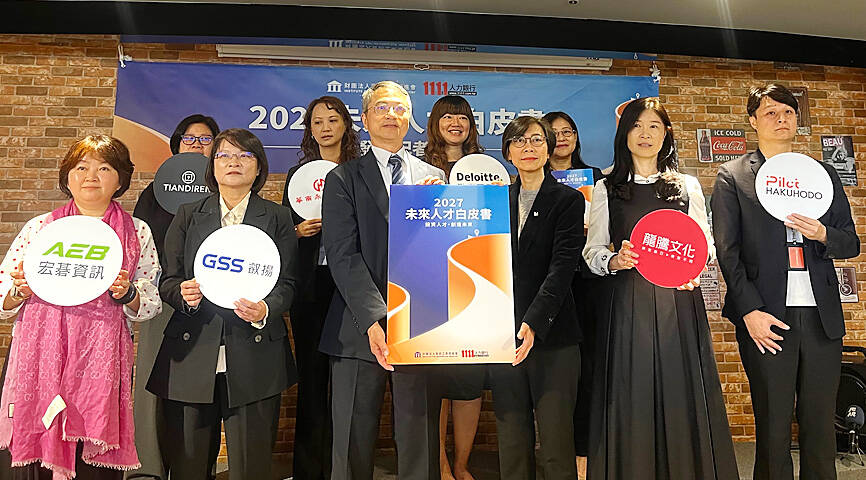
Photo: CNA
“Demand for AI talent is no longer limited to the technology industry,” the report said. “As various industries accelerate their digital transformation, demand for AI and information technology talent is growing simultaneously.”
In the technology sector, job openings in computer and consumer electronics manufacturing increased 23.26 percent in the third quarter from the first quarter, while the electronics components and semiconductor industries recorded increases of 18.61 percent and 13.63 percent respectively, the report showed.
III deputy executive director Lin Yu-fan (林玉凡) said in the report that as the AI era unfolds, workers will need to develop four key qualities, which she described as the four “I”s: “Imagination,” “Integration,” “Impact” and “Investment.”
“Imagination” refers to identifying innovative opportunities to apply AI in the workplace and across industries, while “Integration” means connecting technology, data, processes and on-site requirements across different fields, Lin said.
“Impact” involves creating value through internal and external communication, while “Investment” refers to continuous learning and practical experience to keep pace with technological advances and changes in the workplace, she added.
Lin also predicted that positions related to AI agents will be in high demand.
She said people working in the field should begin with small-scale applications, accurately identify pain points and quickly put the technology into practice to build up successful cases. Otherwise, they could encounter problems involving insufficient data, security risks and inadequate processes, she added.
According to the report, job openings for AI-related engineers increased 66.12 percent in the third quarter compared with the first quarter, while openings for algorithm development engineers rose 54.41 percent. Cybersecurity engineers and systems engineers also saw increases of 35.47 percent and 26.38 percent, respectively.
Enditem/ASG
Taiwan Semiconductor Manufacturing Co (TSMC, 台積電) said yesterday that its subsidiary TSMC Partners Ltd had acquired 6,024,096 shares in US artificial intelligence (AI) company Anthropic PBC for about US$500 million. TSMC Partners paid US$83 per share, the price of Anthropic’s initial public offering (IPO), giving TSMC a stake of about 0.03 percent, according to a regulatory filing by the world’s largest contract chipmaker. Anthropic, the developer of the Claude AI assistant, priced its IPO on Wednesday at a valuation of about US$1.5 trillion. Its shares were scheduled to begin trading on the NASDAQ yesterday under the ticker symbol "ANT." The purchase was primarily
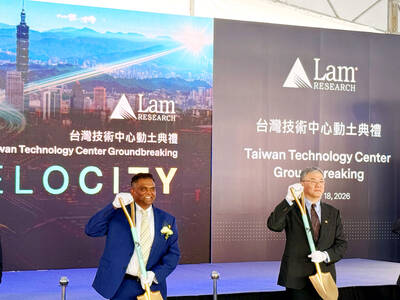
R&D EXPANSION: An executive told a ceremony that the lab, which is set to open in 2028, would increase its overall cleanroom capacity in Taiwan by over nine times US chipmaking equipment supplier Lam Research Corp yesterday broke ground on a technology center in Miaoli County’s Jhunan Township (竹南), a facility set to play a key role in the company’s five-year, US$3 billion global research and development (R&D) expansion. The investment — which would increase the firm’s cleanroom capacity in Taiwan more than ninefold — aims to improve the company’s R&D, testing and validation capabilities, enabling engineering teams to collaborate more closely with customers and accelerate the transition from technology development to fab adoption, Lam Research said. “When this lab opens in 2028, it will have more than 40,000 square meters
CAPACITY BOOST: The agreement ‘helps secure the advanced packaging capacity and turnkey production needed to meet demand,’ an Nvidia executive said Siliconware Precision Industries Co (SPIL, 矽品精密) yesterday unveiled a new multibillion-dollar deal with Nvidia Corp, aiming to scale up its advanced packaging capacity in Taiwan to support booming demand for artificial intelligence (AI) infrastructure. Under the deal, SPIL would execute a multiyear expansion to triple its advanced packaging capacity by the middle of 2029 and support Nvidia’s platforms, the subsidiary of ASE Technology Holding Co (日月光投控) said in a statement. The expansion includes new production lines for turnkey support from bumping, assembly and testing, as well as facility upgrades, interposer wafer fabrication and increased automation — steps designed to shorten lead
Taiwan Semiconductor Manufacturing Co (TSMC, 台積電) is tightening restrictions on Chinese chip designers, suspending some previously permitted advanced manufacturing orders and generally limiting affected customers to older chipmaking technology, according to two people familiar with the matter. The move could close one of the last remaining routes for Chinese companies to produce powerful artificial intelligence (AI) processors, complicating Beijing’s efforts to develop domestic alternatives to chips designed by Nvidia Corp and manufactured by TSMC. The world’s largest contract chipmaker has instructed that affected orders using manufacturing processes of 16 nanometres and below be halted unless customers obtain US export licences, the people


 RSS