

Taiwan’s unemployment rate fell to a 26-year low last month, while the labor force participation rate climbed to its highest level in nearly 37 years, reflecting growing willingness among women and older people to enter the workforce, the Directorate-General of Budget, Accounting and Statistics (DGBAS) said yesterday.
The labor market is expected to remain stable, with unemployment likely to decline further this month and next month, the agency said.
The unemployment rate edged down to 3.35 percent, 0.01 percentage points lower than September and a year earlier, the lowest October reading since 2000. After seasonal adjustments, the rate was unchanged from September at 3.33 percent.
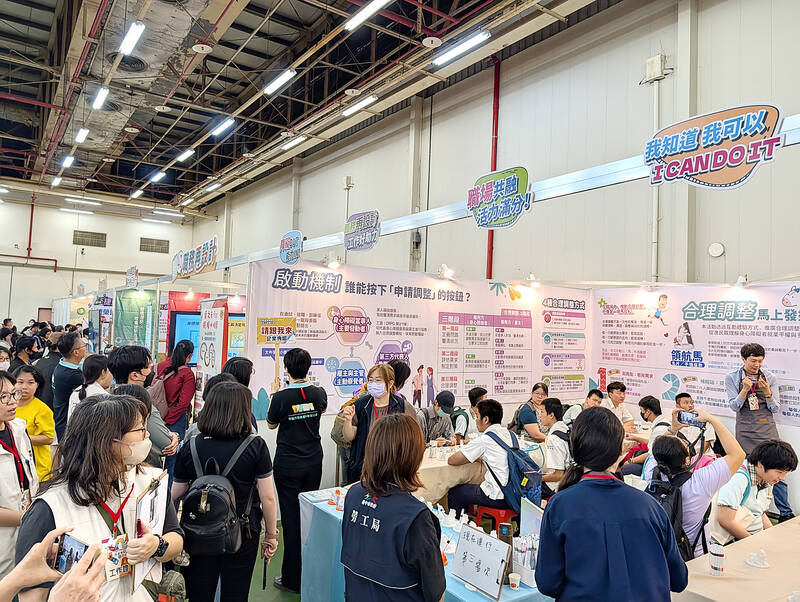
Photo: CNA
“The labor market remained stable amid favorable economic conditions, and the unemployment rate is likely to continue its seasonal decline over the final two months of the year,” Census Department Deputy Director Tan Wen-ling (譚文玲) told a news conference in Taipei.
The labor force participation rate rose to 59.63 percent last month, its highest level in almost 37 years, as more women and older people entered the workforce amid government efforts toward their inclusion, Tan said.
However, Taiwan’s persistently low birthrate poses a longer-term challenge to labor supply as the working-age population continues to shrink, she said.
The number of unemployed people fell by 1,000, or 0.22 percent, to 404,000, as a 3,000 decline in first-time jobseekers more than offset a 2,000 increase in people who had left their previous jobs, DGBAS data showed.
University graduates had the highest unemployment rate among education groups, at 4.45 percent, followed by people with postgraduate degrees at 3.13 percent and those with senior-high school or vocational-high school qualifications at 3.08 percent, the data showed.
Younger workers continued to face greater challenges entering the job market, as the unemployment rate among people aged 15 to 24 stood at 11.46 percent, largely reflecting first-time job searches and difficulties adjusting to workplace requirements, the DGBAS said. The rate was 5.75 percent among those aged 25 to 29 and 3.45 percent among those aged 30 to 34.
Despite the overall improvement, the average duration of unemployment lengthened by 1.4 weeks to 20.3 weeks last month, the agency said.
The number of people who had been unemployed for at least a year rose by 3,000 from the previous month to 45,000, unchanged from a year earlier, it said.
Taiwan’s seasonally adjusted unemployment rate of 3.33 percent remained relatively high compared with other Asian economies, including Singapore at 3 percent, South Korea at 2.5 percent and Japan at 2.4 percent, the DGBAS said.

Taiwan Semiconductor Manufacturing Co (TSMC, 台積電) said yesterday that its subsidiary TSMC Partners Ltd had acquired 6,024,096 shares in US artificial intelligence (AI) company Anthropic PBC for about US$500 million. TSMC Partners paid US$83 per share, the price of Anthropic’s initial public offering (IPO), giving TSMC a stake of about 0.03 percent, according to a regulatory filing by the world’s largest contract chipmaker. Anthropic, the developer of the Claude AI assistant, priced its IPO on Wednesday at a valuation of about US$1.5 trillion. Its shares were scheduled to begin trading on the NASDAQ yesterday under the ticker symbol "ANT." The purchase was primarily
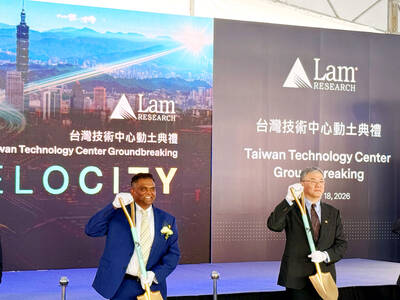
R&D EXPANSION: An executive told a ceremony that the lab, which is set to open in 2028, would increase its overall cleanroom capacity in Taiwan by over nine times US chipmaking equipment supplier Lam Research Corp yesterday broke ground on a technology center in Miaoli County’s Jhunan Township (竹南), a facility set to play a key role in the company’s five-year, US$3 billion global research and development (R&D) expansion. The investment — which would increase the firm’s cleanroom capacity in Taiwan more than ninefold — aims to improve the company’s R&D, testing and validation capabilities, enabling engineering teams to collaborate more closely with customers and accelerate the transition from technology development to fab adoption, Lam Research said. “When this lab opens in 2028, it will have more than 40,000 square meters
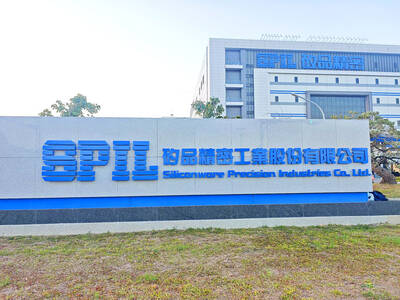
CAPACITY BOOST: The agreement ‘helps secure the advanced packaging capacity and turnkey production needed to meet demand,’ an Nvidia executive said Siliconware Precision Industries Co (SPIL, 矽品精密) yesterday unveiled a new multibillion-dollar deal with Nvidia Corp, aiming to scale up its advanced packaging capacity in Taiwan to support booming demand for artificial intelligence (AI) infrastructure. Under the deal, SPIL would execute a multiyear expansion to triple its advanced packaging capacity by the middle of 2029 and support Nvidia’s platforms, the subsidiary of ASE Technology Holding Co (日月光投控) said in a statement. The expansion includes new production lines for turnkey support from bumping, assembly and testing, as well as facility upgrades, interposer wafer fabrication and increased automation — steps designed to shorten lead
Taiwan Semiconductor Manufacturing Co (TSMC, 台積電) is tightening restrictions on Chinese chip designers, suspending some previously permitted advanced manufacturing orders and generally limiting affected customers to older chipmaking technology, according to two people familiar with the matter. The move could close one of the last remaining routes for Chinese companies to produce powerful artificial intelligence (AI) processors, complicating Beijing’s efforts to develop domestic alternatives to chips designed by Nvidia Corp and manufactured by TSMC. The world’s largest contract chipmaker has instructed that affected orders using manufacturing processes of 16 nanometres and below be halted unless customers obtain US export licences, the people


 RSS