

Industrial production rose more than 19 percent year-on-year last month, driven by the artificial intelligence (AI) boom, marking the 31st consecutive month of growth, the Ministry of Economic Affairs said yesterday.
The industrial production index rose 19.17 percent from a year earlier to 140.76 last month, while the manufacturing subindex, which accounts for more than 90 percent of total production, rose 20.21 percent to 143.31, ministry data showed.
In the third quarter, industrial production rose 21.95 percent year-on-year, with the manufacturing subindex up 23.05 percent, while in the first nine months of the year, industrial production grew 20.53 percent, with the manufacturing subindex up 21.83 percent, the data showed.
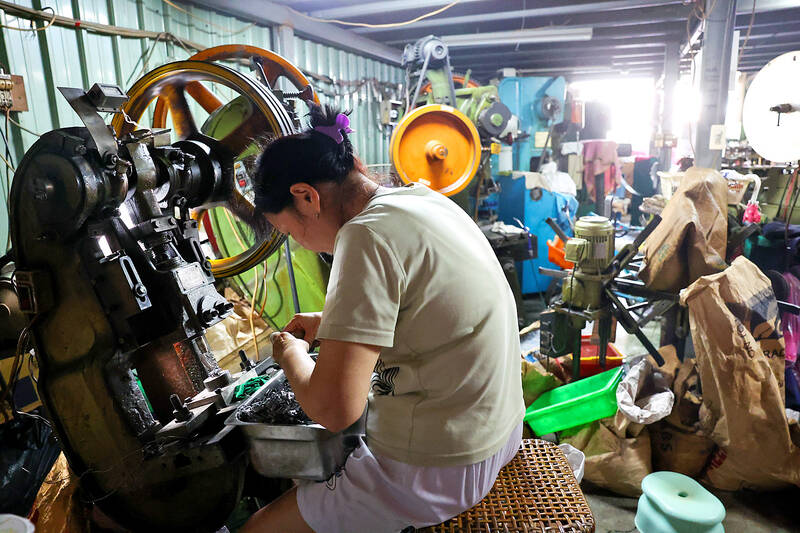
Photo: CNA
The export-oriented manufacturing sector continued to benefit from strong global demand for AI applications, high-performance computing devices and cloud services, the ministry said in a statement.
Launches of new consumer electronics by international brands also boosted Taiwan’s information and electronic components industries, while also lifting non-tech manufacturers, the statement said.
Last month, production in the electronic components industry rose 23.62 percent year-on-year, led by 12-inch wafer foundries, integrated circuit (IC) packaging and testing firms, memorychip suppliers, IC designers and IC substrate makers, it said.
Production in the computer, electronic and optical products industry soared 45.92 percent last month from a year earlier as AI development pushed up demand for AI servers, switches, semiconductor inspection equipment and solid-state drives, the statement said.
That marked the 39th straight month of growth, the ministry said.
With semiconductor suppliers installing equipment to expand capacity, production in the machinery industry rose 26.02 percent year-on-year, while base metal production rose 1.39 percent on a recovery in demand, it said.
Bucking the trend, production in the chemical material and fertilizer industry fell 4.29 percent year-on-year due to slower demand and reduced output during annual maintenance, it said.
Production of autos and auto parts rose 2.35 percent year-on-year, driven by higher output of electric passenger cars and all-terrain vehicles, it said.
Looking ahead, the global AI boom and year-end holiday shopping season are expected to continue supporting Taiwan’s industrial production for the rest of the year, although geopolitical tensions and major economies’ trade policies could continue to create uncertainty for the global economy, the ministry said.
Manufacturing production is expected to expand by 20.5 to 24.2 percent year-on-year this month, it added.
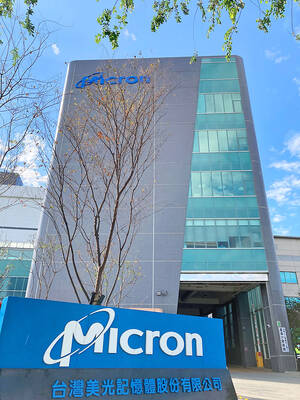
STOCK, CASH: Quarterly profit-sharing bonuses would supplement payments under the Incentive Pay Plan, offering ‘transparency’ and ‘predictability,’ an executive said Micron Memory Taiwan Co (台灣美光) yesterday unveiled a new profit-sharing program and structural wage hikes as part of its efforts to build a predictable and transparent compensation framework in response to feedback from unions. The memorychip maker, a subsidiary of US-based Micron Technology Inc, announced the major compensation structural overhaul during an online news conference following a milestone agreement with the union representing more than 10,000 workers at its Taichung facility. Under the new framework, quarterly profit-sharing bonuses would supplement payments under the Incentive Pay Plan (IPP), the company said. The IPP formula has also been substantially enhanced, it said. “Profit-sharing mechanisms are common

Micron Memory Taiwan and a union representing workers at its Taichung operations today said they had signed a labor-management agreement covering multiple issues, prompting both sides to withdraw from mediation scheduled for tomorrow. The joint statement did not disclose the terms of the agreement, saying the company and the union would separately communicate details to affected employees in the coming days. Idaho-based Micron, the world's third-largest memory chipmaker, employs about 15,000 people in Taiwan, a key manufacturing base where it produces DRAM and high-bandwidth memory chips used in artificial intelligence (AI) servers. Any disruption to Micron's Taiwan operations could affect already strained global
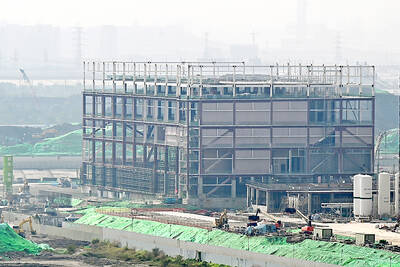
Taiwan Semiconductor Manufacturing Co (TSMC, 台積電) is suspending some construction work after an accident at one of its building sites in southern Taiwan led to the deaths of four workers. The incident took place on Tuesday during steel structure construction at TSMC’s Fab 22 in Kaohsiung, the company said. Workers fell from a height while performing steel structure hoisting and installation, a report from the Central News Agency said. A cause might be aged bolts, it said, citing a preliminary assessment by the Southern Taiwan Science Park Bureau. The bureau said that work would only resume after Shang Hao Machinery Co (上昊機械),

AGREEMENT REACHED: The joint statement did not disclose the details of the deal, which comes a day before the Taoyuan union is to hold a strike Micron Memory Taiwan Co (台灣美光) and a union representing workers at its Taichung operations yesterday said that they had signed a labor-management agreement covering multiple issues, prompting both sides to withdraw from mediation scheduled for today. The joint statement did not disclose the terms of the agreement, saying the company and the union would separately communicate details to affected employees in the coming days. Idaho-based Micron, the world’s third-largest memory maker, employs about 15,000 people in Taiwan, a key manufacturing base where it produces DRAM and high-bandwidth memory chips used in artificial intelligence (AI) servers. Any disruption to Micron’s Taiwan operations could affect


 RSS