

Camera lens supplier Young Optics Inc (揚明光學) yesterday said it expects shipments this quarter to decline sequentially due to soft demand, partly because customers’ planned changes to new logistics projection lenses could delay or suspend demand.
Shipments of 3D printing products this quarter are expected to increase slightly as customers begin testing new models, Young Optics said in a statement to the Taiwan Stock Exchange.
Shipments from other product lines are expected to remain flat or decline slightly from last quarter as customers become more cautious about year-end inventory management, the company said.

Photo: Ou Yu-hsing, Taipei Times
Young Optics yesterday posted a second consecutive quarterly decline in net profit of NT$1.22 million (US$37,529) last quarter, slumping 76.25 percent from NT$5.14 million the previous quarter. That represented an improvement from a net loss of NT$10.08 million a year earlier, company data showed.
Earnings per share were NT$0.01, down from NT$0.05 the previous quarter, but up from losses per share of NT$0.09 a year earlier.
Gross margin rose to 16.8 percent last quarter from 16.44 percent in the second quarter, but was down from 17.02 percent a year earlier.
In the third quarter, shipments of smart home products were flat from the previous quarter as continued growth in new models shipments was offset by the phaseout of older low-end lens products, Young Optics said.
Shipments of optical components increased quarter-on-quarter as customers’ new augmented reality (AR) glasses entered mass production, while 3D printing product shipments slowed as customers adjusted inventories of older models and conducted verification of new models, it said.
Automotive product shipments increased slightly as new lidar lens models entered mass production and replaced older models, the company added.
The third-quarter shipment trends largely matched the guidance provided in July.
In the second quarter, automotive products accounted for about 15 to 20 percent of Young Optics’ NT$738.28 million in revenue, while optical components made up 25 to 30 percent, company president Cynthia Chang (張雅容) said at the time.
The share of optical components could rise to about 30 percent this year, supported by volume production of logistics projection lenses and AR glasses, Chang said.
Regarding fiber array unit products, the company said two mechanical transfer ferrule projects are undergoing trial production, while molded glass lens arrays and optical transceiver modules remain in the proof-of-concept verification phase, Young Optics said.
The company is also developing new automotive lidar lens products, Young Optics said.
Increases in manufacturing complexity, particularly in molded glass components, could weigh on gross margin during the initial stage of mass production, it said.
Young Optics has three major customers for applications related to AR glasses, mainly supplying optical engine components, said Wayne Lin (林威嶧), another company president.
One customer focuses primarily on swimming goggles, while the others are leading North American customers for AR glasses, Lin said.
One of the two North American customers is already in mass production, while the other began mass production last year and plans to launch a second-generation product in the second half of this year, he said.
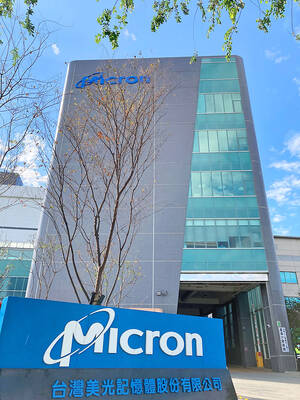
STOCK, CASH: Quarterly profit-sharing bonuses would supplement payments under the Incentive Pay Plan, offering ‘transparency’ and ‘predictability,’ an executive said Micron Memory Taiwan Co (台灣美光) yesterday unveiled a new profit-sharing program and structural wage hikes as part of its efforts to build a predictable and transparent compensation framework in response to feedback from unions. The memorychip maker, a subsidiary of US-based Micron Technology Inc, announced the major compensation structural overhaul during an online news conference following a milestone agreement with the union representing more than 10,000 workers at its Taichung facility. Under the new framework, quarterly profit-sharing bonuses would supplement payments under the Incentive Pay Plan (IPP), the company said. The IPP formula has also been substantially enhanced, it said. “Profit-sharing mechanisms are common

Micron Memory Taiwan and a union representing workers at its Taichung operations today said they had signed a labor-management agreement covering multiple issues, prompting both sides to withdraw from mediation scheduled for tomorrow. The joint statement did not disclose the terms of the agreement, saying the company and the union would separately communicate details to affected employees in the coming days. Idaho-based Micron, the world's third-largest memory chipmaker, employs about 15,000 people in Taiwan, a key manufacturing base where it produces DRAM and high-bandwidth memory chips used in artificial intelligence (AI) servers. Any disruption to Micron's Taiwan operations could affect already strained global

Taiwan Semiconductor Manufacturing Co (TSMC, 台積電) is suspending some construction work after an accident at one of its building sites in southern Taiwan led to the deaths of four workers. The incident took place on Tuesday during steel structure construction at TSMC’s Fab 22 in Kaohsiung, the company said. Workers fell from a height while performing steel structure hoisting and installation, a report from the Central News Agency said. A cause might be aged bolts, it said, citing a preliminary assessment by the Southern Taiwan Science Park Bureau. The bureau said that work would only resume after Shang Hao Machinery Co (上昊機械),

AGREEMENT REACHED: The joint statement did not disclose the details of the deal, which comes a day before the Taoyuan union is to hold a strike Micron Memory Taiwan Co (台灣美光) and a union representing workers at its Taichung operations yesterday said that they had signed a labor-management agreement covering multiple issues, prompting both sides to withdraw from mediation scheduled for today. The joint statement did not disclose the terms of the agreement, saying the company and the union would separately communicate details to affected employees in the coming days. Idaho-based Micron, the world’s third-largest memory maker, employs about 15,000 people in Taiwan, a key manufacturing base where it produces DRAM and high-bandwidth memory chips used in artificial intelligence (AI) servers. Any disruption to Micron’s Taiwan operations could affect


 RSS