

Powerchip Semiconductor Manufacturing Corp (力積電) is negotiating with customers to further hike prices by 10 to 20 percent next year, the logic and memory chipmaker said yesterday, citing persistent capacity constraints across the industry.
The company said it would prioritize capacity allocation for customers under long-term supply agreements with fixed volumes and pricing.
Last quarter, Powerchip raised prices by 23 percent from the previous quarter, and expects another 30 percent increase this quarter, it said.
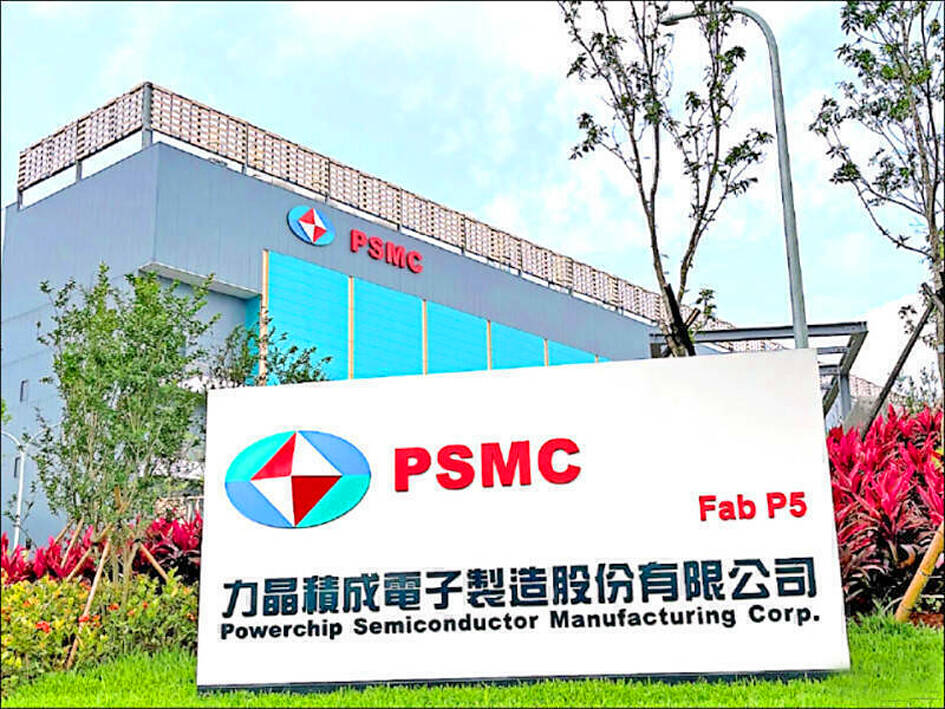
Photo: Grace Hung, Taipei Times
“Provided that artificial intelligence [AI] momentum remains strong, we hold a highly optimistic outlook for 2027 revenue and profitability,” Powerchip president Martin Chu (朱憲國) said at an earnings conference.
The company also unveiled a new capacity expansion plan for the next three to five years, saying that it is scouting a site to build a small-scale chip facility in Taiwan, Japan or Singapore.
The new plant would focus on expanding advanced packaging-related technologies, including post-wafer-finish (PWF) service, interposers used in advanced chip-on-wafer-on-substrate packaging and integrated passive devices (IPD), which are used in AI-related applications, it said.
“We have to expand clean room space to address strong customer demand for those technologies,” Powerchip chairman Brian Shieh (謝再居) said.
Demand for IPD would surge to as many as 50,000 wafers a month in the second half of next year, exceeding its current capacity of 10,000 wafers per month, he said.
To mitigate capital expenditure risks, the company aims to secure 30 to 60 percent of funding for new production line expansions from customers via leasing or prepayments, Shieh said.
Micron Technology Inc has set a precedent by fully funding the manufacturing equipment for Taiwan’s PWF mid-to-back-end packaging expansion through prepayments, he said.
Powerchip is poised to become the world’s sole memory manufacturer producing legacy DRAM from DDR1 to DDR3, utilizing 63-nanometer to 20-nanometer process technologies, Shieh said.
Those technologies are projected to have an extended lifecycle of 10 to 15 years, he said.
The company attributed the ongoing supply crunch to aggressive AI server buildouts, which have spurred massive demand for high-bandwidth memory (HBM) and squeezed mature DDR3 and DDR4 DRAM production.
“As major memory makers aggressively reallocate capacity to HBM and exit mature DRAM, we expect supply tightness for customers,” Chu said. “We anticipate that our niche DRAM foundry pricing will remain robust, showing no signs of a downward adjustment.”
Powerchip attributed the mild pricing weakness in DDR3 DRAM to a temporary supply influx, driven by an enterprise refresh cycle where outdated computers were replaced with AI-capable models.
This pricing softness is expected to be short-lived, the company said.
The company expects revenue to expand by a double-digit percentage sequentially this quarter, after revenue expanded 23 percent last quarter.
Net profit last quarter almost doubled to NT$6.5 billion (US$200 million), from NT$3.29 billion in the previous quarter. That reversed a loss of NT$2.73 billion in the third quarter last year.
Earnings per share rose to NT$1.38 last quarter from NT$0.76 in the previous quarter, while gross margin improved to 48 percent from 28 percent a quarter earlier.
Micron Memory Taiwan and a union representing workers at its Taichung operations today said they had signed a labor-management agreement covering multiple issues, prompting both sides to withdraw from mediation scheduled for tomorrow. The joint statement did not disclose the terms of the agreement, saying the company and the union would separately communicate details to affected employees in the coming days. Idaho-based Micron, the world's third-largest memory chipmaker, employs about 15,000 people in Taiwan, a key manufacturing base where it produces DRAM and high-bandwidth memory chips used in artificial intelligence (AI) servers. Any disruption to Micron's Taiwan operations could affect already strained global

IN GOOD FAITH: Lai said he appreciates Micron’s commitment to Taiwan and that it would continue expanding its investment in the country, while also working with labor President William Lai (賴清德) yesterday called for US memory maker Micron Technology Inc and its workers to negotiate “sincerely” ahead of a possible strike by the company’s union in Taiwan. Last week, a Taiwanese union representing workers at Micron said it had secured authorization from its members to strike over a dispute concerning the company’s bonus scheme, escalating a labor conflict at the chipmaker’s largest manufacturing hub. Micron employs about 15,000 people in Taiwan and has said it invested more than NT$1.6 trillion (US$49.6 billion) in the country. Speaking in Taichung at the opening of a new Micron advanced assembly and testing facility,

China proposed adding advanced artificial intelligence (AI) technologies to its export-control list, potentially restricting overseas transfers of AI models and chip designs in an effort to keep closer control over homegrown advancements in a strategically important sector. The draft proposal covers 23 AI technologies, including large language models, agents, chip designs and computing clusters. Restricted technologies would include model weights and source code for products exceeding certain performance thresholds. Chinese AI startups have this summer made significant progress in closing the gap on US industry leaders. Models such as Moonshot (月之暗面) AI’s Kimi K3 and DeepSeek’s (深度求索) latest editions offer better pricing,
CoreWeave Inc has become caught in a tug of war between investors who see rising bond yields as a potential rally killer for the artificial intelligence (AI) trade and those who think demand for computing power will make those concerns seem passe before long. The cloud-computing services provider’s shares plunged 20 percent in the first three sessions of last week, including more than 15 percent on Wednesday, as its debt tumbled to levels that typically indicate distress. On Thursday morning, the cost of protecting CoreWeave bonds against default rose to the highest intraday level on record, while swaps priced in a


 RSS