

Taiwan’s economy is on track for strong growth this year, driven by booming artificial intelligence (AI) demand, resilient exports and investment, and government efforts to shield consumers from higher energy costs, DBS Bank Ltd said yesterday.
The Singapore-based bank maintained its forecast for Taiwan’s GDP growth at 11.6 percent this year and 5.6 percent next year, DBS senior economist Ma Tieying (馬鐵英) said at a news conference in Taipei.
“The AI cycle remains the key driver of Taiwan’s growth,” Ma said, adding that information and communication products and electronic components accounted for almost 80 percent of the nation’s exports in the first nine months of this year.
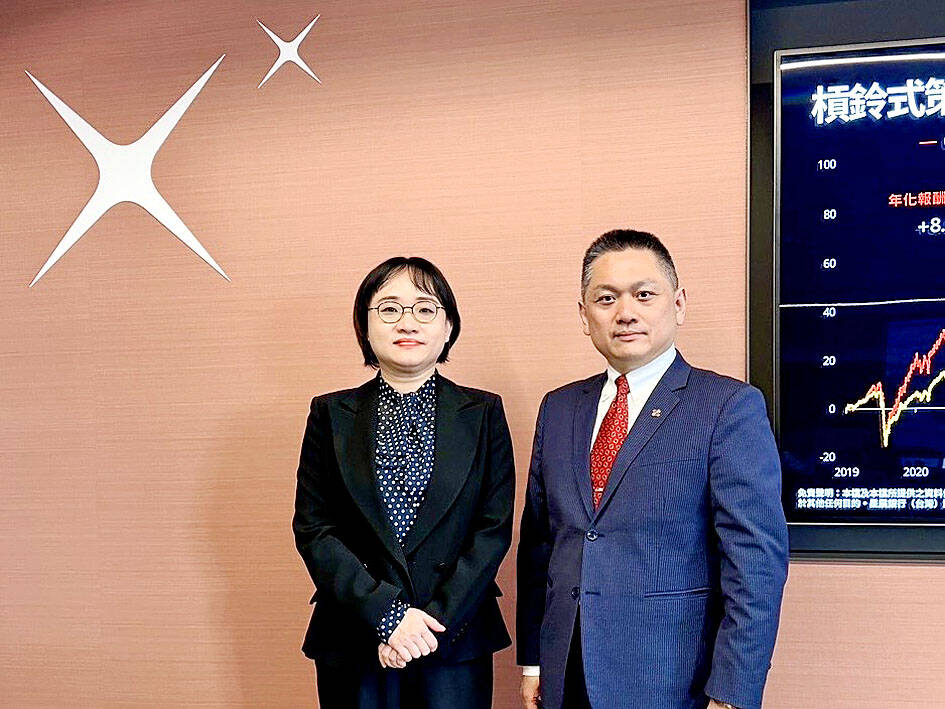
Photo courtesy of DBS Bank Taiwan
Export growth is expected to ease back from unusually high levels from this quarter, but remain robust, broadly tracking capital spending by US cloud service providers and semiconductor sales, she said, adding that Taiwan’s investment should follow a similar trajectory.
Technology companies continue to report strong revenue growth, particularly in semiconductors, servers and personal computers, Ma said.
Rising capacity utilization at leading Taiwanese foundries points to sustained investment demand, she said.
The AI boom is beginning to support domestic demand through growing financial wealth and wages, Ma said. The TAIEX has climbed about 70 percent this year, lifting Taiwan’s stock market capitalization to the world’s fifth largest, she said.
Equities and mutual funds account for almost 30 percent of household financial assets, leaving households better positioned to benefit from rising share prices, she added.
The stock rally has boosted incomes, with wage growth picking up in the services sector, particularly financial services, Ma said.
Strong earnings at financial institutions, especially securities firms, have prompted higher compensation as companies compete to retain talent, she said.
These wealth and income gains should underpin household consumption, she added.
DBS said consumer price growth remains broadly in line with its expectations for inflation.
The bank expects headline inflation to stay close to 2.5 percent this quarter, while maintaining its full-year forecasts of 2 percent this year and 2.1 percent for next year, it said.
Ma said government efforts to contain energy prices have helped limit the impact of higher energy costs on consumers, with state-run CPC Corp, Taiwan (台灣中油) and Taipower Co (台電) absorbing much of the increase.
Mounting losses at the two state-owned companies could put pressure on the government to reconsider its approach, she said.
Authorities need to decide whether to provide additional subsidies to cover the shortfalls or allow increases in domestic energy prices, particularly after local elections next month, Ma said.

IN GOOD FAITH: Lai said he appreciates Micron’s commitment to Taiwan and that it would continue expanding its investment in the country, while also working with labor President William Lai (賴清德) yesterday called for US memory maker Micron Technology Inc and its workers to negotiate “sincerely” ahead of a possible strike by the company’s union in Taiwan. Last week, a Taiwanese union representing workers at Micron said it had secured authorization from its members to strike over a dispute concerning the company’s bonus scheme, escalating a labor conflict at the chipmaker’s largest manufacturing hub. Micron employs about 15,000 people in Taiwan and has said it invested more than NT$1.6 trillion (US$49.6 billion) in the country. Speaking in Taichung at the opening of a new Micron advanced assembly and testing facility,

China proposed adding advanced artificial intelligence (AI) technologies to its export-control list, potentially restricting overseas transfers of AI models and chip designs in an effort to keep closer control over homegrown advancements in a strategically important sector. The draft proposal covers 23 AI technologies, including large language models, agents, chip designs and computing clusters. Restricted technologies would include model weights and source code for products exceeding certain performance thresholds. Chinese AI startups have this summer made significant progress in closing the gap on US industry leaders. Models such as Moonshot (月之暗面) AI’s Kimi K3 and DeepSeek’s (深度求索) latest editions offer better pricing,
CoreWeave Inc has become caught in a tug of war between investors who see rising bond yields as a potential rally killer for the artificial intelligence (AI) trade and those who think demand for computing power will make those concerns seem passe before long. The cloud-computing services provider’s shares plunged 20 percent in the first three sessions of last week, including more than 15 percent on Wednesday, as its debt tumbled to levels that typically indicate distress. On Thursday morning, the cost of protecting CoreWeave bonds against default rose to the highest intraday level on record, while swaps priced in a

Taiwan should not rule out any energy source or abandon environmental sustainability in favor of ideology and short-term benefits, President William Lai (賴清德) said in an interview, calling for a “professional assessment” of whether nuclear power should be reintroduced into Taiwan’s energy mix. In an online interview with influencer Yu Ting-hao (游庭皓) that aired yesterday, Lai reiterated his position on nuclear power. SHIFT Lai’s remarks marked a shift from the Democratic Progressive Party’s (DPP’s) longstanding opposition to nuclear power. As premier from 2017 to 2019, Lai pushed for more gas-fired power capacity while sticking to the DPP’s nuclear free homeland ideology and rejected the


 RSS