

Zhen Ding Technology Holding Ltd (臻鼎), the world’s biggest printed circuit board (PCB) supplier, yesterday said it expects no near-term relief in the supply of PCBs, related components and materials, as demand remains driven by global cloud service providers’ (CSPs) investments in artificial intelligence (AI) infrastructure.
The company’s comments dashed the hope that the supply constraints could be mitigated next year or in 2028. CSPs’ rapid expansion of AI servers is triggering severe supply constraints across the technology industry, spanning AI chips, substrates, PCBs and critical upstream materials such as copper clad laminate, T-glass and glass fiber fabric.
“We haven’t seen any relief in component shortages yet,” Zhen Ding chairman Charles Shen (沈慶芳) said at a media briefing at a trade show organized by the Taiwan Printed Circuit Association in Taipei. “Some people say the material shortage might clear up by 2027 or 2028, but there’s still no sign of it right now.”
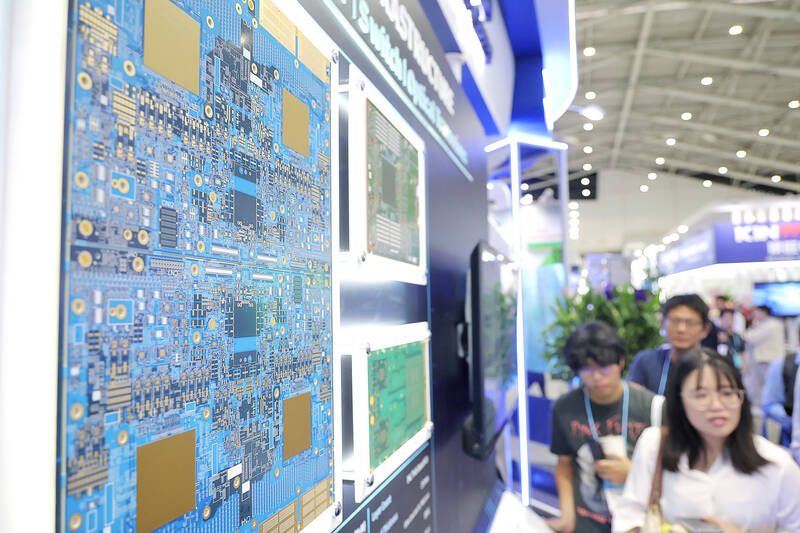
Photo: CNA
In addition to PCB-related components and materials, the company experienced extended lead times for manufacturing equipment, with laser tools seeing lead times stretch to 12 months, he added.
Zhen Ding counts Nvidia Corp, Apple Inc and US-based CSPs among its major customers.
The company sees still-strong AI infrastructure deployment by major CSPs despite stock market volatility on concern about rising borrowing costs, which recently hit a 25-year high.
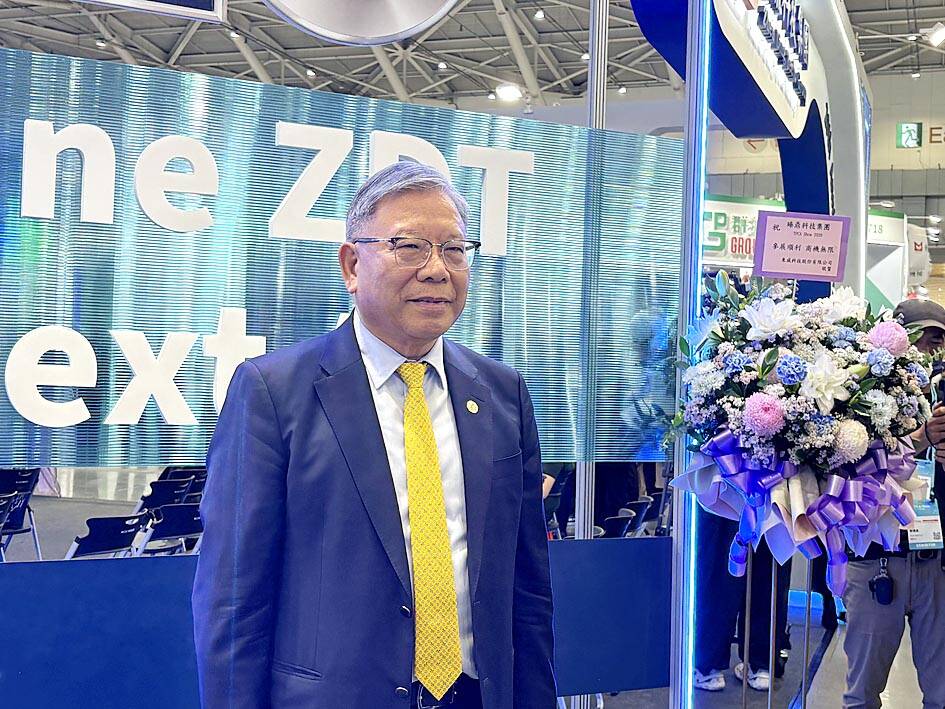
Photo: Lisa Wang, Taipei Times
Asked whether major CSPs would slow down AI server expansion due to surges in funding costs, Shen said the chances are slim.
“Capital remains abundant in the US market now,” he said.
To meet the surging demand for PCBs, the company is aggressively expanding its production capacity through 2030, Shen said.
By then, Zhen Ding expects to operate 59 factories across Taiwan, Thailand and China — more than doubling the current 28, he said.
The company’s capacity expansion matches the growth of the overall PCB market, which according to the Taiwan Printed Circuit Association is expected to surge to NT$130 billion to NT$140 billion (US$3.99 billion to US$4.29 billion) in 2030, compared with NT$80 billion to NT$90 billion last year.
A significant share of that new capacity would be utilized to produce high-density interconnects (HDI) and optical modules, which are used in AI servers, the company said.
Optical modules are a new growth engine, with revenue expected to rise next year from this year, Shen said.
That should boost the revenue share for HDIs to 38 percent in 2030, after surpassing revenue contribution from flexible printed circuit boards in 2028 for the first time, Shen said.
Flexible PCB, which is the company’s largest revenue contributor, should decline to about 20 percent in 2030, followed by rigid PCB to about 10 percent, he said.
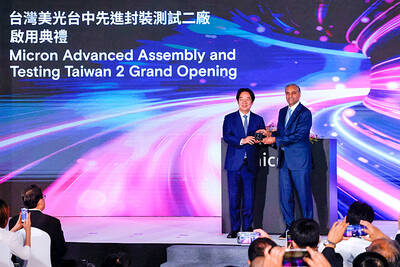
IN GOOD FAITH: Lai said he appreciates Micron’s commitment to Taiwan and that it would continue expanding its investment in the country, while also working with labor President William Lai (賴清德) yesterday called for US memory maker Micron Technology Inc and its workers to negotiate “sincerely” ahead of a possible strike by the company’s union in Taiwan. Last week, a Taiwanese union representing workers at Micron said it had secured authorization from its members to strike over a dispute concerning the company’s bonus scheme, escalating a labor conflict at the chipmaker’s largest manufacturing hub. Micron employs about 15,000 people in Taiwan and has said it invested more than NT$1.6 trillion (US$49.6 billion) in the country. Speaking in Taichung at the opening of a new Micron advanced assembly and testing facility,

China proposed adding advanced artificial intelligence (AI) technologies to its export-control list, potentially restricting overseas transfers of AI models and chip designs in an effort to keep closer control over homegrown advancements in a strategically important sector. The draft proposal covers 23 AI technologies, including large language models, agents, chip designs and computing clusters. Restricted technologies would include model weights and source code for products exceeding certain performance thresholds. Chinese AI startups have this summer made significant progress in closing the gap on US industry leaders. Models such as Moonshot (月之暗面) AI’s Kimi K3 and DeepSeek’s (深度求索) latest editions offer better pricing,
CoreWeave Inc has become caught in a tug of war between investors who see rising bond yields as a potential rally killer for the artificial intelligence (AI) trade and those who think demand for computing power will make those concerns seem passe before long. The cloud-computing services provider’s shares plunged 20 percent in the first three sessions of last week, including more than 15 percent on Wednesday, as its debt tumbled to levels that typically indicate distress. On Thursday morning, the cost of protecting CoreWeave bonds against default rose to the highest intraday level on record, while swaps priced in a

Taiwan should not rule out any energy source or abandon environmental sustainability in favor of ideology and short-term benefits, President William Lai (賴清德) said in an interview, calling for a “professional assessment” of whether nuclear power should be reintroduced into Taiwan’s energy mix. In an online interview with influencer Yu Ting-hao (游庭皓) that aired yesterday, Lai reiterated his position on nuclear power. SHIFT Lai’s remarks marked a shift from the Democratic Progressive Party’s (DPP’s) longstanding opposition to nuclear power. As premier from 2017 to 2019, Lai pushed for more gas-fired power capacity while sticking to the DPP’s nuclear free homeland ideology and rejected the


 RSS