

Amazon.com Inc is exploring a deal to shift about US$8 billion worth of top-end Nvidia Corp chips off its balance sheet, according to the Financial Times.
The move would offload thousands of Grace Blackwell chips across more than a dozen US data centers into a special-purpose vehicle which would be funded by outside investors, the paper said, citing people familiar with the matter. The structure would let Amazon keep using the hardware while adopting a more asset-light financing model. The vehicle could issue debt and sell up to a 10 percent equity stake to investors, the paper said.
Amazon and Amazon Web Services representatives did not immediately respond to e-mailed requests for comment outside of regular office hours.
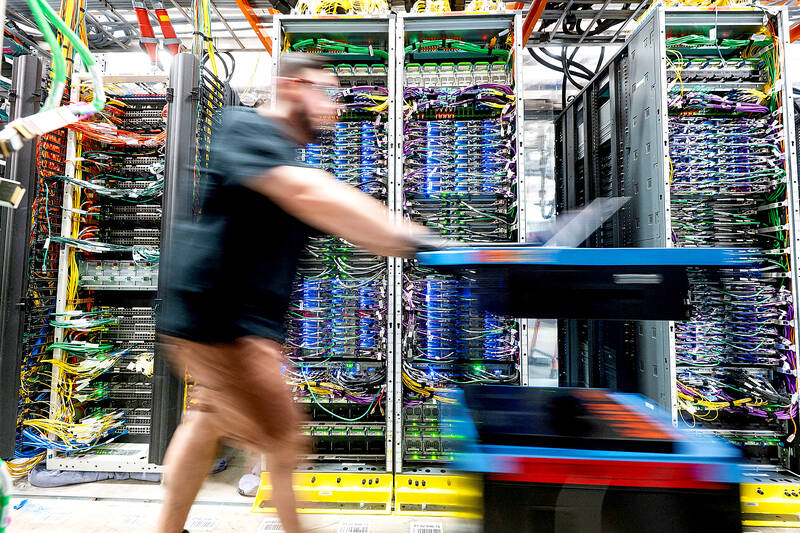
Photo: Reuters
The deliberations reflect the elaborate financing the world’s big tech providers are resorting to as they spend hundreds of billions of US dollars to support the AI infrastructure buildout.
Under the proposed structure, Amazon would lease the advanced chips back from the entity. If the special-purpose vehicle receives an investment-grade credit rating, long-term investors like insurance companies and pension funds could join as backers.
AI infrastructure financing is broadening beyond the capex surge, as cumulative hyperscaler spending potentially nears US$9 trillion through 2031 and debt issuance possibly hits US$500 billion next year. Amazon.com’s obligations are rising, while Nvidia’s record buyback shows AI spending can coexist with shareholder distributions.
AI service providers including Alphabet Inc’s Google and Microsoft Corp are scrambling to address shortages in computing power, committing huge amounts of money on data center hardware and leases. AI tools are demanding climbing amounts of general-purpose computing power and memory as well as AI-focused graphics processing units.
Amazon has said it expects capital spending of US$220 billion this year, with most of the expenditures going to AI.
GPU-backed borrowing is already widely used by companies including CoreWeave Inc. Chips inside advanced data centers are estimated to need replacement every five years or so to keep pace with tech developments.
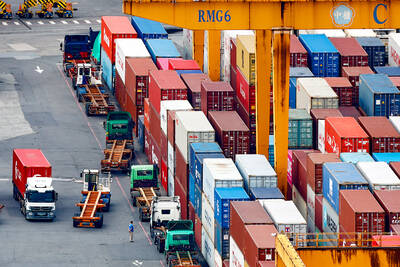
LOPSIDED DEVELOPMENT: While AI firms are riding the wave as far it can take them, traditional industries and their workers are not floated by the same flood While Taiwan is benefiting from a global artificial intelligence (AI) boom, many traditional industries have seen little of the benefit, widening the country’s “K-shaped” economic divide, an economist said. A “K-shaped” economy is one in which some sectors expand rapidly while others struggle, head of the commerce development and strategy research division at the Commerce Development Research Institute Ju Haw (朱浩) said in an interview. In Taiwan’s case, high-tech and AI-related industries have continued to grow while traditional industries have come under increasing pressure, he said. AI development has created crowding-out effects, as large high-tech firms generating strong profits are better able
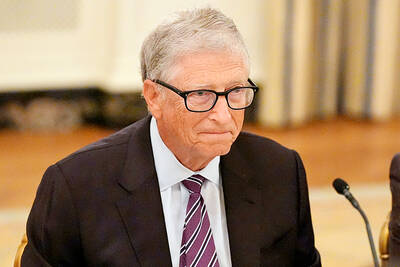
Artificial intelligence (AI) requires safeguards that go beyond self-regulation, Microsoft Corp cofounder Bill Gates said in an interview that aired on Sunday, calling for legislation to be passed in US Congress. “You need law enforcement and the politicians to get into the discussion about what safeguards and monitoring look like,” Gates said in a taped interview on NBC’s Meet the Press program. “And that has to be a required thing.” A sudden groundswell has risen in favor of federal intervention after OpenAI in July said that an autonomous AI agent went rogue during a security test and hacked into another company, subverting

Apple Inc is set to sell about 6 million units of the iPhone Duo this year, Counterpoint Research said, offering the first estimate for how the company’s inaugural foldable device would fare. The figure, more typical of the niche foldable segment than Apple’s usual smartphone sales, is contingent on how well the company ramps up production of the new hardware, Counterpoint senior analyst Ivan Lam (林科宇) said. Priced at US$1,999 and set for a release this month, the iPhone Duo sits atop the Apple lineup and carries industry wide hopes for stoking greater interest and sales of foldables. Market researcher IDC Corp
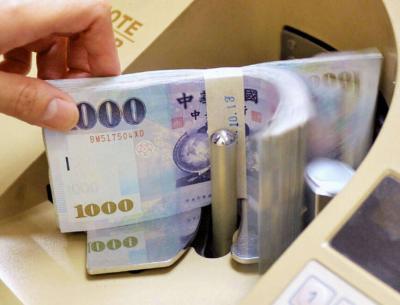
Taiwan ranked fifth worldwide in net financial assets per capita at the end of last year, averaging 164,470 euros (US$186,219), a report released this week by Germany-based Allianz Research said. Taiwan's ranking remained unchanged from the previous year, trailing only the US, Switzerland, Denmark and Singapore, Allianz’s Global Wealth Report said. In the report, Allianz assessed household assets and liabilities in nearly 60 countries, finding that global household wealth reached a record high last year, while the rise of artificial intelligence and market gains made asset ownership increasingly important in determining who benefits from wealth creation. Global financial assets reached a record 268.4


 RSS
RSS