

Fund managers wading back into South Korean memory makers’ stocks got a fresh gut check after DeepSeek’s latest artificial intelligence (AI) model raised doubts on the strength of demand.
SK Hynix Inc and Samsung Electronics Co shares dipped 2.2 and 3.5 percent respectively yesterday, paring their nascent rebound from July’s steep selloff. DeepSeek’s comment that it has reduced the amount of high-bandwidth memory required in its AI models added to concerns on tech amid fears of US interest rate hikes.
Sentiment toward the chip duo had been improving on signs of continued Big Tech spending, along with cheap stock valuations, bumper earnings and generous shareholder returns. While most investors see the latest DeepSeek development as a short-term setback, the latest declines show the rebound would not be linear.

Photo: Reuters
“DeepSeek’s new model could stoke concerns about a slowdown in semiconductor demand in the near term,” Eugene Asset Management chief investment officer Ha SeokKeun said. Still, new models from the likes of Meta Platforms Inc and OpenAI “will have a greater impact on the industry’s fundamentals by boosting actual AI usage and semiconductor demand.”
Local retail traders drove a feverish rally in Samsung and SK Hynix earlier this year before abruptly reversing course on a severe bout of AI skepticism. They have been rapidly exiting leveraged exchange-traded funds tied to the chipmakers, and have sold about US$10 billion worth of the two stocks this month alone.
Daily swings being less dictated by the whims of retail investors has tempted the return of some foreign funds, which have been large sellers year to date.
“We are definitely more positive on [South] Korean memory chipmakers than anything else in semiconductors,” said Isaac Thong, senior investment director and manager of the Aberdeen Asian Income Fund in Singapore. Based on a blend of price-to-book and price-to-earnings valuations, “these stocks look cheap, especially compared to global peers,” he added.
Samsung trades at 2.7 times current book value and SK Hynix at five times, compared with 11 times for the Philadelphia Semiconductor Index. The South Korean memory stocks are trading at about four times forward estimated earnings, versus 19 times for the gauge of global chipmakers.
However, the two South Korean memory stocks remain more than 25 percent below their all-time highs, with investors still spooked by wild swings on daily news and position adjustments.
“These names are going to be volatile. For most investors, there are ways to get the same returns with a lot less volatility,” Tuttle Capital Management chief executive officer Matthew Tuttle said.
Despite the decrease in leverage and measures implemented by regulators to restore calm, daily moves of 5 percent or more are still common for Samsung and SK Hynix. Given the strong fundamentals, foreign investors might return when there is a significant decrease in volatility, Fibonacci Asset Management Global chief executive officer Jung In Yun said.
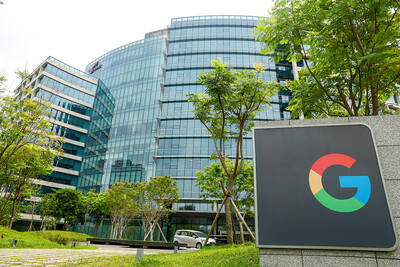
READJUSTMENT? Despite the rumors, a senior Google official said that the company plans to expand its AI research center in Taipei’s Shilin District Google Taiwan is reducing its workforce as the company continues to adjust operations to improve efficiency and focus resources on core goals, the Chinese-language Liberty Times (sister paper of the Taipei Times) reported yesterday. The Alphabet Inc unit said the organizational adjustments have begun and would continue, even though it did not put a figure on the number of potential job cuts or specify the affected departments in its Taiwan operations. The company’s response came after rumors circulated on social media about major job cuts at Google Taiwan. Some posts said the downsizing would target the company’s consumer electronics-related departments
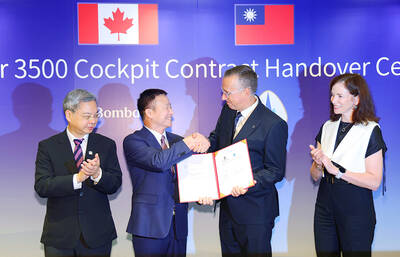
Taiwanese aircraft maker Aerospace Industrial Development Corp (AIDC, 漢翔航空) yesterday announced that it has secured a 20-year partnership agreement with Canada-based Bombardier Inc. The two companies held a ceremony in Taipei yesterday to exchange signed copies of the agreement, launching the 20-year partnership under which AIDC would supply cockpit and forward fuselage structural components for Bombardier’s super-midsize Challenger 3500 business jets, the Taiwanese company said. The agreement represents a new milestone in cooperation between the two companies, which dates back to 1999, with the Taiwanese supplier having provided rear fuselage structural components for more than 1,000 Challenger 3500 aircraft, it
FOUNDRY DATA: Demand pushed production on some TSMC lines to full utilization, while Samsung’s market share of 5.9 percent dropped, TrendForce said Taiwan Semiconductor Manufacturing Co’s (TSMC, 台積電) foundry market share edged up to 72.5 percent in the second quarter from 72.3 percent in the previous quarter, propelled by robust artificial intelligence (AI) and smartphone chip revenue, data compiled by market researcher TrendForce Corp (集邦科技) showed yesterday. TSMC’s revenue last quarter grew 12 percent sequentially to US$40.2 billion, outpacing the 11.5 percent average growth among the world’s top 10 foundry companies, the researcher said. Combined revenue of the top 10 is expected to grow further this quarter from US$53.49 billion last quarter, supported by strong demand and price hikes, it said. The increased demand has

Global notebook computer shipments are expected to fall 8 percent year-on-year to 167.9 million units this year, dragged by weak demand, high component prices and supply constraints, the Market Intelligence and Consulting Institute (MIC) said on Tuesday. Next year, shipments are expected to decline by a further 4.7 percent to 160 million units as higher retail prices weigh on consumption, MIC deputy director-general Edward Lin (林柏齊) told a news conference in Taipei. The downtrend is expected to extend into 2028, with replacement demand unlikely to recover before supplies of key components rebound and costs decline, Lin said. Surging demand for artificial intelligence (AI)


 RSS
RSS