

Global server shipments this year are expected to grow 15.1 percent year-on-year to 16.6 million units, while artificial intelligence (AI) server shipments are forecast to rise 20.7 percent to 4.6 million units, the Market Intelligence and Consulting Institute (MIC) said yesterday.
Next year, global server shipments are estimated to grow 12.4 percent year-on-year to 18.6 million units and AI server shipments are predicted to rise about 18 percent to 5.4 million units, MIC deputy director-general Edward Lin (林柏齊) told a news conference in Taipei.
Growth next year would be driven by AI infrastructure investment by major cloud service providers and AI model developers, as well as neocloud providers’ accelerated deployment of computing capacity to meet global inference demand, he said.
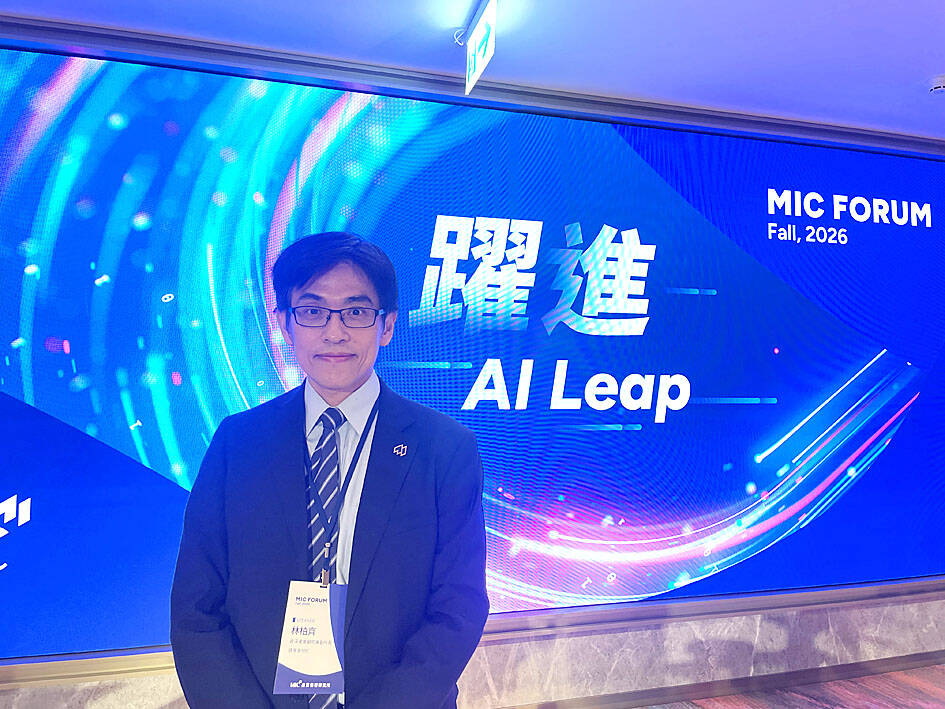
Photo: Meryl Kao, Taipei Times
Robust AI infrastructure momentum is expected to continue through 2028 and is unlikely to fade before 2030, Lin said.
Private-sector investment is continuing to grow as cloud service providers, technology companies and data center operators increase spending on servers, networking equipment, memory, power and cooling systems, he said.
Initiatives such as the Stargate Project in the US, the EU’s planned AI Gigafactories and China’s computing network strategy are moving toward the procurement and funding stage, creating new opportunities for Taiwanese and global AI supply chains, he said.
Taiwanese server makers — including Hon Hai Precision Industry Co (鴻海), Quanta Computer Inc (廣達), Inventec Corp (英業達), Wistron Corp (緯創), Wiwynn Corp (緯穎), Pegatron Corp (和碩) and Giga Computing Technology Corp (技鋼) — have accelerated their diversification of production to meet customer demand, Lin said.
Their production sites span Taiwan, China, the US, Southeast Asia and Mexico, he said.
Plants in Thailand and Malaysia are being tasked with higher-end system assembly, while those in Vietnam mainly focus on “Level 6 (L6)” compute-tray assembly, Lin said.
The companies also use Mexico and the US as interconnected manufacturing hubs, with Mexican plants mainly handling Level 10 (L10) assembly, while US plants, being closer to major cloud service providers, focus on Level 11 (L11) assembly, rack configuration and delivery, he said.
The diversification of Taiwanese server production to the US, Mexico and Southeast Asia would be a continuing trend, driven by customer demand for local manufacturing and geopolitical risk management, Lin told the Taipei Times on the sidelines of the forum.
“These manufacturers’ overseas capacity is expected to increase, but Taiwan would remain their main production base for AI servers,” he said.
Taiwan’s server industry would not be hollowed out, as global server demand is still expanding and the value of local production could continue to grow despite some capacity moving abroad, he said.
In the near term, Taiwan is likely to retain production of graphics processing units, next-generation server platform design, prototype development and validation, given its concentration of semiconductor and component suppliers, Lin said.
High-value, compact modules could be shipped overseas for further assembly, he said.
Large systems and rack-scale integration from L10 to L11 are more likely to move closer to overseas customers first, where local assembly can reduce transport and logistics costs, he said.
As manufacturing experience improves later, overseas plants could gradually take on more manufacturing stages, including L6 assembly, he said.
The extent of the shift would depend on whether upstream suppliers establish local operations alongside system makers, he added.
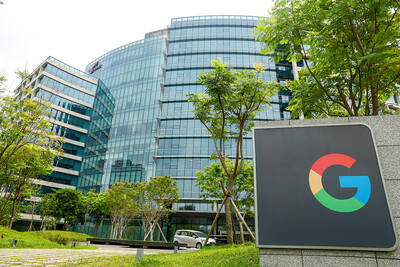
READJUSTMENT? Despite the rumors, a senior Google official said that the company plans to expand its AI research center in Taipei’s Shilin District Google Taiwan is reducing its workforce as the company continues to adjust operations to improve efficiency and focus resources on core goals, the Chinese-language Liberty Times (sister paper of the Taipei Times) reported yesterday. The Alphabet Inc unit said the organizational adjustments have begun and would continue, even though it did not put a figure on the number of potential job cuts or specify the affected departments in its Taiwan operations. The company’s response came after rumors circulated on social media about major job cuts at Google Taiwan. Some posts said the downsizing would target the company’s consumer electronics-related departments
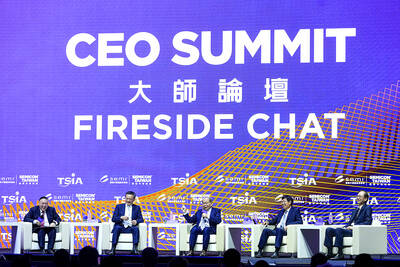
Taiwan Semiconductor Manufacturing Co (TSMC, 台積電) is accelerating capacity expansion fivefold this year, but it is still unable to keep up with the booming demand for artificial intelligence (AI), TSMC deputy cochief operating officer Cliff Hou (侯永清) said yesterday. This year alone, the company is building 25 chip manufacturing fabs and advanced packaging facilities worldwide, including 13 plants in Taiwan, which is unprecedented, Hou said at a CEO Summit fireside chat at Semicon Taiwan in Taipei. In the past, the company was able to build five or six factories a year, said Hou, who is also chairman of the Taiwan Semiconductor Industry
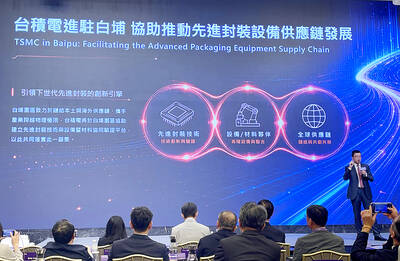
EXPANSION: The 3-hectare site would include small clean rooms and laboratories as well as a world-class training base for advanced packaging talent, the company said Taiwan Semiconductor Manufacturing Co (TSMC, 台積電) is to establish a presence in the Baipu Industrial Park (白埔產業園區) in Kaohsiung to accelerate the testing and validation of semiconductor materials and equipment, a company executive said on Tuesday. The company is working with the Ministry of Economic Affairs and the Kaohsiung City Government on the plan, which is expected to improve validation efficiency by 25 to 50 percent, TSMC vice president of advanced packaging technology and service Jun He (何軍) said at a 3D IC global summit held ahead of the Semicon Taiwan trade show, which opened in Taipei yesterday. TSMC would also conduct
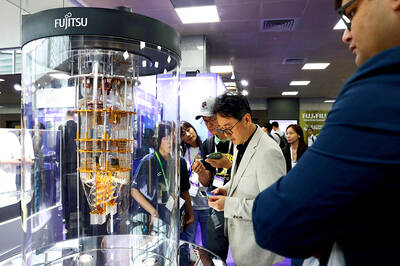
Visitors look at a 64-qubit superconducting quantum computer on display at the Fujitsu booth at the Semicon Taiwan trade show in Taipei yesterday.


 RSS
RSS