

Clients have drifted away from Song Oh-soon’s fortune-telling village on the edge of Seoul, preferring online artificial intelligence (AI)-powered divination to the centuries-old prophesying tradition still practiced there.
At 86, Song is one of the last members of a community of visually impaired practitioners that drew generations of South Koreans seeking answers and advice about everything from illness and money to love and fate.
In one of the world’s most AI-connected societies, the village’s greatest challenge is not fading belief in fortune-telling, but the way it is consumed.
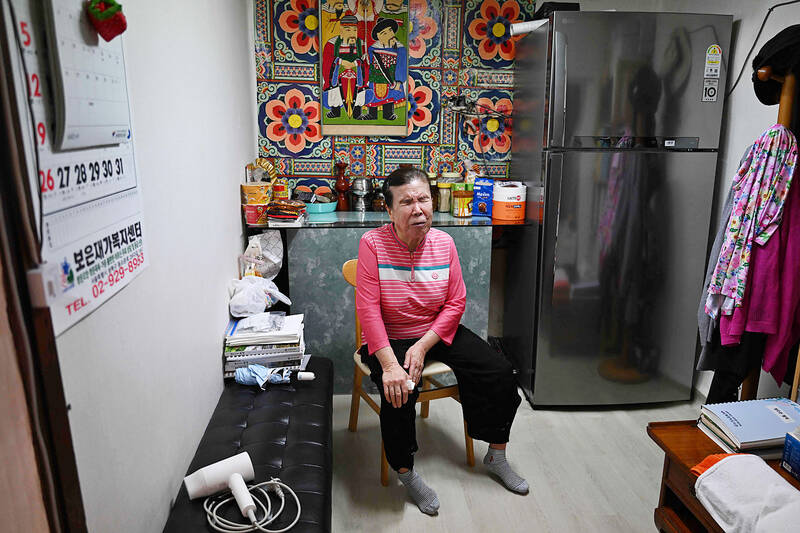
Photo: AFP
Song remains adamantly offline, relying on the “Four Pillars of Destiny” astrology in Braille and on her four decades of experience in careful listening — a skill her automated competition cannot match.
“There were people who came here wanting to die,” Song said in northern Seoul’s Mia village. “I persuaded them to keep living.”
“I also once wanted to die, but I found this work and survived,” she said.
Today, silence is often Song’s only visitor. The community was once home to 70 or 80 practitioners, but fewer than 20 remain.
Many have died. Their shops down narrow alleys sit dark behind faded signs advertising “traditional fortune-telling houses.”
“When I go outside for a walk, it’s quiet,” Song said in her tiny room that serves as home and consulting space. “It feels lonely.”
Figures show South Korea’s fortune-telling business is growing — worth 1.4 trillion won (US$988.2 million) as of 2024, according to start-up analysis firm InnoForest.
Many now turn to mobile apps and AI chatbots such as ChatGPT and Gemini for readings, a survey by market researcher Embrain said this year.
However, occasionally someone still seeks out a human intervention.
University professor Oh Ji-hye for years walked past the village without going inside, opting instead for AI readings during her commute.
Only recently, anxious about her career, did she turn to Song for a phone consultation.
“It felt good that someone rather than AI was concentrating on and listening to my story,” the 44-year-old said.
Mia village emerged in 1966 after the first blind fortune-teller settled there, said the Seongbuk Cultural Centre, which researches the district’s history.
As Seoul boomed in the 1970s and 1980s the neighborhood enjoyed cheap rents and a constant foot traffic of potential customers by the time Song arrived in 1984.
She lost her sight in a childhood illness before the Korean War and by 11 was studying Korean fortune-telling — predicting subjects’ futures based on their birth dates and times.
She was a professional by 16, working in an industry where many people with disabilities — especially women — have been historically confined owing to discrimination.
“Nowadays, if a visually impaired person is musically talented, they can pursue a career in music,” she said. “But back when I lost my sight, there was nothing else I could do besides this job.”
Over her lifetime, South Korea has witnessed the devastation of the 1950-1953 war, periods of military rule and the 1990s financial crisis.
After periods of hardship and loss, the nation has emerged as a global financial powerhouse — with recent astronomical profits from manufacturing AI microchips.
Those gains have lifted the nation’s fortunes. Clients who once came for advice about medical ailments can now head to hospital instead.
However, the technology has drawn away clients from Song’s 50,000-won sessions in favor of free or affordable AI readings.
Most of the remaining practitioners have little online presence, and many cannot be found through major search platforms.
“I don’t think people are less interested in fortune-telling,” Song said. “But these days, they look online, so they do not come all the way to us.”
Despite the village’s decline, Song believes no fate is set in stone.
“If you put in the effort and make wise judgements, good fortune will come your way three times in your life,” she said.
South Korea’s SK Hynix Inc is considering options for its Chongqing, China-based facility, including bringing in an investor to help accelerate growth, people with knowledge of the matter said. The company, a key supplier of high-bandwidth memory chips to Nvidia Corp, is speaking with prospective advisers to help review the business, the people said, asking not to be identified discussing private information. A potential stake sale could value the facility at about US$3 billion, the people said. The Chongqing facility provides a large scale semiconductor packaging and testing base, helping boost the company’s NAND flash back-end production to grow globally. Suitors may include

E.Sun Financial Holding Co (玉山金控) is to formally merge with Mercuries Life Insurance Co (三商美邦人壽) on Sept. 1, creating Taiwan’s fifth-largest listed financial holding company by assets and paving the way for capital injections totaling NT$22 billion (US$683.91 million) to shore up the insurer’s finances, top executives said yesterday. “The first priority after the merger will be to bring the insurer back to health through capital injections,” E.Sun Financial chairman Joseph Huang (黃男州) told a news conference in Taipei ahead of a company earnings call. E.Sun would inject NT$16 billion into Mercuries Life next month, followed by another NT$6 billion next year,

WELL MATCHED: The joint venture would lower Sony’s spending burden to stay relevant in chips, while TSMC secures steady revenue, said an analyst, calling it ‘virtually risk-free’ Taiwan Semiconductor Manufacturing Co (TSMC, 台積電) and Sony Group Corp are in talks to spend a combined ¥1 trillion (US$6.3 billion) on their planned image sensor factory in Japan, a person familiar with the matter said. The companies are seeking to begin production in 2029, the person said, asking not to be named because the talks are private. No time frame was given for the investment under discussion, they said. TSMC and the Japanese company’s chip arm, Sony Semiconductor Solutions Corp, are eyeing demand for artificial intelligence (AI)-wielding robots and self-driving vehicles, which are expected to require more sensors to

Taiwan Semiconductor Manufacturing Co (TSMC, 台積電) yesterday said its board of directors has approved investment of ¥282 billion (US$1.77 billion) to form a joint venture with Sony Semiconductor Solutions Corp to develop and manufacture next-generation image sensors for smartphones in Japan. The joint venture, Advanced Vision Semiconductor Manufacturing Corp, would be sited in Koshi City, Kumamoto Prefecture, TSMC said in a statement. It should commence volume production in 2029, TSMC said. Sony Semiconductor would invest ¥465 billion in the joint venture through a combination of cash and assets, the statement said. These capital contributions are expected to be made in phases based


 RSS
RSS