

Industrial computer maker Ennoconn Corp (樺漢科技) yesterday said revenue in the second half of this year is expected to exceed first-half levels driven by rising demand for smart factory and facility management solutions from semiconductor makers investing in high-tech and automation systems.
Ennoconn’s revenue in the first half grew 23.62 percent from a year earlier to NT$85.49 billion (US$2.67 billion).
Capacity expansion by semiconductor customers would remain a key growth driver for Ennoconn’s smart factory and facility management business in the second half, Ennoconn chairman Steve Chu (朱復銓) told an earnings conference in Taipei.
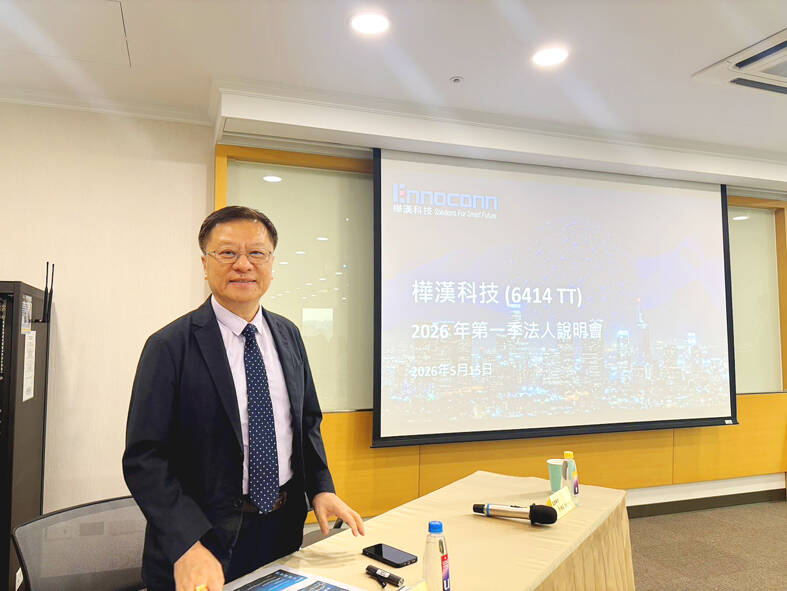
Photo courtesy of Ennoconn Corp
The company since last quarter has benefited significantly from the second-phase expansion of Taiwan Semiconductor Manufacturing Co’s (台積電) US fabs through its 37.88 percent-held subsidiary Marketech International Corp (帆宣), Chu said.
Growth is also expected to be supported by Ennoconn’s project with Atlanta, Georgia-based retail solutions provider NCR Voyix Corp, he said.
The Atlanta project is expected to generate NT$14 billion to NT$16 billion for the full year, with significant revenue contribution starting last quarter, he said.
Based on a strategic partnership agreement signed by the companies in August 2024, Ennoconn took over NCR Voyix’s design and manufacturing, as well as supply of NCR Voyix’s self-checkout, point-of-sale hardware and other financial end devices, he said.
The hardware products entered volume production in April, Chu said.
Products for NCR Voyix have evolved from traditional boards and box PCs into autonomous artificial intelligence (AI) systems integrating sensors, cameras, AI computing and software, lifting gross margin to more than 35 percent, Ennoconn president Nelson Tsay (蔡能吉) said.
Collaboration with NCR Voyix is expected to lift Ennoconn’s overall margin, Tsay said.
Meanwhile, Ennoconn expects to complete its tender offer for German embedded computing subsidiary Kontron AG on Thursday next week, raising its stake to about 49.4 percent.
Kontron has high-margin businesses in Europe, including rail transportation, aerospace and software, with combined revenue exceeding NT$10 billion, Chu said.
Ennoconn plans to leverage its supply chain and market presence in Asia to expand Kontron’s products across the Asia-Pacific region, while the two companies would jointly develop the North American market, the company said.
Ennoconn also plans to introduce its centralized procurement, enterprise resource planning and manufacturing management systems to Kontron, it said.
The deeper integration could generate at least 40 million euros (US$46.27 million) in additional revenue, it said.
The firm holds orders totaling NT$255 billion, up from NT$215 billion last quarter, indicating robust shipment momentum this year, it said.
Ennoconn’s business consists of three main segments: industrial Internet of Things (IoT), which accounted for 46 percent of total revenue in the first half; intelligent software and solutions (12 percent); and smart factory and facility management (42 percent), it said.
Among the three segments, growth from IoT, and smart factory and facility management is expected to be the greatest in the second half, Chu said.
Ennoconn on Thursday reported that first-half net profit rose 21.6 percent year-on-year to NT$1.8 billion. Earnings per share rose to NT$12.31 from NT$10.13 a year earlier.
Gross margin fell to 19.66 percent from 19.86 percent a year earlier as higher component costs weighed on profitability, but is expected to improve as memory-related price rises are passed on to customers starting this quarter, Chu said.
South Korea’s SK Hynix Inc is considering options for its Chongqing, China-based facility, including bringing in an investor to help accelerate growth, people with knowledge of the matter said. The company, a key supplier of high-bandwidth memory chips to Nvidia Corp, is speaking with prospective advisers to help review the business, the people said, asking not to be identified discussing private information. A potential stake sale could value the facility at about US$3 billion, the people said. The Chongqing facility provides a large scale semiconductor packaging and testing base, helping boost the company’s NAND flash back-end production to grow globally. Suitors may include

E.Sun Financial Holding Co (玉山金控) is to formally merge with Mercuries Life Insurance Co (三商美邦人壽) on Sept. 1, creating Taiwan’s fifth-largest listed financial holding company by assets and paving the way for capital injections totaling NT$22 billion (US$683.91 million) to shore up the insurer’s finances, top executives said yesterday. “The first priority after the merger will be to bring the insurer back to health through capital injections,” E.Sun Financial chairman Joseph Huang (黃男州) told a news conference in Taipei ahead of a company earnings call. E.Sun would inject NT$16 billion into Mercuries Life next month, followed by another NT$6 billion next year,
WELL MATCHED: The joint venture would lower Sony’s spending burden to stay relevant in chips, while TSMC secures steady revenue, said an analyst, calling it ‘virtually risk-free’ Taiwan Semiconductor Manufacturing Co (TSMC, 台積電) and Sony Group Corp are in talks to spend a combined ¥1 trillion (US$6.3 billion) on their planned image sensor factory in Japan, a person familiar with the matter said. The companies are seeking to begin production in 2029, the person said, asking not to be named because the talks are private. No time frame was given for the investment under discussion, they said. TSMC and the Japanese company’s chip arm, Sony Semiconductor Solutions Corp, are eyeing demand for artificial intelligence (AI)-wielding robots and self-driving vehicles, which are expected to require more sensors to
Taiwan Semiconductor Manufacturing Co (TSMC, 台積電) yesterday said its board of directors has approved investment of ¥282 billion (US$1.77 billion) to form a joint venture with Sony Semiconductor Solutions Corp to develop and manufacture next-generation image sensors for smartphones in Japan. The joint venture, Advanced Vision Semiconductor Manufacturing Corp, would be sited in Koshi City, Kumamoto Prefecture, TSMC said in a statement. It should commence volume production in 2029, TSMC said. Sony Semiconductor would invest ¥465 billion in the joint venture through a combination of cash and assets, the statement said. These capital contributions are expected to be made in phases based


 RSS
RSS