

The government yesterday raised its economic growth forecast for this year to 11.05 percent, which would be the fastest pace in 39 years, as stronger-than-expected exports, investment and consumption extended the economy’s artificial intelligence (AI)-fueled expansion.
The latest forecast was 1.41 percentage points higher than the previous estimate of 9.64 percent in May, reflecting surging demand for Taiwanese-made AI hardware, stronger private investment and better-than-expected domestic consumption, the Directorate-General of Budget, Accounting and Statistics (DGBAS) said.
“Exports, the biggest contributor to economic growth, have been driven by demand for electronics, and information and communications technology products,” DGBAS Minister Chen Shu-tzu (陳淑姿) told a news conference in Taipei.
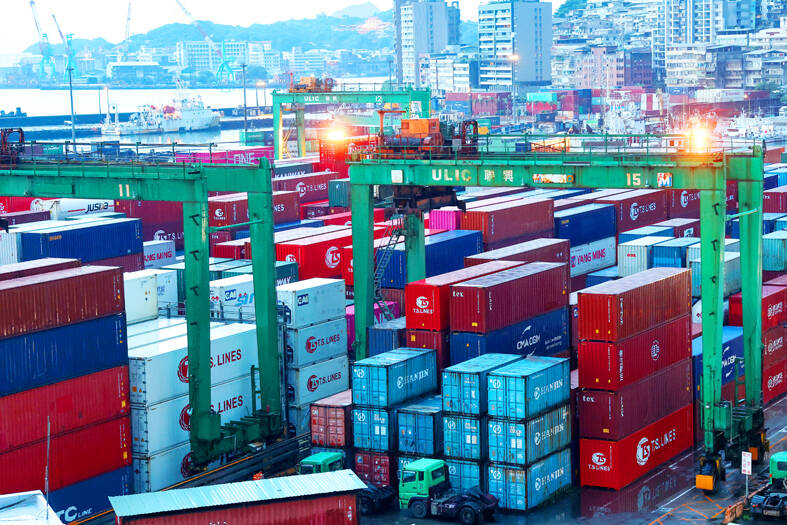
Photo: CNA
Taiwan is at the center of the global AI supply chain and is benefiting as AI applications expand beyond cloud-based training into inference, AI agents and edge devices, driving demand for computing power.
Exports of non-tech products rose 8.6 percent in the first seven months of the year, suggesting that traditional industries are emerging from weakness, said Tsai Yu-tai (蔡鈺泰), head of the DGBAS statistics department.
The economy grew 14.15 percent in the first half and is projected to expand 11.42 percent in the third quarter before slowing to 5.37 percent in the fourth quarter.
Major US cloud service providers continue to ramp up investment in AI infrastructure, while demand for general-purpose accelerators and customized chips remains robust, Tsai said.
Against that backdrop, exports are projected to reach a record US$903.6 billion this year, up 41.19 percent from last year. Exports are also expected to benefit from the recovery in traditional manufacturing and tight supplies of key electronic components, including memory chips, which have pushed up prices.
Private investment is forecast to grow 11.58 percent this year, the fastest pace in five years and 5.15 percentage points higher than the previous estimate.
Demand for AI infrastructure has prompted global customers to secure capacity through advance payments and long-term contracts, encouraging local semiconductor, packaging and testing, memory, substrate and equipment suppliers to accelerate capacity expansion, Tsai said.
The DGBAS also increased its inflation forecast for this year to 2.07 percent, slightly above the central bank’s 2 percent warning threshold, citing higher fuel prices amid tensions in the Middle East.
The inflation outlook remained manageable, Tsai said, adding that consumer prices rose 1.7 percent in the first half, while total wages increased 3.5 percent, meaning real wages were up.
Inflation is unlikely to accelerate sharply and is expected to moderate to 1.9 percent next year, the DGBAS said.
The agency forecast economic growth of 6.04 percent next year, with exports projected to reach US$1.0725 trillion, up 18.7 percent from the projected total for this year released yesterday.
South Korea’s SK Hynix Inc is considering options for its Chongqing, China-based facility, including bringing in an investor to help accelerate growth, people with knowledge of the matter said. The company, a key supplier of high-bandwidth memory chips to Nvidia Corp, is speaking with prospective advisers to help review the business, the people said, asking not to be identified discussing private information. A potential stake sale could value the facility at about US$3 billion, the people said. The Chongqing facility provides a large scale semiconductor packaging and testing base, helping boost the company’s NAND flash back-end production to grow globally. Suitors may include

E.Sun Financial Holding Co (玉山金控) is to formally merge with Mercuries Life Insurance Co (三商美邦人壽) on Sept. 1, creating Taiwan’s fifth-largest listed financial holding company by assets and paving the way for capital injections totaling NT$22 billion (US$683.91 million) to shore up the insurer’s finances, top executives said yesterday. “The first priority after the merger will be to bring the insurer back to health through capital injections,” E.Sun Financial chairman Joseph Huang (黃男州) told a news conference in Taipei ahead of a company earnings call. E.Sun would inject NT$16 billion into Mercuries Life next month, followed by another NT$6 billion next year,
WELL MATCHED: The joint venture would lower Sony’s spending burden to stay relevant in chips, while TSMC secures steady revenue, said an analyst, calling it ‘virtually risk-free’ Taiwan Semiconductor Manufacturing Co (TSMC, 台積電) and Sony Group Corp are in talks to spend a combined ¥1 trillion (US$6.3 billion) on their planned image sensor factory in Japan, a person familiar with the matter said. The companies are seeking to begin production in 2029, the person said, asking not to be named because the talks are private. No time frame was given for the investment under discussion, they said. TSMC and the Japanese company’s chip arm, Sony Semiconductor Solutions Corp, are eyeing demand for artificial intelligence (AI)-wielding robots and self-driving vehicles, which are expected to require more sensors to
Taiwan Semiconductor Manufacturing Co (TSMC, 台積電) yesterday said its board of directors has approved investment of ¥282 billion (US$1.77 billion) to form a joint venture with Sony Semiconductor Solutions Corp to develop and manufacture next-generation image sensors for smartphones in Japan. The joint venture, Advanced Vision Semiconductor Manufacturing Corp, would be sited in Koshi City, Kumamoto Prefecture, TSMC said in a statement. It should commence volume production in 2029, TSMC said. Sony Semiconductor would invest ¥465 billion in the joint venture through a combination of cash and assets, the statement said. These capital contributions are expected to be made in phases based


 RSS
RSS