

Semiconductor equipment manufacturer Skytech Inc (天虹科技) on Wednesday said that it expects customer demand to be high through the second quarter of next year, particularly for equipment used in advanced chip manufacturing and packaging technologies driven by the artificial intelligence (AI) boom.
The company’s new physical vapor deposition devices used in panel-level packaging (PLP) have been rapidly gaining traction, with three machines to be delivered to server customers and one to a US customer in the first quarter next year, Skytech chief executive officer George Yi (易錦良) said in Hsinchu City.
“Customer validation has been exceptionally strong. We are preparing for the shipment of the fifth machine in just eight months since we began developing the equipment last year upon the establishment of new industry standards,” Yi said.
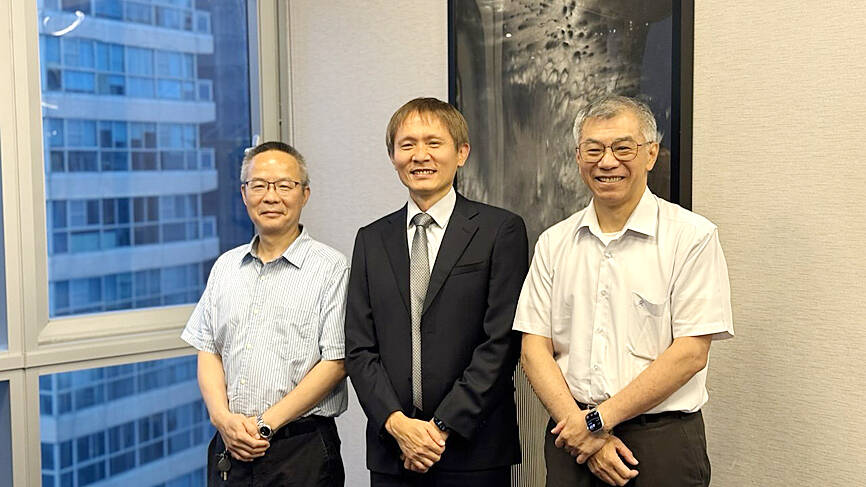
Photo: Lin Yi-ju, Taipei Times
“It usually takes one to two years to develop new semiconductor equipment,” he added.
Last year, the 310mm by 310mm panel size emerged as an industry standard for PLP technology after Taiwan Semiconductor Manufacturing Co (台積電) and ASE Technology Holding Co (日月光投控) replaced circular 300mm wafers with them.
PLP technology is widely expected to be a successor to chip-on-wafer-on-substrate technology, which is used to package Nvidia Corp’s AI chips.
Skytech expects advanced packaging equipment to make up about 40 percent of the company’s total revenue this year, Yi said.
The company also expects indium phosphide-based and silicon-carbide-based wafer manufacturing equipment to become another growth driver, thanks to rapidly growing demand for optical transceiver modules used in AI servers, he said.
This year as a whole, Skytech’s revenue is expected to outgrow last year’s NT$2.24 billion (US$69.63 million), Yi said, after revenue in the first seven months soared 37 percent year-on-year to NT$1.5 billion.
“We have order visibility through the second quarter of next year,” he said.
In the first half of the year, Skytech’s net profit was NT$171 million, up 151.06 percent from NT$68.11 million a year earlier. Earnings per share jumped to NT$2.54 from NT$1.01, while gross margin advanced to 41.71 percent from 40.45 percent.
Revenue expanded 34 percent to NT$1.3 billion from NT$974 million over the same period, company data showed.
South Korea’s SK Hynix Inc is considering options for its Chongqing, China-based facility, including bringing in an investor to help accelerate growth, people with knowledge of the matter said. The company, a key supplier of high-bandwidth memory chips to Nvidia Corp, is speaking with prospective advisers to help review the business, the people said, asking not to be identified discussing private information. A potential stake sale could value the facility at about US$3 billion, the people said. The Chongqing facility provides a large scale semiconductor packaging and testing base, helping boost the company’s NAND flash back-end production to grow globally. Suitors may include
WELL MATCHED: The joint venture would lower Sony’s spending burden to stay relevant in chips, while TSMC secures steady revenue, said an analyst, calling it ‘virtually risk-free’ Taiwan Semiconductor Manufacturing Co (TSMC, 台積電) and Sony Group Corp are in talks to spend a combined ¥1 trillion (US$6.3 billion) on their planned image sensor factory in Japan, a person familiar with the matter said. The companies are seeking to begin production in 2029, the person said, asking not to be named because the talks are private. No time frame was given for the investment under discussion, they said. TSMC and the Japanese company’s chip arm, Sony Semiconductor Solutions Corp, are eyeing demand for artificial intelligence (AI)-wielding robots and self-driving vehicles, which are expected to require more sensors to

China’s humanoid robot makers commanded more than 97 percent of global shipments in the first half of this year, according to new industry data affirming the country’s early lead against US rivals in the burgeoning field. Global humanoid robot shipments totaled about 19,100 units in the first half of this year, more than triple the 5,100 units shipped in the same period last year, data from Smart Analytics Global showed. The California-based research firm said it expects shipments to rise to around 60,000 units this year and reach 500,000 by 2030. Agibot Innovation (Shanghai) Technology Co (智元創新) overtook Hangzhou-based Unitree

Taiwan Semiconductor Manufacturing Co (TSMC, 台積電) yesterday said its board of directors has approved investment of ¥282 billion (US$1.77 billion) to form a joint venture with Sony Semiconductor Solutions Corp to develop and manufacture next-generation image sensors for smartphones in Japan. The joint venture, Advanced Vision Semiconductor Manufacturing Corp, would be sited in Koshi City, Kumamoto Prefecture, TSMC said in a statement. It should commence volume production in 2029, TSMC said. Sony Semiconductor would invest ¥465 billion in the joint venture through a combination of cash and assets, the statement said. These capital contributions are expected to be made in phases based


 RSS
RSS