

SK Hynix Inc plans a 54 trillion won (US$38 billion) expansion of its chipmaking facilities in South Korea, the memorychip maker said in a statement yesterday.
The company is to build a new DRAM manufacturing facility in Yongin and a NAND fabrication plant in Cheongju, with roughly two-thirds of the budget going to the first of them.
The move, covering dynamic memory for the lowest latency and solid-state storage for fast access to greater quantities of data, is in response to “the continuously growing demand for memory in the [artificial intelligence] AI era,” SK Hynix said in the statement.
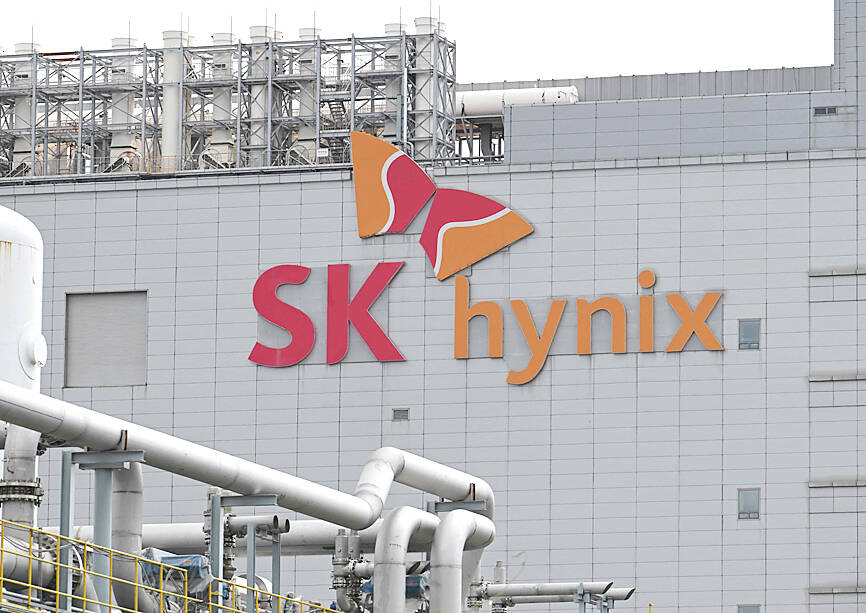
Photo: AFP
The new Yongin Y2 is to be the second of four fabs planned at the Yongin semiconductor cluster, it said.
The company intends to break ground on the project in July next year, targeting June 2029 for opening the first cleanroom en route to producing high-bandwidth memory and other next-generation DRAM.
The Cheongju M17 expansion is to break ground in February next year and its first cleanroom is targeted for the end of 2028.
The investment period runs through April 2031.
A linchpin of the AI infrastructure boom and key partner to Nvidia Corp, SK Hynix has helped drive South Korea’s KOSPI higher, but in recent times it has also turned into a source of massive volatility as sentiment around AI shifts from enthusiasm to doubt.
While the company’s production capacity is sold out through next year and it is increasingly securing long-term deals with customers, questions persist about its ability to sustain the enviable profit margins of today over the long run.
SK Hynix, along with Samsung Electronics Co, has made a large commitment to invest further in building South Korea’s domestic manufacturing and AI capabilities.
The country aims to double its memory production capacity within five years and secure world-class manufacturing capabilities to pull far ahead of competing nations, the South Korean Ministry of Trade, Industry and Resources said in announcing a broad plan at the end of June.
Seoul-traded shares in SK Hynix closed down 4.9 percent yesterday, but trimmed losses to 2.1 percent in post-market trading on Nextrade as of 4:45pm.
The moves come after a separate filing that the company would detail shareholder return plans in the third quarter.
“The company is actively reviewing additional shareholder return initiatives as part of its ongoing commitment to enhancing shareholder value,” it said.

BOOMING BUSINESS: Memory supply constraints would be even more severe in 2027 and 2028, prompting customers to sign long-term supply agreements, Micron said Micron Memory Taiwan Co (台灣美光) yesterday said it is accelerating memorychip capacity expansion amid growing artificial intelligence (AI)-driven demand, with its accumulated investment in Taiwan reaching NT$1.6 trillion (US$50.2 billion) as of June. The company’s investment in Taiwan has surged over the past four years, with recent spending equaling the total invested over the past 25 years, Micron Taiwan chairman Donghui Lu (盧東暉) told a media briefing in Taipei. “The launch of ChatGPT and the outbreak of COVID triggered increasing demand for memory chips. Since then, demand has gathered pace rapidly, with only a brief pause in 2023 when a major downturn”

Artificial intelligence (AI) requires safeguards that go beyond self-regulation, Microsoft Corp cofounder Bill Gates said in an interview that aired on Sunday, calling for legislation to be passed in US Congress. “You need law enforcement and the politicians to get into the discussion about what safeguards and monitoring look like,” Gates said in a taped interview on NBC’s Meet the Press program. “And that has to be a required thing.” A sudden groundswell has risen in favor of federal intervention after OpenAI in July said that an autonomous AI agent went rogue during a security test and hacked into another company, subverting

Apple Inc is set to sell about 6 million units of the iPhone Duo this year, Counterpoint Research said, offering the first estimate for how the company’s inaugural foldable device would fare. The figure, more typical of the niche foldable segment than Apple’s usual smartphone sales, is contingent on how well the company ramps up production of the new hardware, Counterpoint senior analyst Ivan Lam (林科宇) said. Priced at US$1,999 and set for a release this month, the iPhone Duo sits atop the Apple lineup and carries industry wide hopes for stoking greater interest and sales of foldables. Market researcher IDC Corp
Taiwan ranked fifth worldwide in net financial assets per capita at the end of last year, averaging 164,470 euros (US$186,219), a report released this week by Germany-based Allianz Research said. Taiwan's ranking remained unchanged from the previous year, trailing only the US, Switzerland, Denmark and Singapore, Allianz’s Global Wealth Report said. In the report, Allianz assessed household assets and liabilities in nearly 60 countries, finding that global household wealth reached a record high last year, while the rise of artificial intelligence and market gains made asset ownership increasingly important in determining who benefits from wealth creation. Global financial assets reached a record 268.4


 RSS