

Solar module suppliers Sino-American Silicon Products Inc (SAS, 中美晶) and United Renewable Energy Co (URE, 聯合再生) yesterday said they are creating a US$40 million solar module manufacturing venture in the US to capitalize on green energy demand from artificial intelligence (AI) data centers.
“As rapid growth in AI data centers is straining power grids and boosting electricity costs in many US states, data center operators are required to have their energy supply solutions when applying for new deployments,” SAS chairperson Doris Hsu (徐秀蘭) said during an online news conference.
That has prompted some US state and city governments to mandate that data center operators fund clean local power utilities and distributed energy resources, Hsu said.
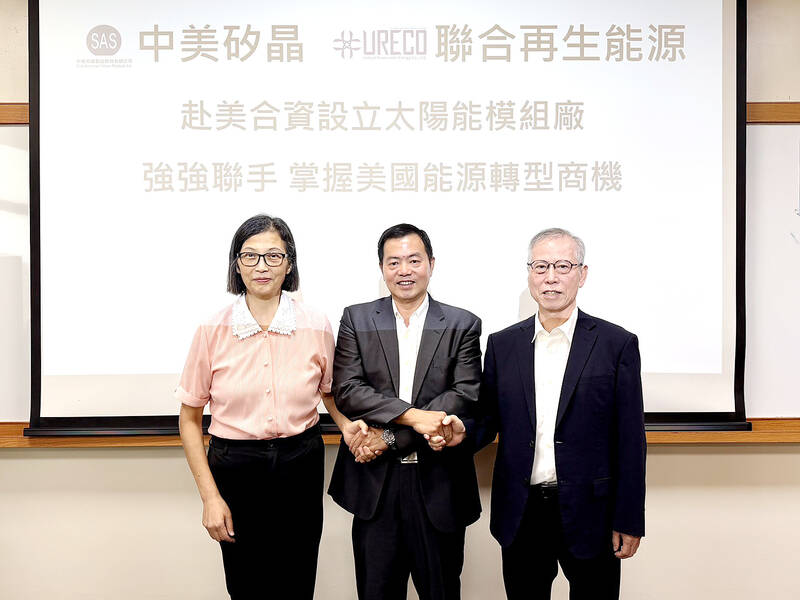
Photo courtesy of United Renewable Energy Co
“We noticed that such [a trend] will further boost already strong demand for green energy in the US,” she said. “The energy demand is running higher and more urgently than before.”
The US solar energy market has an annual consumption of 40 to 45 gigawatts, which represents a wide market outlet for local solar companies, given the very limited home market, Hsu said.
The venture seeks Taiwanese electronics manufacturers for its customers, some of whom are already customers of SAS and have sought local green energy supply, she said.
The venture, 51 percent owned by SAS and 49 percent held by URE, is working to identify a site in the US to build a manufacturing line with production capacity of 1 gigawatt, given government subsidies, worker availability and operating costs, venture executive Fred Yeh (葉正賢) said.
The production line could start operations within a year after the land lease is signed, Yeh said.
The capacity would be 70 to 80 percent covered by customers of URE, which has built a presence in the US market over the past decade, URE chief executive officer Richard Chang (張為策) said.
URE has built solar systems in nine US states.
“Through this partnership with SAS, we are bringing together Taiwan’s premier solar supply chain team to combine our competitive strengths in global markets,” URE chairman Sam Hong (洪傳獻) said. “Furthermore, this collaboration demonstrates Taiwan’s critical role and value in driving the global energy transition amid an evolving geopolitical landscape.”
Asked if high operating costs would be a concern, Hsu said it is less of a concern than a semiconductor manufacturing fab, as the solar module production line is largely automated and not labor intensive.
There is no requirement for clean rooms or wastewater treatment plants as there are for a chipmaking fab, she said.
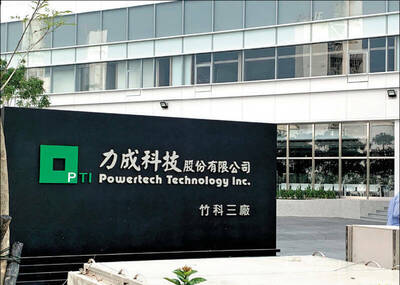
SINGAPORE PLANS: The joint venture would focus on offering technology for advanced package substrates in response to demand from an international customer Powertech Technology Inc (力成科技), a provider of memory and logic chip packaging services, on Thursday said it plans to invest US$400 million to create a new joint venture with Broadcom Inc in Singapore to cater to customer demand for advanced panel-based packaging services. The joint venture would concentrate on offering additive finer-geometry redistribution layer (RDL) technology for advanced package substrates, Powertech said in a statement after the company’s board of directors approved the deal. RDL is a crucial part of fan-out panel-level packaging (FOPLP) technology, which relies on RDL to route electrical connections beyond the physical footprint of silicon. The new investment was

AI RETHINK: Volatility has resurfaced in AI stocks amid concerns about increased competition, possible overcapacity and whether big investments would pay off A selloff in chipmakers gathered pace last week, driving the high-profile group of stocks to a bear market on worries that the artificial intelligence (AI) spending spree is becoming harder to justify. The cohort of semiconductor powerhouses last week saw its worst week since April last year, with a key industry gauge sinking 20 percent from a record. News of a powerful Chinese AI model, Kimi K3, by start-up Moonshot AI Technology Co (月之暗面) further shook markets. Similar to when China’s DeepSeek (深度求索) announced its AI model last year, another low-cost rival to big Western AI models like ChatGPT and

ASML Holding NV plans to raise prices for its chipmaking equipment, setting up a potential clash with its biggest customer, Taiwan Semiconductor Manufacturing Co (TSMC, 台積電), The Information reported on Wednesday, citing people familiar with the matter. TSMC is already pushing back against the Dutch toolmaker’s plans, The Information reported. TSMC declined to comment. A representative for ASML pointed to comments by its chief financial officer, Roger Dassen, during its earnings call on Wednesday about pricing, but declined to comment further. ASML makes the cutting-edge extreme ultraviolet (EUV) lithography machines that are necessary for chipmakers to manufacture advanced semiconductors and is experiencing a surge

ROBOT LINES: Servers made at the facility are to be assembled by humanoid robots and robotic arms, a source said, amid a push to establish overseas high-tech parks Hon Hai Precision Industry Co (鴻海精密), the world’s largest contract server maker, yesterday said it expects to begin small-volume production of artificial intelligence (AI) servers at its Texas plant within the next two months. The plant would handle back-end assembly and system integration, including Level 10 and Level 11 assembly processes, a source familiar with the matter told the Taipei Times. The servers would be assembled by humanoid robots and robotic arms developed with Nvidia Corp, the source said. Hon Hai is testing a wide range of robots at its US server facilities, including industrial robotic arms and humanoid robots, rather than relying


 RSS
RSS