


Automated optical inspection tool supplier Machvision Inc (牧德科技) is positive about its business outlook as customers are procuring inspection tools to handle the artificial intelligence (AI) boom.
“We are very optimistic about order visibility from the third quarter this year to the first half of next year,” Machvision chief executive officer Jasper Chen (陳復生) said at an online earnings conference on Tuesday. “The challenge is not to secure more orders, but rather securing [sufficient] material capacity.”
“This is a situation that has never happened to the company before,” Chen said.
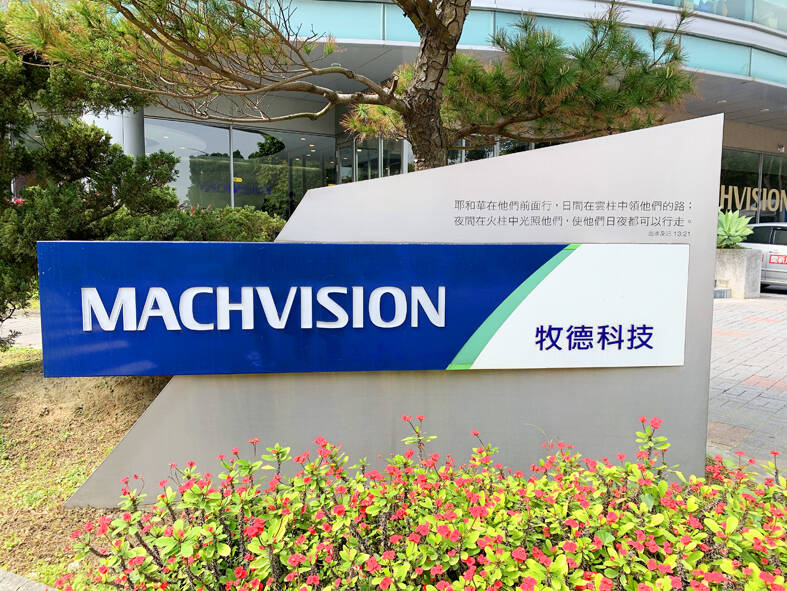
Photo: Grace Hung, Taipei Times
Machvision hiked prices by about 5 to 8 percent in May to pass higher raw material costs on to customers, he said.
Machvision provides automated inspection tools for high-end IC substrate manufacturing and automated vision inspection tools for chip manufacturing and packaging.
The AI boom has significantly accelerated the adoption and advancement of the company’s products for producing AI-related chips or components such as optical transceiver modules, Chen said.
Machvision has received orders to deliver 20 units of wafer automated visual inspection (AVI) systems, signaling better demand than last year, he said.
Wafer AVI is a high-efficiency inspection system specifically engineered for semiconductor back-end assembly and testing and wafer fabrication processes. Machvision commands about an 80 percent share of that market, it said.
In addition, Machvision has secured preliminary orders of NT$2 billion (US$62.7 million) to supply optical transceiver modules from several first-tier printed circuit board clients, Chen said.
The company plans to start shipments this quarter, he said.
Because of strong customer demand, Machvision saw strong order backlog with a longer lead time of about six months, compared with two-and-a-half to three months in the past, Chen said.
The company has received customer prepayment of NT$250 million, he said.
The company said it has secured orders from multiple clients, dismissing speculation that it only supplies wafer automated vision inspection systems to its major shareholder ASE Technology Holding Co (日月光投控). ASE, which owns about 23 percent of Machvision shares, is the world’s biggest chip packager and tester.
The company also counts the nation’s major PCB suppliers, including Unimicron Technology Corp (欣興電子), Nan Ya Printed Circuit Board Corp (南亞電路板) and Kinsus Interconnect Technology Corp (景碩), among its customers, it said.
Machvision’s net profit fell 3 percent annually to NT$295 million in the first quarter. Earnings per share dropped to NT$4.61 from NT$4.75 and gross margin declined to 60.6 percent from 64 percent over the period.
The company’s shares climbed 9.89 percent to close at NT$778 yesterday, having risen about 50 percent since the beginning of this year, Taiwan Stock Exchange data showed.


The US Federal Communications Commission (FCC) on Friday said it would ban the import of more equipment from a group of Chinese manufacturers, the latest move by Washington to crack down on Chinese-made electronic gear. The move expands an FCC ban imposed in 2022 on new models of telecommunications and video surveillance equipment made by Huawei Technologies Co (華為), ZTE Corp (中興通訊), Hytera Communications Corp (海能達通信), Hikvision Digital Technology Co (海康威視) and Dahua Technology Co (大華科技), citing national security risks. The expanded ban includes old models, not just those designed starting in late 2022, of equipment used for “public safety, security of

IBM Corp yesterday unveiled new semiconductor technology that the company said could deliver computer chips with 50 percent better performance while dramatically lowering power consumption. The technology developed by IBM is not yet ready for industrial use, but the Armonk, New York-based company said it “sees a path to production in as early as the next five years.” The breakthrough could mean a major leap forward as the industry races to cram more computing power into smaller devices, but as worries grow over the tech industry’s huge energy needs. Taiwan Semiconductor Manufacturing Co (TSMC, 台積電), the world’s leading chip manufacturer, has begun mass-producing
UNSURPRISING LEADER: TSMC led in both net profit and revenue this year, followed by other big names in the Taiwanese sphere of tech as well as finance Taiwan’s 5,000 largest companies posted a record high in aggregate net profit last year, up more than 11 percent from a year earlier, with contract chipmaker Taiwan Semiconductor Manufacturing Co (TSMC, 台積電) holding on as the country’s most profitable company amid the artificial intelligence (AI) boom, credit information agency CRIF Taiwan (中華徵信所) said on Wednesday. Strong global demand for AI applications continued to benefit Taiwan’s top 5,000 enterprises last year, CRIF said in a report. Their combined net profit totaled NT$5.77 trillion (US$181.1 billion), up 11.01 percent from a year earlier, while aggregate revenue hit a record high of NT$48.50 trillion,

US artificial intelligence (AI) company Anthropic PBC has said that Chinese technology and e-commerce giant Alibaba Group Holding Ltd (阿里巴巴) illicitly extracted its Claude AI model capabilities in what it said was the largest known attack of its kind on the company, a letter seen by Reuters showed. The strike by Alibaba is described as a “distillation” effort, which Anthropic has said involves training a less capable model on the outputs of a stronger one. The campaign was conducted between April 22 and June 5, and generated more than 28.8 million exchanges with Claude through almost 25,000 fraudulent accounts, Anthropic said. Distillation is


 RSS
RSS