


ASML Holding NV yesterday raised its full-year sales forecast as the surge in global artificial intelligence (AI) spending fuels semiconductor production and boosts demand for the company’s advanced chipmaking machines.
Net sales would be between 36 billion euros and 40 billion euros (US$42.56 billion and US$47.29 billion) this year, the Dutch company said in a statement.
That compares with a previous range of 34 billion to 39 billion euros.
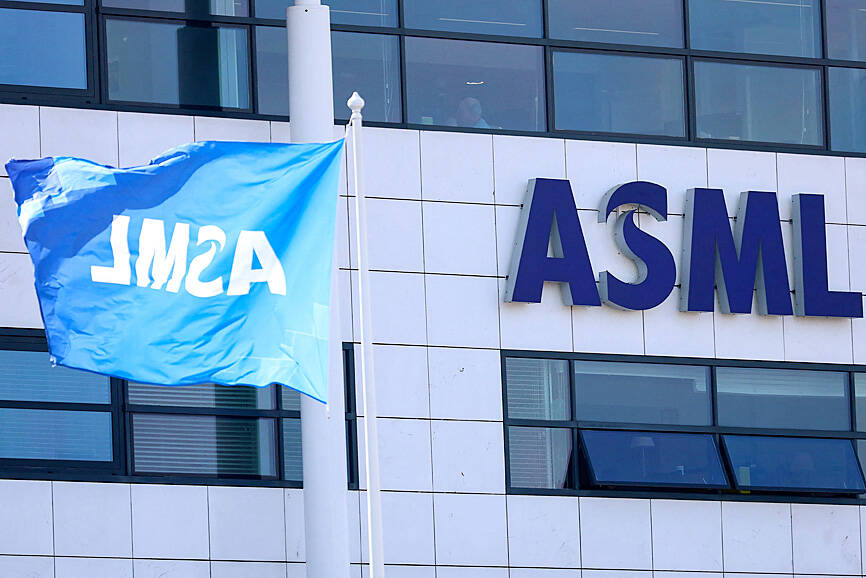
Photo: Nicolas Economou, Reuters
ASML’s customers are racing to ramp up chip production this year to meet demand from big tech companies building out AI capacity. US tech firms have pledged more than US$500 billion dollars in capital spending this year, and ASML is the only company that makes the advanced lithography machines that are necessary to produce the cutting-edge semiconductors they need.
“We expect in fact that the supply will not meet the demand for the foreseeable future,” ASML CEO Christophe Fouquet said in a video released with the results.
“This is creating a strong constraint in the end markets from AI to mobile and PC,” he said.
The improved outlook was tempered by a weaker-than-expected sales forecast in the second quarter. ASML, Europe’s most valuable company, sees net sales in the second quarter of 8.4 billion euros to 9 billion euros.
That compares with analyst estimates of 9.07 billion euros, data compiled by Bloomberg showed.
To accommodate the boom, ASML customers such as chipmakers Taiwan Semiconductor Manufacturing Co (TSMC, 台積電) and Samsung Electronics Co are investing in production. TSMC in January announced capital spending of as much as US$56 billion for this year, while South Korean chipmaker SK Hynix Inc outlined plans to spend about US$8 billion on ASML’s cutting-edge tools in a deal that runs through next year.
ASML expects to produce at least 60 of its second-most advanced tools, known as low NA extreme ultraviolet (EUV) lithography machines, this year.
“We’re increasing our move rate really quarter-on-quarter,” ASML chief financial officer Roger Dassen said in the video, adding that the company could produce at least 80 low NA EUV units next year.
The toolmaker also faces geopolitical headwinds in China, its largest market last year. US lawmakers this month proposed legislation that would curb sales of all of ASML’s deep ultraviolet (DUV) immersion lithography tools to China and includes banning engineers from servicing tools at certain facilities there.
ASML has never been able to sell its most-advanced EUV tools to China due to US restrictions aimed at curtailing Beijing’s technology advances. The Dutch government imposed export controls on some DUV machines to the country in 2024.
“We expect that the bandwidth in our 2026 guidance accommodates potential outcomes of ongoing discussions around export controls,” Fouquet said.
China accounted for 19 percent of net system sales in the first quarter, down from 36 percent in the previous quarter.
South Korea emerged as ASML’s largest market in the first quarter as the country’s memory makers increase purchases to address chronic shortages stemming from the AI boom.
Shipments of the Dutch company’s chipmaking tools to South Korea surged in the first quarter to 45 percent of net system sales, compared with 22 percent in the preceding three months, while Taiwan was ASML’s second-largest market in the quarter.
ASML net sales last quarter rose 13 percent from a year earlier to 8.77 billion euros, meeting analyst estimates. Net income was up 17 percent to 2.76 billion euros.
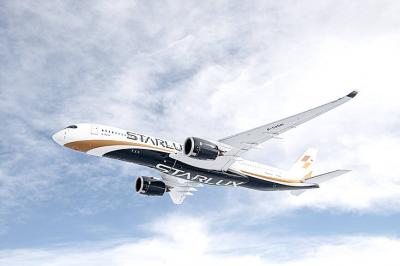
Starlux Airlines Co (星宇航空) today unveiled a long-haul network expansion plan at a shareholders’ meeting in Taipei, including direct flights to Barcelona, Spain, and Zurich, Switzerland, as well as a service connecting Taipei, Sydney and New Zealand. Starlux is to become the first Taiwanese carrier to offer non-stop services to the two European cities, while the inaugural oceanic route is expected to expand transit opportunities within the Australia-New Zealand market, Starlux said. Flight services to Chicago, Dallas, Washington and New York are under evaluation, the airline added. Prior to the shareholders’ meeting, the airline earlier this year announced that it would be
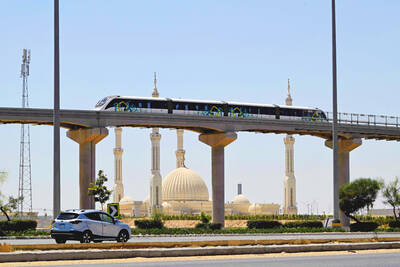
Cairo’s new monorail slices across the city skyline, running above the familiar chaos of blaring horns and aging buses’ exhaust fumes that mark rush hour below. The US$4.5 billion monorail, opened this month, is among Egypt’s most prominent new transport projects, part of a debt-funded infrastructure drive criticized for sapping state finances while bringing limited benefits to most of the country’s 109 million people. “It feels like you’re in a different country,” said Ramy Sayed, a restaurant manager, aboard a driverless Innovia 300 train. “No noise, no traffic, we’re not used to this.” The eastern line runs 56km from the bustling middle-class
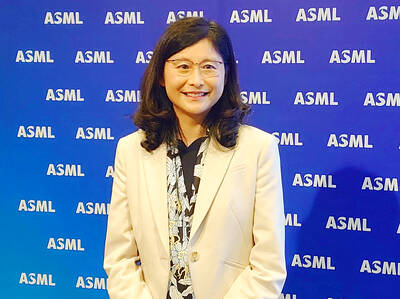
Netherlands-based semiconductor equipment supplier ASML Holding NV yesterday said that it is planning to hire an additional 1,000 people in Taiwan this year in response to growing demand from clients. ASML had previously planned to recruit 600 people this year, but that the plan has been adjusted upward, ASML vice president and ASML Taiwan general manager Grace Wang (汪佳慧) told reporters. ASML has a workforce of more than 4,500 in Taiwan, accounting for about 10 percent of its global total, Wang said. This year’s recruitment campaign would focus on adding people in the customer support, manufacturing and supply chain domains to assist ASML
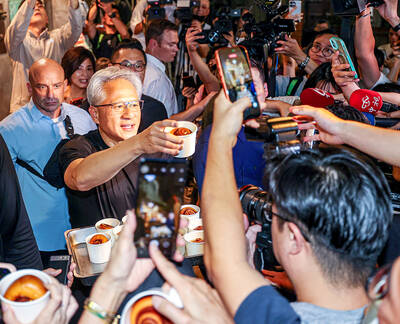
Nvidia Corp yesterday announced that CEO Jensen Huang (黃仁勳) would attend an employee meeting in Taipei tomorrow to celebrate the launch of the company’s Taiwan headquarters project. Huang would attend a gathering at the site of Nvidia’s planned headquarters in Beitou Shilin Technology Park (北投士林科技園區), the company said in a statement. After arriving in Taiwan on Saturday last week, Huang told reporters that he plans to meet with Quanta Computer Inc (廣達) chairman Barry Lam (林百里) and Taiwan Semiconductor Manufacturing Co (TSMC, 台積電) chairman C.C. Wei (魏哲家), and would attend the groundbreaking ceremony for Nvidia’s Taiwan headquarters tomorrow. Nvidia has not yet applied


 RSS
RSS