


Taiwan’s manufacturing sector expanded for a fifth consecutive month last month, with growth accelerating to the fastest pace in nearly four years despite fewer working days due to the Lunar New Year holiday, the Chung-Hua Institution for Economic Research (CIER, 中經院) said yesterday.
The official purchasing managers’ index (PMI) rose 1.3 points to 58.5, marking the rapidest expansion since March 2022 as robust demand from artificial intelligence (AI) applications continued to support industrial activity, the Taipei-based think tank said.
PMI readings above 50 indicate expansion, while readings below the level signal contraction.
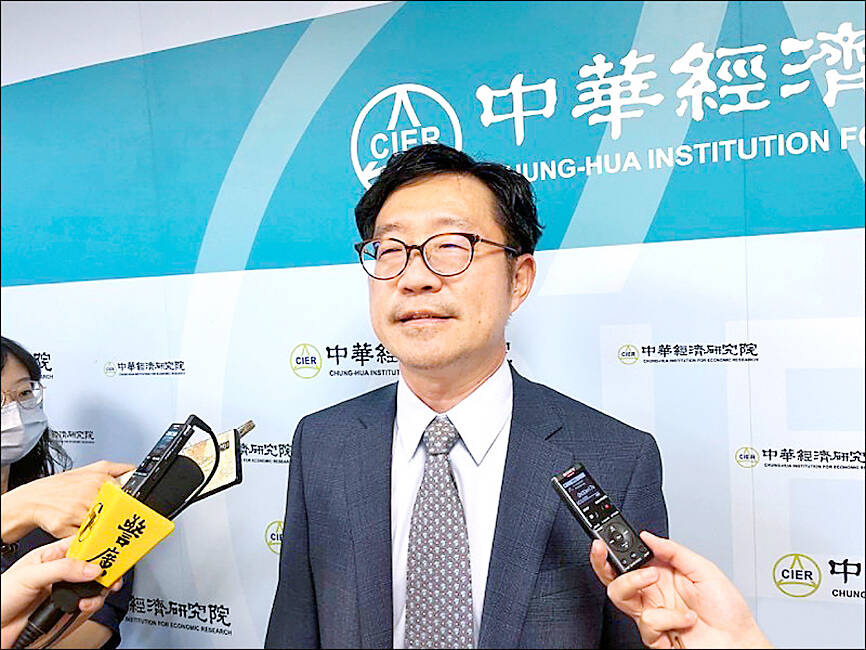
Photo: Hsu Tzu-ling, Taipei Times
The result came even though the number of working days last month was roughly half that of February last year due to the timing of the Lunar New Year and 220 Peace Memorial Day holidays.
“Demand for electronic components remains sturdy, driven by AI-related applications and advanced semiconductor processes,” CIER president Lien Hsien-ming (連賢明) told a news conference.
The institute remains optimistic about Taiwan’s economic outlook this year, although renewed US trade scrutiny, and the regional conflict involving Iran, Israel and the US are adding uncertainty, Lien said.
US President Donald Trump has launched a new trade probe aimed at establishing a legal basis for previously imposed tariffs after the US Supreme Court struck down their legality, he said.
Subindices for new orders and production remained firmly in expansionary territory for a fifth consecutive month, rising to 63.7 and 59.8 respectively, reflecting strong demand.
However, supply-side pressures intensified.
Manufacturers reported surging raw material prices and longer supplier delivery times, with the raw material price index exceeding 70 for the second month in a row.
Firms said that demand for advanced semiconductor processes, combined with shortages and price increases in memory chips, has deepened supply tightness.
Some manufacturers responded by placing rush orders for laptops and bringing forward procurement schedules, boosting demand for related substrates and high-end notebook components, Lien said.
Companies also cited sharp fluctuations in prices for metals and petrochemical products, as well as freight rates, following the conflict in the Middle East, adding uncertainty to cost management and delivery schedules.
Looking ahead, manufacturers were positive. The six-month outlook index rose 1.6 points to 66.7, the fastest expansion since March 2022, indicating improving optimism about demand.
Developments in the Middle East warrant close monitoring, but the government has price stabilization mechanisms to prevent sharp fluctuations in domestic prices, Lien said.
The consumer price index is likely to remain below the central bank’s 2 percent alert level this year as long as oil prices do not rise sharply for a prolonged period, he said.
Service providers also performed well. Taiwan’s non-manufacturing index was 53.4 last month, marking 12 consecutive months of expansion.
With manufacturing activity expected to rise further, businesses anticipate a rebound in consumer confidence.
The six-month outlook index for the service sector climbed 5.8 points to 62.1, with all major industries reporting positive expectations for the first time since August 2024.
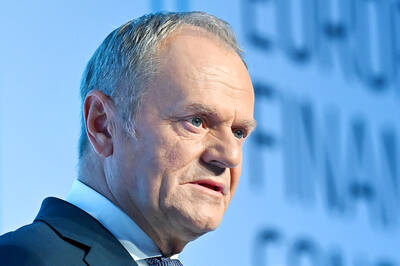
Poland is betting on a flood of investments and technology transfers from Taiwanese companies to reengineer its US$1 trillion economy. Polish Prime Minister Donald Tusk said yesterday that Poland will no longer be “just an assembly hub” as it pursues further investments from the likes of Foxconn Technology Group (富士康). The firm, whose full name is Hon Hai Precision Industry Co (鴻海精密), last month agreed to build electric vehicles (EVs) in the European Union nation and now could be a partner in a semiconductor venture, he said. The government’s aim is to boost manufacturing and the country’s high-tech chops in an era
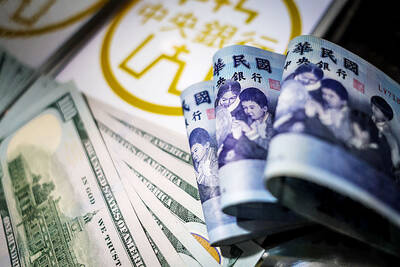
Taiwan remained the sixth-largest net creditor nation in the world last year, despite a fall of more than 10 percent in its net international investment position (NIIP) over the year, the central bank said yesterday. The NIIP is the difference between a country’s external financial assets and its external financial liabilities. Taiwan’s external financial assets hit US$3.27 trillion at the end of last year, up US$275.75 billion or 9.2 percent from a year earlier, the central bank said in its annual NIIP report. The growth largely reflected an increase in holdings of overseas marketable securities by residents in Taiwan, as well as a
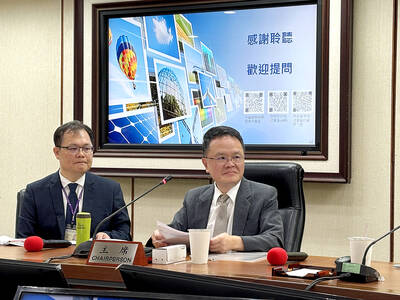
BAD FAITH LITIGATION? The two companies, owned by a California-based private equity firm, could be seeking licensing fees or a settlement payout with the suit Taiwan Intellectual Property Office (TIPO) Director-General Liao Cheng-wei (廖承威) said yesterday he suspected that two firms suing contract chipmaker Taiwan Semiconductor Manufacturing Co (TSMC, 台積電) for patent infringement are “patent trolls.” A patent troll refers to a company that buys patents not for manufacturing products, but to sue other companies for compensation, accusing them of using its patents. Patent trolls, formally called Non-Practicing Entities or Patent Assertion Entities, were responsible for more than 50 percent of lawsuits in the US last year, costing targeted businesses tens of billions of US dollars a year, according to the US-based LegalCharity Web site. Asked whether

RESTRICTION BREACH: ASML said that it denies ‘unfounded rumors regarding non-compliance with export controls concerning China,’ and enforces controls strictly US Secretary of Commerce Howard Lutnick in a series of recent meetings outlined concerns to Dutch chip-equipment giant ASML Holding NV’s senior leaders that one of its top-of-the-line machines might have made its way into China, in violation of US-led export restrictions. In the meetings, Lutnick expressed concern to ASML executives over the company’s extreme ultraviolet lithography (EUV) machines, people familiar with the talks said. EUV systems are used by firms such as Taiwan Semiconductor Manufacturing Co (台積電) to manufacture processors for the likes of Nvidia Corp and Apple Inc. ASML has never been allowed to ship them to China because of curbs


 RSS
RSS