


The Ministry of Economic Affairs (MOEA) has approved an application filed by artificial intelligence (AI) chip designer Nvidia Corp to remit NT$3.3 billion (US$105 million) into Taiwan for an investment in a new Taipei office,.
The approval came just a day ahead of the scheduled arrival by Nvidia CEO Jensen Huang (黃仁勳), who is expected to attend a "Weiya" banquet slated for tomorrow. Weiya is a year-end dinner held by businesses before the Lunar New Year holiday, which begins on Feb. 14 this year.
The funds prepared by Nvidia will be used to raise the capital of Nvidia Iconic Taiwan Co (台灣輝達經典) and the increased capital will be allocated for the development of the company’s new Taipei office, which will be located in Beitou Shilin Technology Park (北投士林科技園區), the ministry’s Department of Investment Review said in a statement.
Photo: EPA
Late last year, Taipei City Government terminated a contract giving the surface rights to Shin Kong Life Insurance Co () for the T17 and T18 lots of land in the technology park, where the US company wanted to build its new office.
On Monday, the city government approved a plan to combine the two lots into one by eliminating a 15-meter wide road dividing the two parcels of land in a bid to give Nvidia a larger area for development. In addition, the city government also changed the use of the land as a special technology development section.
Other than attending Nvidia’s Weiya in Taipei, Huang is also expected to meet with Taiwanese tech heavyweights at a second dinner banquet on Saturday including Taiwan Semiconductor Manufacturing Co (台積電) chairman C.C. Wei (魏哲家).
The Taipei City Government is hoping to sign an agreement with Nvidia witnessed by Huang during his stay in Taipei.
In addition to Nvidia’s NT$3.3 billion plan, the MOEA also approved a NT$1.54 billion investment in Taiwan offshore wind energy development sector by UK-based Stonepeak Formosa 4-3 Holdings Co.
As for outbound investments, the ministry said it has approved a US$500 million investment by PC brand Asustek Computer Inc (華碩) in its subsidiary Asus Global Pte Ltd focused on sales of 3C products such as computer systems, motherboards, various board cards, tablets and smartphones.
The ministry said it has also approved telecom service provider Taiwan Mobile Co (台灣大哥大) to invest US$90 million in PACM CPT Media Ltd in the British Virgin Islands, which will use the funds to invest in US-based Paramount Skydance Corp for global video publication.
In addition, AI server and iPhone assembler Hon Hai Precision Industry Co (鴻海精密) secured approval to remit a total of US$575 million overseas to expand production of computers, smartphones and other electronics items.
Meanwhile, the ministry has also give the green light to CTBC Bank Co’s (中國信託銀行) investment of about US$63.85 million in consumer banking business in Xiamen, China.
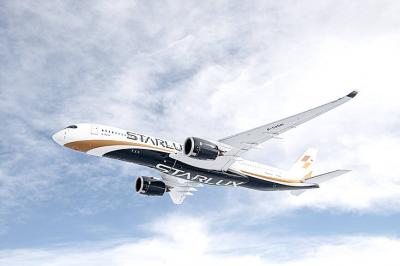
Starlux Airlines Co (星宇航空) today unveiled a long-haul network expansion plan at a shareholders’ meeting in Taipei, including direct flights to Barcelona, Spain, and Zurich, Switzerland, as well as a service connecting Taipei, Sydney and New Zealand. Starlux is to become the first Taiwanese carrier to offer non-stop services to the two European cities, while the inaugural oceanic route is expected to expand transit opportunities within the Australia-New Zealand market, Starlux said. Flight services to Chicago, Dallas, Washington and New York are under evaluation, the airline added. Prior to the shareholders’ meeting, the airline earlier this year announced that it would be
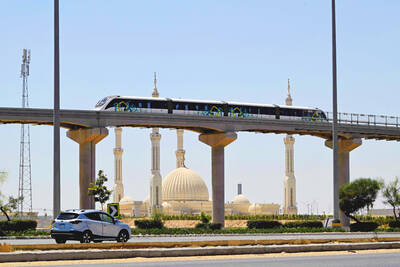
Cairo’s new monorail slices across the city skyline, running above the familiar chaos of blaring horns and aging buses’ exhaust fumes that mark rush hour below. The US$4.5 billion monorail, opened this month, is among Egypt’s most prominent new transport projects, part of a debt-funded infrastructure drive criticized for sapping state finances while bringing limited benefits to most of the country’s 109 million people. “It feels like you’re in a different country,” said Ramy Sayed, a restaurant manager, aboard a driverless Innovia 300 train. “No noise, no traffic, we’re not used to this.” The eastern line runs 56km from the bustling middle-class

Netherlands-based semiconductor equipment supplier ASML Holding NV yesterday said that it is planning to hire an additional 1,000 people in Taiwan this year in response to growing demand from clients. ASML had previously planned to recruit 600 people this year, but that the plan has been adjusted upward, ASML vice president and ASML Taiwan general manager Grace Wang (汪佳慧) told reporters. ASML has a workforce of more than 4,500 in Taiwan, accounting for about 10 percent of its global total, Wang said. This year’s recruitment campaign would focus on adding people in the customer support, manufacturing and supply chain domains to assist ASML

Nvidia Corp yesterday announced that CEO Jensen Huang (黃仁勳) would attend an employee meeting in Taipei tomorrow to celebrate the launch of the company’s Taiwan headquarters project. Huang would attend a gathering at the site of Nvidia’s planned headquarters in Beitou Shilin Technology Park (北投士林科技園區), the company said in a statement. After arriving in Taiwan on Saturday last week, Huang told reporters that he plans to meet with Quanta Computer Inc (廣達) chairman Barry Lam (林百里) and Taiwan Semiconductor Manufacturing Co (TSMC, 台積電) chairman C.C. Wei (魏哲家), and would attend the groundbreaking ceremony for Nvidia’s Taiwan headquarters tomorrow. Nvidia has not yet applied


 RSS
RSS